

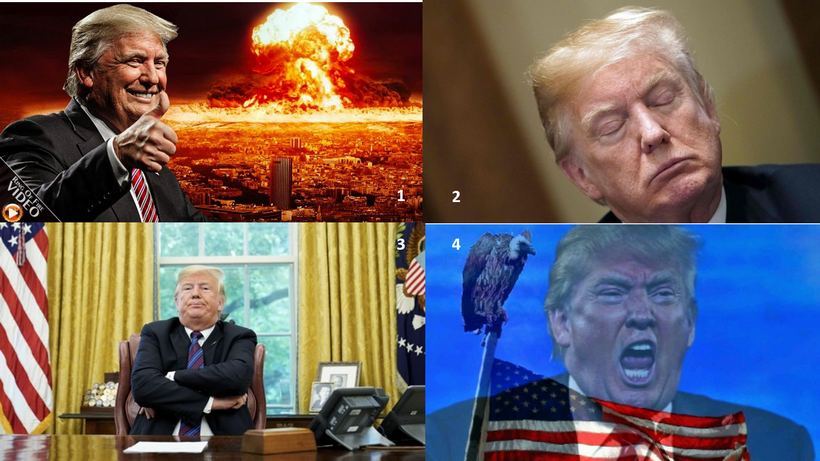
Some believe that Donald Trump actually wants to end the war in Ukraine. Others believe he’s as belligerent as his predecessors. Who’s right? Perhaps a bit of both. He may have wanted to end American involvement in the war in Ukraine but, as president, he cannot put a stop to the United States’ war-mongering. If he gives the impression of wanting to end the war, it may be in order to turn it over to the Europeans and begin the one he wants to start with China, which is the priority target.
Gilbert Doctorow is one of those who take MAGA ideology seriously and he believes that Trump is sincere about the war in Ukraine. During the presidential race, the current president distanced himself from his predecessor and announced that he could end this war in 24 hours. However, this could have been just smoke and mirrors. He constantly repeats that it is Biden’s war, not his, which is not true because he trained and armed Kiev’s forces during his first term (2017-2021). But, back in power, his statements gave additional reasons to take him at his word. He admitted through Marco Rubio that the United States had waged a proxy war in Ukraine [1] and that now the world has entered a new era, that of multipolarity [2]. We also know that Trump is a man who is primarily interested in making deals and that no war was started during his first term.
Brian Berletic disagrees. He does not believe in a peaceful Donald Trump, or in the United States giving up its dream of a unipolar world. He even expressed concern about Vladimir Putin visiting Alaska, which is US territory [3].
Who is right?
Is Doctorow right? As he admitted in an interview on Professor Glenn Diesen’s excellent program, Trump’s seemingly pacifying attitude toward the Ukraine war seems to be contradicted by the US president’s belligerent attitude toward Gaza[4]. Trump has indeed given Israel the green light, advising Netanyahu to “finish the job”[5] . How can these two seemingly contradictory positions be reconciled?
Things become a little clearer if we admit that Trump perhaps only wanted to rely on a division of labor: Europe would now take care of Russia and Israel of Gaza, while the United States would target China. As for Netanyahu in Gaza, the division of labor is already in full swing. Support for Israel puts Trump on the side of the stronger and gives him hope for a quick resolution without direct US involvement. As for Ukraine, however, support for Zelensky is support for the loser. He is no longer a good subcontractor. It is therefore appropriate to distance himself from an adventure that the United States initiated and that is going wrong, and to leave the dirty work to the Europeans. This is exactly what Secretary of Defense Pete Hegseth went to tell the Europeans in February 2025, taking up the principle of the division of labor [6]. The United States, and Trump in particular, needs success, or the appearance of it, not association with another failure, after Indochina, Iraq, Afghanistan, and Iran.
According to this view, Trump’s ultimate goal is not to restore peace. The US withdrawal from the conflict in Ukraine is simply a way to absolve himself and delegate the military task to a new subcontractor. Support for Israel, on the other hand, must be maintained, because in this case, Netanyahu seems capable of carrying out the ethnic cleansing of Gazans.
War as an opportunity to make good deals
The neocons were able to sell Trump on the idea that the division of military labor would likely allow for the conclusion of certain deals that would meet the expectations of those who advocate the principle of America First. The American state seems indeed to be able to conclude several deals: with the Congo allowing US access to the country’s extractive resources, about the Zangezur corridor which has just been created in Armenia, not to mention the deal concluded with the new allies of Al Qaeda now in power in Syria. Regarding Ukraine, a deal was also concluded with Zelensky allowing the United States to benefit from the rare earths found on its territory, as a way of paying back the billions transferred by the United States to help it keep Russia at bay.
The United States is not a large multinational corporation headed by a business leader. Rather, it is an imperialist and imperial state headed by a commander-in-chief. The commander-in-chief serves not only a military-industrial complex, but more generally an economic empire that seeks to further establish its domination over the world. The American warlike posture will continue, but it wants to find a new theater of activity, provided that the ongoing wars can be delegated to willing subcontractors.
The difference between the two situations, that of Gaza and that of Ukraine, can therefore be easily explained. With the war in Ukraine, the United States must look for a new proxy to fight Russia. No longer able to rely solely on a losing Ukraine, they have played mediator and ensured that Europe is involved. With Israel, the United States has the best of subcontractors. It is not just a vulgar proxy, because this country is an extension of the United States in the Middle East.
The neocons were thus able to convince businessman Trump to get involved in every bloody conflict, because it would be without Americans shedding a single drop of blood. By supporting Israel, Trump will be able to make a fortune by exploiting the enormous underwater gas reserves located on the edge of Gaza. He may also still hope to be able to include the Saudis in an expanded ” Abraham” agreement. In Ukraine, the new European proxy will take care of increasing its military budget by purchasing its equipment from the United States. These are certainly long detours that must be taken, but they all lead to the promised land of an America made great again, because it profits from every conflict it provokes.
To give the impression that he is distancing himself from the Israel/Palestine conflict, Trump can easily count on Netanyahu, who is perceived by many as the sole master aboard the genocidal enterprise. Trump has been convinced that he can play the role of negotiator with Iran on the nuclear issue and with Hamas in Doha, while Israel pretends to be out of control, acting on its own, even though it clearly benefits from American bombs, planes, and logistics to carry out its dirty work. To distance himself from the conflict in Ukraine, he can play the role of mediator above the fray, even if it means playing the role of a Pontius Pilate, ready to wash his hands of it, after having tried “in vain” to bring the two sides together. If, in addition to Ukrainian resources, he can secure lucrative military equipment contracts from European heads of state, it can only be a good deal.
Trump will be satisfied to appear to have tried everything. Putin will maintain his demands because he is in a strong position on the ground. As for Zelensky , his survival depends on it. He does not want to give in, because otherwise his days would be numbered. So the war will continue and it will be settled on the ground.
In short, Trump probably wanted to put an end to wars that stood in the way of making golden deals for the United States. But he may have been convinced that these same wars could be the shortest path to this goal, hence the name change for the Department of Defense, which became the Department of War. And to make him feel comfortable in this endeavor, he could play the role of negotiator with Hamas or mediator between Putin and Zelensky . Trump is certainly impressed by Putin and Netanyahu, but he is also and above all manipulable when confronted to a deep state of consultants who surround him and advise him.
A shadow on the picture
Netanyahu wanted to fight Iran, and he could not do it without US help. How could Trump extricate himself from involvement in this confrontation? Israel’s attacks on Iran took place while the United States pretended to be preparing for a “negotiation” with Tehran. The Israeli attack led to a relentless Iranian response that lasted 12 days. Iran had the means to inflict serious damage on Israel and could pierce the Iron Dome with hypersonic bombs launched at a speed of three kilometers per second.
The Americans had no choice. They had to respond, but they were able to warn Iran in advance to inform them of the facilities that would be targeted. Iran then proceeded in the same way by informing the United States of the military base that would be the target of their reprisals. In this way, both parties would save face and put an end to the escalation: Iran by being the last to strike; the United States by letting it be believed that Iran’s nuclear infrastructure had been completely destroyed. This activity turned out to be a kind of kabuki theater. All this resulted in a ceasefire that suited everyone, especially Netanyahu, who was the one requesting it because he knew that Israel could no longer hold out under the rain of Iranian projectiles. Israel would lose even more if the confrontation with Iran were to continue.
Conclusion
Very quickly after entering the White House, Trump realized that he could not easily achieve success by ending these two wars. Perhaps the advisors and members of his staff who remained neoconservatives convinced him to do better than simply trying to end the war. He could act as a mediator to avoid being perceived as pro-war, while also striking lucrative deals that would benefit the United States. He is now convinced that this is the only way forward for the United States.
The Americans were the agents provocateurs in the Ukraine war, and Gaza would never have been razed without the help of 80,000 tons of bombs and American planes. Nevertheless, by adopting the posture of mediator and seeking to make deals, Trump hoped to satisfy his MAGA base.
Some wonder why he got involved in the intractable Ukrainian conflict, as it is like walking into a hornet’s nest. What matters, however, is to capture the imagination of the American public. Trump must be seen as the one who “did everything” to end a war that, he says, is not his.
If Trump, Zelensky , and Putin meet, the disagreement will be finalized, and upon seeing the impasse, Trump will be able to claim that he no longer wants to get involved. By adopting this posture, which will capture the public’s imagination, he also hopes to receive the blessing of his neocon entourage , because it helps to conceal the fundamental belligerence of American imperialism. The Americans will continue to sell military equipment to the Europeans, who will now act as primary suppliers of Ukraine.
Only pro-American and pro-NATO diehards believe that the United States came to Zelensky ‘s rescue in Ukraine and that Netanyahu is, well, out of control. In both cases, imperial power provided them with everything they needed to continue the war.
Notes
[1] https://www.youtube.com/watch?v=cfZZzYVFcdA
[2] https://www.youtube.com/watch?v=42WDKnx4nLA
[3] https://rumble.com/v6xerf8-us-russian-presidents-to-meet-us-prepares-dagger-of-betrayal-again.html?e9s=src_v1_eh_cs
[4] https://www.youtube.com/watch?v=tyzGNH5vO0g
[5] https://rumble.com/v4zv1qz-trump-to-israel-finish-the-job.html?e9s=src_v1_s%2Csrc_v1_s_o



