

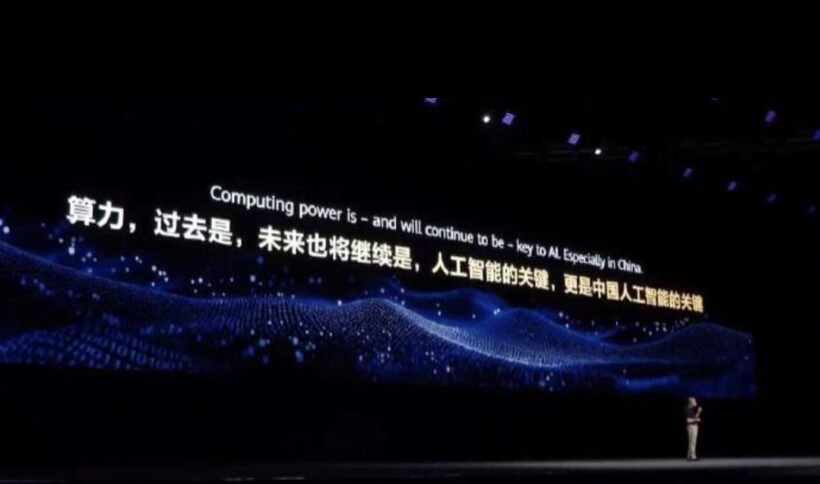
What appears to be a mere technological rivalry between Huawei and NVIDIA is, in reality, the tangible expression of a civilizational bifurcation. This essay argues that the competitive advantage announced by Huawei on September 18, 2025, does not primarily reside in its hardware, but rather in its commitment to an open, collaborative, and adaptive system paradigm that echoes a Taoist conception of harmony and evolution. Contrasted with the Western paradigm of control and extreme specialization—effective in a stable environment but rigid when faced with change—the Chinese model emphasizes resilience and collective intelligence as keys to survival. The technical dispute is, essentially, a large-scale experiment on which paradigm is best equipped to navigate the complexities of the 21st century, where technological autonomy becomes the new pillar of national sovereignty.
Prologue: The Day the Tech World Bifurcated
On September 18, 2025, at the Shanghai World Expo Exhibition & Convention Center, the historic fracture announced in the summary materialized. Eric Xu, vice president of Huawei, did more than unveil new products: he revealed the company’s roadmap for the coming years, showcasing a technological architecture that signaled an alternative reality principle (Huawei, 2025a; ITWare Latam, 2025). This was not merely a commercial challenge to NVIDIA’s hegemony; it was the embodiment of two antagonistic worldviews.
The essence of the announcement was both philosophical and technical. Huawei introduced its SuperPoDs and SuperClusters strategy. Imagine, instead of relying on a single Formula 1 engine, connecting thousands of efficient motorcycle engines via a transmission so perfect that, acting in unison, they far outperform the racecar. Each engine is an Ascend chip. The transmission system is the UnifiedBus interconnection protocol. The chassis is the SuperPoD. Huawei announced the Atlas 950 SuperPod (with 8,192 processors) for 2026 and the Atlas 960 SuperPod (with 15,488 processors) for 2027, with plans to group them into “SuperClusters” with more than one million chips (Gómez, 2025; Huawei, 2025a).
This move was a direct response to an explosive geopolitical context: U.S. sanctions prevented China from accessing the most advanced technology, and crucially, China’s internet regulator decided to block local companies from purchasing certain NVIDIA chips (EFE, 2025). Huawei’s masterstroke was to complement the hardware with an open-source pledge, releasing technologies like UnifiedBus to invite global developers onto its platform (Huawei, 2025a). Against NVIDIA’s closed and proprietary ecosystem, epitomized by its CUDA standard, Huawei raised the banner of the collaborative network against the fortified Great Wall.
The message that resonated in the market was clear: China had a viable path to technological autonomy. The movie that began screening that day was one of a world splitting, where a country’s ability to determine its digital future independently from foreign suppliers becomes the new frontier of sovereignty.
Chapter 1: The Anatomy of the Bifurcation – The Great Wall and the Living Network
The contest between Huawei and NVIDIA is often reduced to a simplistic question: who has the most powerful chip? This perspective misses the true nature of the conflict, which is a fundamental divergence in the architecture of computational power. To understand the future, it is essential to dissect the anatomy of the two competing models.
The Closed Ecosystem: The Great Wall of the Fortress
The paradigm embodied by NVIDIA resembles a medieval castle surrounded by a Great Wall. It is an imposing construction, designed to be impregnable, built around a central core of power: the supremacy of the individual chip. The strategy is to make each unit—each GPU—so powerful that it dissuades any challenge.
This strategy relies on building ever-higher walls. The Silicon Wall is erected with access to the world’s most advanced foundries, achieving a density and computing power unattainable for any competitor with restricted access. The Software Wall, CUDA, becomes the main canvas. This proprietary programming ecosystem has become a global standard, creating a technological moat that makes it prohibitively costly to abandon.
The Entropy of the Wall: The Wear of the Closed System
However, this model contains the seed of its own vulnerability: entropy. In thermodynamics, entropy measures the degree of disorder in an isolated system, which tends to increase. An isolated castle, no matter how high its walls, requires ever-increasing energy just to stay standing.
This law finds a parallel in NVIDIA’s strategy. Isolation through proprietary technology makes the ecosystem rigid, slowing its agility. The Law of Diminishing Returns means each incremental advance in chip power is costlier than the previous one, running into physical barriers like heat management. When the environment changed radically with sanctions, the wall’s fragility was exposed. Its solidity became rigidity, and the energetic cost to remain relevant in a fractured world accelerates its internal entropy (EFE, 2025).
The Open Architecture: The Power of the Living Network
In contrast to the rigid wall, Huawei presented the living network strategy. If the wall expends energy keeping itself apart, the network gains energy by connecting. Recognizing its disadvantage in the individual chip race, the company chose a different evolutionary principle: adaptability through massive-scale collaboration (Huawei, 2025a).
The core is a three-layer architecture. The soldiers are the Ascend chips, efficient units designed for AI that, individually, may be less powerful than NVIDIA’s solutions. The nervous system is UnifiedBus, an open interconnection protocol that enables thousands of chips to connect. The organism is the SuperPoDs and SuperClusters, modular systems integrating these units to act as a colossal computing entity. The promise is not the power of one component, but the system as a whole. Huawei claims that a cluster with 8,192 Ascend accelerators achieves performance 6.7 times greater than NVIDIA’s NVL144 system (Huawei, 2025a).
This architecture is inherently more adaptable. Built on modular units and an open standard, it can scale flexibly and better withstand disruptions. It is the technological application of the principle that enabled Homo sapiens to survive the Neanderthal: collective intelligence and the ability to collaborate at large scale surpassed brute individual strength in a changing environment. The bifurcation, therefore, is not accidental but philosophical: optimization and control versus resilience and openness.
Chapter 2: Sovereign AI – Technological Autonomy as Ethical Imperative
The technical bifurcation is not an end in itself. It is the means to a higher strategic objective that redefines the relationship between technology and national sovereignty: achieving Sovereign Artificial Intelligence.
Sovereign AI is the capacity of a country or community to develop, govern, and use AI in accordance with its own laws, values, and national interests, without critical dependence on infrastructures or models controlled by foreign powers. Its construction rests on three pillars that Huawei’s architecture aims to enable: data sovereignty (controlling information within borders), computational sovereignty (owning physical infrastructure, like SuperClusters), and algorithmic sovereignty (influencing the AI models used, facilitated by the open-source approach) (Huawei, 2025b).
The advantage of Sovereign AI is cultural and resilience-based. It allows each nation to “edit” access to information and define the ethical limits of AI. This is crucial to protect human development, allowing a country to decide how its children are exposed to these tools and how to integrate them into education to strengthen cultural values, avoiding homogenization by a global algorithm. It permits contextual ethical governance, where what is deemed “dangerous” or “unproductive” reflects local social consensus. In national and cyber security, it is imperative: depending on foreign AI to manage critical infrastructure is an existential risk.
The risks of not pursuing this autonomy doom a country to strategic dependence and what might be called “digital colonization.” Its citizens are shaped by foreign algorithms, its digital economy develops under others’ terms, and it remains vulnerable to extraterritorial sanctions, possibly stripped of critical technology by foreign government decisions, as has repeatedly occurred in the U.S.–China conflict (EFE, 2025).
Against a paradigm of sanctions and control, the Chinese proposal, symbolized by initiatives like the Belt and Road, presents itself as a framework for multipolar cooperation. It does not seek to homogenize, but to create an umbrella under which different systems can coexist and develop along their own trajectories. It is the principle of “we consider but do not judge” applied to the digital sphere: an invitation to technological self-determination. Under this umbrella, the possibility that a Latin American or African country could build its own AI, speak its language, and respect its history, is no longer a utopia but a viable political project.
Chapter 3: The Geopolitics of Talent – The Great Wall, the Living Network, and Reverse Brain Drain
If technology is the new battlefield, human talent is its most strategic resource. The bifurcation announced by Huawei in September 2025 is not merely an architectural split between SuperPoDs and GPUs; it is the materialization of a clash of ecosystems of power, where the global circulation of minds begins to reorient, accelerating the creation of a multipolar technological world. The “Great Wall” not only restricts chips, but in a boomerang effect, is expelling the very oxygen that fuels innovation: diverse and global talent.
3.1. Coercion as Accelerator: The Accelerated Entropy of the “Great Wall”
The radicalization of sanctions by the Trump administration has only confirmed the exclusionary nature of the “Great Wall” paradigm, quickening its internal contradictions toward a point of critical entropy. This model, based on control and restriction, generates negative externalities that undermine its own sustainability.
- The instrumentalization of the corporation: Far from an opening, the conditional sale of NVIDIA chips to China under an agreement where the company yields a percentage of its revenues to the U.S. government is unprecedented. This move turns a private corporation into an instrument of tax collection and foreign policy, eroding any notion of technological neutrality or legal certainty for global partners. Trust, the basis of global trade, breaks down when a company can be made an arm of geopolitics.
- Deepening strategic distrust: The perception from Beijing and other capitals of the Global South is that chips authorized for sale might incorporate “backdoors” for espionage or remote incapacitation. This distrust only validates the strategic urgency of achieving self-sufficiency. The risk that the “local bully kicks over the board” is no longer a metaphor but a critical risk variable in the planning of any dependent company or government. The search for alternatives thus becomes a national security imperative.
3.2. Building the Living Network: The Kunpeng-Ascend Ecosystem and Sovereign Security
Against coercion, the strategy deployed at HUAWEI CONNECT 2025 (September 18–20 in Shanghai under the slogan “All Intelligence”) consolidates as a living, growing network, based on autonomy and open collaboration (Huawei, 2025a).
- A tangible ecosystem, not a promise: Beyond the announcements of the Atlas 950 (8,192 processors) and Atlas 960 (15,488 processors) SuperPoDs, Huawei reports a network of partners and independent software vendors. This is not an isolated project, but a growing industrial base offering a technically viable escape from dependence. The opening of the UnifiedBus protocol is precisely to create a collaborative standard—the antithesis of the proprietary wall.
- Security as the pillar of sovereignty: The bifurcation is also evident in the conception of cybersecurity. Huawei unveiled its Xinghe AI Fabric 2.0, an “always-on” data center network based on a “zero-trust” architecture. This solution provides comprehensive protection specifically designed to safeguard AI infrastructure and large models from automated cyber threats. It is the technical realization of the “technological autonomy” principle applied to digital defense: the ability to protect your own house with your own keys.
3.3. The War for Talent: Reverse Brain Drain and the New Atlas of Innovation
This is the factor that exponentially accelerates the bifurcation. Historically, the United States was a magnet for the world’s “brains,” an advantage now eroding swiftly due to its own exclusionary policies. The imposition of migration barriers, punitive tariffs, and an increasingly hostile social and political environment is causing a reverse brain drain.
- The structural vulnerability of the West: The American tech industry has structurally depended on immigrant talent, particularly from China, India, and other Asian countries. By shutting its doors, it is voluntarily undermining a fundamental pillar of its technological hegemony. Legal uncertainty and exorbitant costs deter the best talent, which now reconsiders its options.
- The growing appeal of alternative poles: This talent does not disappear; it redirects. China, Southeast Asia, and India present themselves as increasingly attractive destinations. These countries not only offer competitive economic opportunities but, just as important, stability, legal certainty for residence, and the chance to contribute to national-scale projects with a clear purpose of technological sovereignty. The possibility of being part of building the Kunpeng-Ascend ecosystem is enormously attractive to engineers and researchers seeking impact and recognition.
- The advantage of repatriated “creative capital”: This “reverse drain” is not a simple transfer of workers; it is the massive repatriation of tacit knowledge, professional networks, and cutting-edge methodologies. Talents trained or employed in Silicon Valley are returning to their countries of origin with invaluable experience, accelerating the maturity of local tech ecosystems. It is an intelligence flow that strengthens the multipolar network and weakens the isolated wall.
3.4. Outlook: The Irreversibility of Bifurcation and the New Global Map
The combination of technological coercion, autonomous ecosystem building, and reverse brain drain is creating a point of no return. The civilizational choice is no longer speculation, but an ongoing process with observable geopolitical consequences.
Scenario 1: The Besieged Fortress of the “Great Wall” (NVIDIA/West)
This scenario is characterized by the continuation of the current control-and-restriction strategy. Its technological base will remain a closed, proprietary ecosystem, like CUDA, prioritizing brute unit power. The sustaining geopolitical dynamic is that of technological unipolarity maintained via sanctions. However, its primary risk is accelerated entropy. The rigidity of the system, loss of influence in global standardization as alternatives emerge, and relative technological isolation will take their toll. Talent flow will be affected by reverse brain drain, fueled by restrictive migration policies. The most probable outcome is that this ecosystem maintains an edge in its traditional markets, but steadily loses global initiative and capacity to shape the future of technology elsewhere.
Scenario 2: The Expansion of the “Living Network” (Huawei/China and Allies)
This scenario bets on resilience and collaboration. Its technological base is an open ecosystem, with standards like UnifiedBus and MindSpore, prioritizing collective intelligence and massive scalability over individual performance. Geopolitically, it promotes technological multipolarity, fostering South–South cooperation and strategic self-sufficiency. It will attract positive talent flow thanks to the stability it offers and the chance to take part in major national projects. The main risk is initial fragmentation—temporary technical incompatibility with Western standards and the challenge of developing parallel standards. Nevertheless, the outcome is likely leadership in emerging markets and the establishment of alternative standards as the foundation of the 21st-century multipolar economy.
Prospective Synthesis
China’s strategic patience is enhanced by this influx of human capital. While the West, following short-term logic, deprives itself of cognitive diversity, the China–Global South axis absorbs that “creative capital,” closing any remaining technological gaps more swiftly. The “digital highways” connecting Latin America with Asia and Africa will not just be of fiber optics; they will be corridors of talent and scientific cooperation remapping innovation for the 21st century. The bifurcation is irreversible because it has already occurred in the minds and life choices of those who drive innovation. In trying to protect its fortress, the “Great Wall” is expelling the very oxygen that keeps it alive.
Conclusion: Beyond Chips, a Civilizational Choice
The contest between Huawei and NVIDIA, unleashed that September 18, 2025 in Shanghai, ultimately reveals its true face: not a mere commercial rivalry, but a symptom of a deep divergence in the conception of the future. The “Great Wall of China” is a historical heritage symbolizing millennial protection and resilience; by contrast, the technological “Great Wall” erected by the West is a construction of exclusion, designed to maintain a unipolar order no longer sustained by global dynamics. Opposed to it, the “Living Network” strategy—with its SuperPoDs, open-source code, and collaborative invitation—emerges not as an act of replication, but as the embodiment of a more robust evolutionary principle: over time, collective intelligence and adaptive capacity surpass isolated brute force.
This struggle exceeds the technical. As we have seen, technological autonomy (Sovereign AI) has become the new pillar of national sovereignty in the 21st century. It is not empty technological nationalism, but the cultures’ ability to decide their digital destinies. It enables the protection of human development, the editing of AI’s ethical limits according to local values, and the safeguarding of national security. Dependence on an external ecosystem, as sanctions and the instrumentalization of corporations have shown, entails the existential risk of “digital colonization” and the loss of strategic agency.
The outlook of our analysis does not suggest the immediate collapse of either model, but the forced coexistence of two spheres of influence. On the one hand, the West’s closed ecosystem could keep its advantage in traditional markets, but faces the accelerated entropy of isolation, brain drain, and the loss of legitimacy. On the other, the open network promoted by China and embraced by the Global South is positioned to lead emerging markets and set the standards for the multipolar economy. Its advantage is not just technical, but temporal: strategic patience to plan in decades, not election cycles.
The final question, therefore, is not “who has the most powerful chip?” but what values we want to encode in the future. Do we prefer a world of unique standards and centralized control, offering efficiency at the price of vulnerability and homogenization? Or one that is multipolar and resilient, where diversity of approaches—where “we consider but do not judge” is a guiding principle—allows organic evolution and greater responsiveness to global challenges?
The Chinese bet, with all its nuances, embodies a lesson that transcends technology: survival is not always for the strongest at any given moment, but for the systems most capable of learning, collaborating, and adapting to change. The future will not be decided solely by the smallest transistor, but by the ecosystem best suited to generate collective intelligence, sustainability, and above all, to allow the diversity of human experience to find its expression in the digital world. The bifurcation is already here—and with it, the opportunity to consciously choose which future we want to inhabit.
References
– EFE. (2025, September 18). Huawei announces it will launch a new AI chip in 2026 amid China-US tech rivalry. Swissinfo.ch. Retrieved from https://www.swissinfo.ch/spa/huawei-anuncia-que-lanzar%C3%A1-en-2026-nuevo-chip-de-ia-en-pleno-pulso-tecnol%C3%B3gico-china-eeuu/90024653
– Gómez, J. (2025, September 19). Huawei has a plan to deliver the coup de grace to NVIDIA in China: a supernode of 15,000 processors. Xataka. Retrieved from https://www.xataka.com/robotica-e-ia/huawei-tiene-plan-para-asestar-golpe-gracia-a-nvidia-china-supernodo-15-000-procesadores
– Huawei. (2025a). Huawei Connect 2025. Retrieved September 23, 2025, from https://www.huawei.com/en/events/huaweiconnect
– Huawei. (2025b). Intelligent World 2030: Building a Fully Connected, Intelligent World. Huawei Technologies Co., Ltd.
– ITWare Latam. (2025, September 15). Huawei Connect 2025 will take place between September 18 and 20 focused on AI. Retrieved from https://www.tabulado.net/huawei-connect-2025-se-desarrollara-entre-el-18-y-20-de-septiembre-con-foco-en-la-ia/