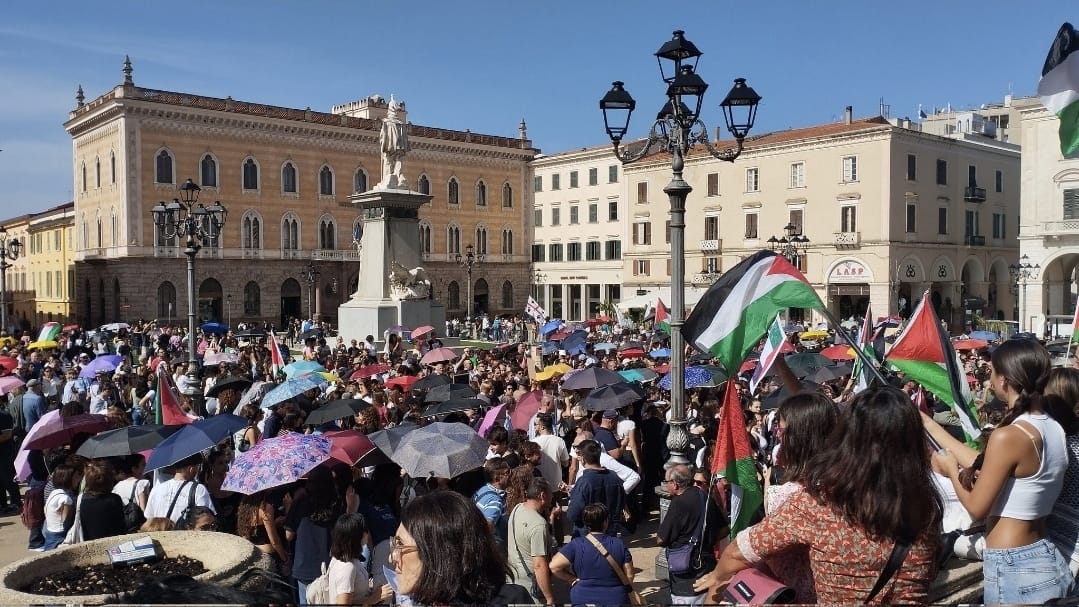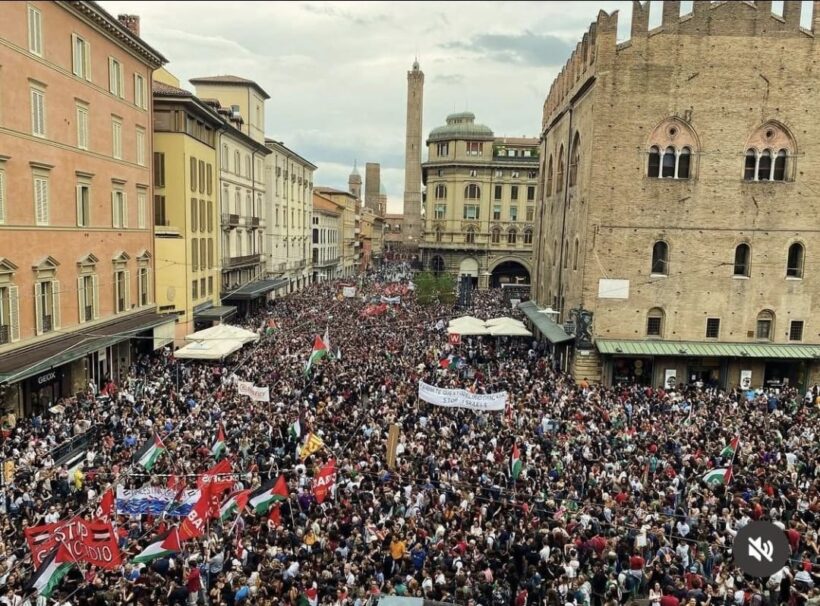
Italy experienced one of the most intense protest days in its recent history for Palestine. Tens of thousands of demonstrators—workers, students, dockworkers, families, and social organizations—took to the streets in more than 80 cities, from north to south and coast to coast. The entire country became the scene of blockades, strikes, and mobilizations under the slogan of “block everything,” demanding an end to the Israeli offensive in Gaza, full recognition of the Palestinian State, and international sanctions against the Israeli government.
In Rome, more than twenty thousand people gathered in front of Termini station, shutting down access and causing massive public transport and urban circulation cuts. The protest extended to hospitals and high schools, where doctors, nurses, and teachers halted activities. In Bologna, thousands interrupted traffic on the A14 motorway and blocked rail traffic, while in Turin, Naples, and Palermo protests were replicated with strong student and union presence.
The actions of the dockworkers and port workers stood out in strategic cities such as Genoa, Livorno, Trieste, Piombino, Ancona, and Ravenna, who blocked access to the docks in protest against the use of Italian ports for loading weapons destined for Israel. In Genoa, workers established direct coordination with international solidarity movements and independent unions to prevent shipments linked to the conflict from leaving.
In Milan, the protest was especially tense: thousands of people entered the Carriage Gallery, the main entrance to the central station, breaking through the police cordon, knocking down doors and furniture. The police responded with riot forces, batons, and tear gas. In that city alone, at least 60 agents were injured and 18 arrested, with mobilization of the carabinieri to restore order.
Nationally, the general strike called by the USB union paralyzed key sectors: schools and universities closed, logistics routes interrupted, and essential services stopped. Organizers reported that the mobilization had an unprecedented unitary character, rejecting the complicity of Giorgia Meloni’s government with Israel and demanding the immediate cessation of Italian military support for the Israeli government.
The movement was accompanied by strong social support: almost two-thirds of Italians consider the humanitarian crisis in Gaza extremely serious, and about 40% demand that the Italian state officially recognize Palestine. The protests—a true wave from the Mediterranean to the Alps—show the resurgence of Italian social and union networks in defense of the Palestinian cause and against the war.