

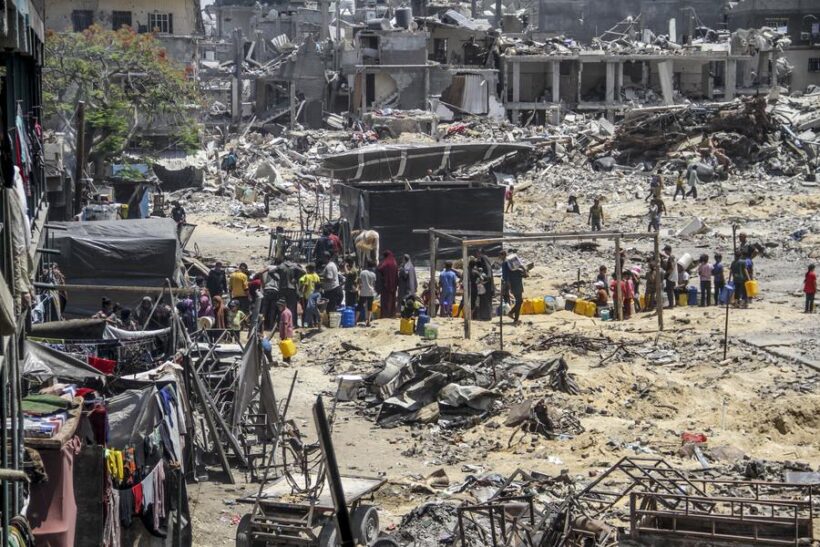
Before dawn, a light without sky breaks through the crust of concrete. In Tel al-Hawa, a family home collapses as if it had lost its bones: several die instantly, others remain trapped beneath slabs of living room and kitchen. Rescuers chip away with hammers and bare hands, because heavy machinery cannot get in and nearby explosions give no respite. In the street, a woman calls her children by name. No one answers. Do not forget those who remain below.
It was not the only strike. From sunrise and throughout the day, dozens of air and artillery attacks pounded neighborhoods in Gaza City, Khan Younis, Rafah, and Deir al-Balah. By nightfall, hospitals reported dozens of dead just today: “at least 52 since dawn,” counted WAFA, with bodies distributed among Al-Shifa, the Baptist, Al-Hilal (Tel al-Hawa), Al-Aqsa, and Nasser hospitals. Al Jazeera put the figure at “at least 53” in its evening live broadcast as explosions continued, including fire from naval vessels. The Associated Press had counted 32 (including 12 children) the previous day, when the bombing intensified over Gaza City; today, the curve rose again.
Entire residential buildings fell in succession as Israel accelerated demolitions in Gaza City with the aim—admitted both off and on the record by Israeli officials—of forcing out those who resist and “taking” the last urban stronghold. Reuters reported that at least 30 blocks were leveled and thousands fled without direction. From the sea came the sound of gunfire; over the rubble lay shoes, torn packets of powdered milk, folded photographs, blackened cooking pots.
At Palestine Stadium in Al-Remal, tents of displaced families went up in flames after a nighttime strike: four dead and several wounded, children among them. In Deir al-Balah, a drone blew apart another family tent, killing six, including women and children. Rafah again saw gunfire on people waiting for aid: four dead. The pattern repeats: the vulnerable stand in line, and the impact comes.
Water is a broken line. In its September 10 update, the World Health Organization warns that malnutrition is accelerating and hospital capacity is exhausted; in July and August, hundreds died of hunger, dozens in just the last few days. UNICEF and OCHA describe water production as devastated and say people survive on 3–5 liters a day, when the emergency minimum is 15. The water infrastructure—wells, pipes, desalination units—is shattered; any cut in fuel stops pumps, plants, and hospital generators. Doctors at Nasser warn: another surge of wounded and the tanks are empty. The incubators are always on the brink.
Eating is also a matter of chance. With the siege and the strikes, community kitchens have closed and distribution centers have been hit in recent months; today, as afternoon wore on, lines for a plate were broken off by sirens and dust. The lack of flour and gas again leaves neighborhoods without bread. No one ignores the equation anymore: “flower, fire, and fear” to keep a pot cooking.
At this hour, people remain beneath their collapsed buildings. There is no stable electricity, communications fail, and humanitarian corridors do not open reliably. Civil defense teams—with fuel rationed—dig and listen. At times, the void breathes. At times, it goes silent.
West Bank, the same day
Meanwhile, in the occupied West Bank, everyday life also contracts. Night and day raids in Hebron, Nablus, Bethlehem, Tulkarem, and Ramallah leave dozens detained—at least 15 today in a single sweep—a young man wounded by gunfire in Tulkarem camp, a school raided in Bethlehem, and settlers entering Deir Jarir under military escort. Checkpoints open and close like a capricious pulse, blocking ambulances and food deliveries.
The rush and the plan
Benjamin Netanyahu presses on. While Doha convenes an Arab-Islamic summit over the Israeli attack on Qatar and Washington recalibrates its public stance, Israel speeds up its operation to empty and seize Gaza City. Governments and organizations speak of “genocide,” “colonization,” “ethnic cleansing”; Israel denies it and claims self-defense. On the ground, the speed of destruction is a political decision: “do it quickly, demolish everything,” cut off water, food, medicine, and fuel to break the population while the world debates. Thousands have left; thousands have nowhere to go.
The ultimate meaning is read in hospital wards: “we have hours of diesel left,” “there aren’t enough painkillers,” “we’ve performed three cesareans by flashlight.” The WHO and the ICRC—who already in public analyses this week and in previous months warned of a health-system collapse—insist on the basics: protect hospitals and staff, allow in fuel and supplies, guarantee access. Each incubator that shuts down is a sentence. Each basement that cannot be opened in time is a register of absent names.
Under the building in Tel al-Hawa, people are still there. This paragraph exists so as not to forget them: those who pound from inside, those who run out of air, the woman who whispers names; the neighbors who hold their breath to catch a faint knock. Outside, the city is running out of bread, out of water, out of places to return to. Here we continue naming.



