

The tragic assassination of right-wing activist Charlie Kirk has shaken the American political landscape. First and foremost, let us be clear: such an act of violence is absolutely horrendous and indefensible. As someone who deeply believes in Gandhian nonviolence, I condemn it in the strongest possible terms. No political disagreement, no matter how profound, should ever cross into physical harm. Violence not only robs a life but also damages democracy itself.
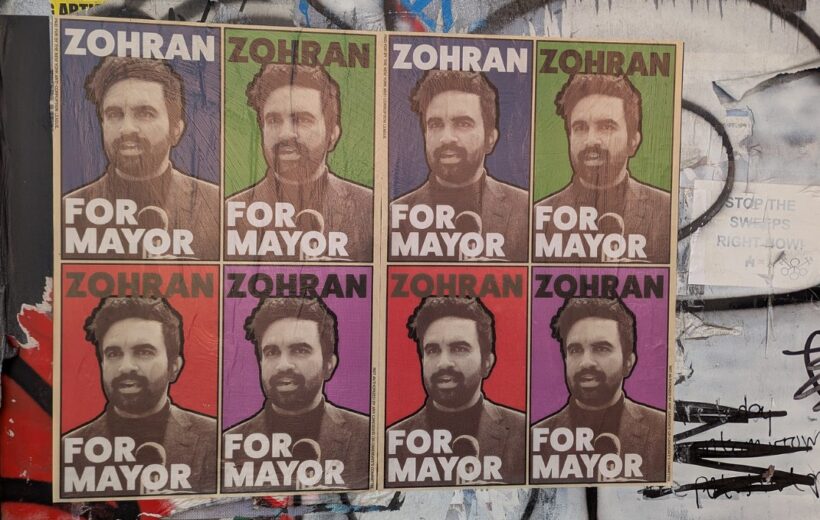
But once the initial shock and grief are acknowledged, we must also ask difficult questions: how is this crime being framed by powerful media outlets and establishment politicians? And what effect might it have on the future of progressive candidates such as Zohran Mamdani, who is now in the spotlight as a serious contender for the next mayor of New York City?
From Victim to Symbol: Media’s Construction of Kirk
Already, sections of big media have begun elevating Kirk into a symbolic figure — a martyr of the far right, painted as a near-saintly defender of “freedom” and “traditional values.” In a twisted irony, those who benefitted most from Kirk’s divisive, often incendiary politics now stand to gain further political mileage from his death. In death, Kirk becomes more useful to them than he ever was in life.
The framing is clear: Kirk is positioned as a victim of a society that, they claim, has become “too radical,” “too violent,” and “too intolerant.” This narrative is not accidental. It serves a calculated purpose: to associate the rise of progressive politics with chaos and violence, regardless of who committed the crime or what the actual motives were.
Law and Order as a Political Weapon
The establishment has long used the rhetoric of “law and order” as a political cudgel. From Nixon in the 1960s to Giuliani in the 1990s, the theme has been consistent: fear sells. By amplifying crime — real or exaggerated — those in power create a sense of insecurity among ordinary people, which then justifies repressive measures and discourages political experimentation.
In this case, Kirk’s assassination risks becoming the latest tool in this arsenal. Progressive leaders like Mamdani, who speak of economic justice, racial equity, and democratic socialism, could be framed as part of the problem — too “radical,” too “soft on crime,” or even indirectly responsible for fostering a “climate of violence.” None of these accusations would have factual basis, but in the world of media spin, perception often matters more than truth.
Mamdani’s Challenge: Staying True to Values
Zohran Mamdani has emerged as a rare voice of genuine democratic socialism in American city politics. His campaign for mayor resonates with New Yorkers who are tired of spiraling rents, growing inequality, and corporate capture of city government. Yet, precisely because of this, the establishment sees him as a threat.
In the aftermath of Kirk’s assassination, Mamdani’s challenge will be twofold. First, he must unequivocally distance himself — and the progressive movement as a whole — from any association with violence. This is essential not only ethically but also politically. He has to remind New Yorkers that the left’s tradition is rooted in nonviolence, solidarity, and grassroots organizing, not in bloodshed.
Second, Mamdani must expose the hypocrisy of establishment politicians and their media allies. While they weep crocodile tears for Kirk, they remain silent about systemic violence — mass evictions, police brutality, racial profiling, immigrant detention, environmental destruction. The violence of poverty and inequality kills far more people than any political assassination. Yet those victims are rarely turned into martyrs on prime-time television.
Will It Hurt His Prospects?
The question remains: will Kirk’s assassination hurt Mamdani’s chances of becoming mayor? The answer depends largely on how effectively he and his allies can control the narrative.
If the establishment’s framing dominates — casting progressives as irresponsible radicals — then Mamdani may indeed face headwinds. Fear, after all, is a powerful motivator in politics. But if Mamdani is able to turn the conversation toward the deeper, structural violence of inequality and the failures of establishment leadership, he could neutralize the spin and even emerge stronger.
In fact, history shows that when progressives remain rooted in truth and grassroots power, they can overcome such challenges. The key is not to retreat in fear, but to speak more boldly about the kind of society we wish to build: one based on justice, compassion, and real safety for all.
The assassination of Charlie Kirk is a tragedy that must never be repeated. But it is also a moment that reveals the cynical workings of political media. Establishment forces are already using this crime to try and delegitimize progressive politics.
Zohran Mamdani’s task is to rise above this manipulation, reaffirm his commitment to nonviolence, and connect with ordinary New Yorkers on their real concerns: housing, jobs, healthcare, education, and dignity. If he can do this, then no amount of media spin can derail his campaign.
In the end, the people will decide whether fear or hope will guide New York City’s future.
References
• Chomsky, Noam. Media Control: The Spectacular Achievements of Propaganda. Seven Stories Press, 2002.
• West, Cornel. Democracy Matters: Winning the Fight Against Imperialism. Penguin, 2005.
• Nixon, Richard. “Law and Order” campaign speeches, 1968 U.S. Presidential Election.
• Mamdani, Zohran. Campaign speeches and policy statements, 2024–2025.
• Gitlin, Todd. The Whole World Is Watching: Mass Media in the Making and Unmaking of the New Left. University of California Press, 1980.
• Herman, Edward S. and Noam Chomsky. Manufacturing Consent: The Political Economy of the Mass Media. Pantheon, 1988.



