

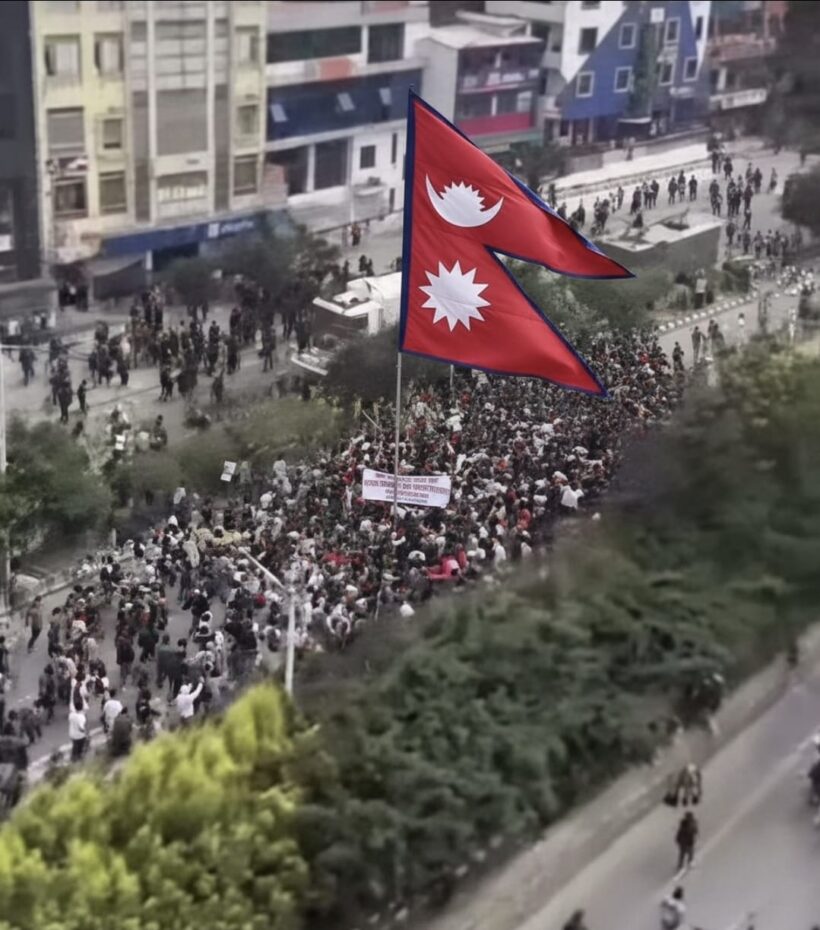
Nepal is going through one of the deepest political and social crises in decades, marked by the convergence of structural problems, immediate triggers, and complex internal and external dynamics that have led to massive protests, the fall of the communist government, and a renewed struggle for transparency and democracy. This essay aims to analyze in detail what is happening in Nepal, the origin and development of the crisis, the internal and external factors at play, the social and political cost of a corrupt and privileged political class, and the specific role of the United States in this context, especially its strategy aimed at the youth.
The communist government of Nepal and the political class have long been accused of corruption and nepotism, accusations that culminated and erupted in the massive protests of September 2025. Prime Minister K.P. Sharma Oli, the central figure of the Communist Party of Nepal (CPN), resigned on September 9 amid escalating social and political pressure. The mobilizations were mainly led by urban youth, particularly the so-called Generation Z, who openly rejected not only government censorship — such as the suspension of 26 social media platforms considered key for communication and denunciation — but also the widespread corruption and blatant nepotism permeating the country’s political elite. The campaign #NepoKid went viral on social media, highlighting the contrast between the ostentatious lives of politicians’ children and the economic reality of the majority.
The scandals that struck leaders and parties, including both the CPN and the Nepali Congress, encompassed multiple cases of fraud—from irregular refugee management and land usurpation to smuggling networks and manipulation of public bidding processes—often supported by clientelist structures. In this scenario, censorship of platforms like Facebook, Instagram, X (formerly Twitter), and YouTube was interpreted as an authoritarian attempt to silence criticism and stop social organization, detonating widespread discontent that quickly spilled into the streets and transformed into violent riots with at least 19 deaths and dozens injured as a result of police repression. Violence reached emblematic scenes: fires in public buildings, including Parliament, and the temporary closure of Kathmandu’s international airport. The international community, including human rights organizations and the United Nations, called for calm and a thorough investigation of the events.
To understand the depth of this outbreak, it is essential to review the recent history of the Communist Party of Nepal and its evolution from an insurgent movement to an institutionally entrenched power marked by authoritarian practices and persistent corruption. Originating in the Maoist insurgency of the 1990s, the CPN waged a civil war against the constitutional monarchy that lasted a decade, leaving more than 17,000 dead. In 2006, the insurgency ended with a peace agreement and the integration of Maoists into the political system. In 2008, Nepal abolished the monarchy and established itself as a federal democratic republic. However, political stability was never fully consolidated due to fragile coalition-building and persistent internal rivalries.
In 2018, the main communist factions attempted to merge to strengthen the CPN, with K.P. Sharma Oli at the helm as prime minister. But this union fell apart amid internal confrontations, power struggles, and court rulings that declared the merger unconstitutional. From then on, Oli and his allies initiated an authoritarian turn, restricting the press, censoring social media, and making arbitrary arrests, while corruption became systemic with opaque contracts and illicit enrichments. Nepotism became especially visible, with relatives of political leaders grabbing official posts and resources, marked by a stark contrast between their ostentation and the structural poverty and unemployment afflicting much of the population, especially the youth.
It is within this hotbed that the September 2025 protests were triggered by the government’s block of social networks, officially presented as a regulatory measure but widely seen as political censorship. The suspension affected key platforms such as Facebook, X, and YouTube, mobilizing thousands of young people who were already fed up with abuse and lack of transparency. What began as peaceful protests turned violent when security forces fiercely repressed the crowds using lethal weapons, causing dozens of deaths.
The political situation collapsed with Oli’s resignation and the mass resignations of ministers and parliamentarians. The government lost its majority, government buildings and official residences were set on fire, and people demanded deep reforms, restoration of free speech, and early elections. The country now faces a political vacuum amid high social fracture.
Adding to this complex internal reality is the strong influence of external actors, especially India, China, and the United States, whose geopolitical rivalries have significantly influenced Nepal’s trajectory. India, with historical and cultural ties, seeks to maintain regional hegemony and access to key resources like hydroelectric power. China has expanded its presence through investments and projects linked to the Belt and Road Initiative, aiming to integrate Nepal into its economic and strategic sphere. Meanwhile, the United States, through an interventionist policy, has increased technical and financial support to youth groups, activists, and social organizations denouncing corruption and authoritarianism.
This U.S. policy, framed within its Indo-Pacific strategy to contain China’s influence, has strengthened the internal opposition to the communist government and emphasized promoting liberal democracy and freedom of expression. While the United States has not directly caused the crisis, its involvement has contributed to political polarization and pressure against Oli’s regime. Special attention has been given to Nepal’s youth, whom Washington supports as a key sector for political change, encouraging a social awakening that manifested strongly in 2025.
The cycle of violence, corruption, and repression in Nepal, alongside foreign power competition, paints a picture where legitimate demands for democracy, transparency, and justice must confront both entrenched local power and a geopolitical web of strategic interests. The crisis highlights the high cost societies pay for becoming grounds of privilege, nepotism, and complicity, but also demonstrates the power of social mobilization in an increasingly interconnected and monitored world. Nepal, a symbol of the Himalayas, today headlines a historic milestone that forecasts risks and opportunities for its political and social future.