
In a land where, for decades, art was silenced under religious and political decrees, the appearance of *Carmen* on a Riyadh stage strikes with the force of lightning in the night. It is not merely an operatic performance: it is a gesture of cultural defiance, an act that pierces the walls of censorship and reveals that even within the most closed regimes, music can assert a truth that cannot be gagged.
That *Carmen*—the story of a free woman who shapes her own destiny despite the chains of patriarchal and military morality—should resonate in Saudi Arabia, performed by Chinese artists and born from the French genius of Georges Bizet, transcends any label of “cultural exchange.” It is the staging of a promise: that the arts remain a space where East and West recognize their shared humanity, even when states fortify themselves behind strategic alliances or ideological borders.
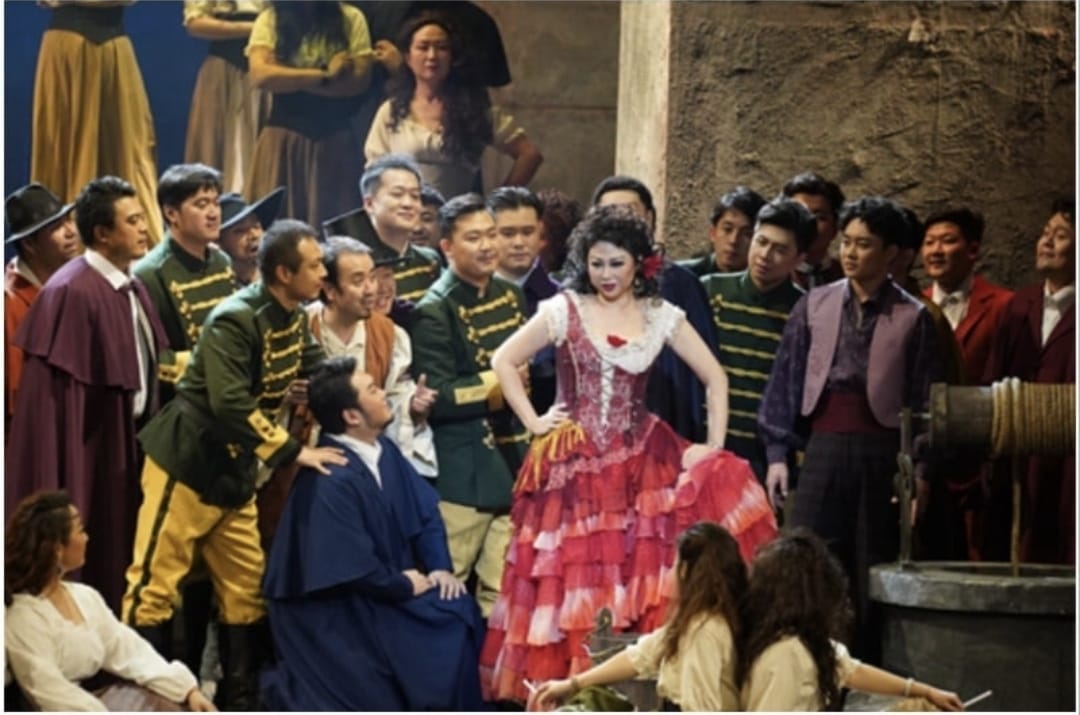
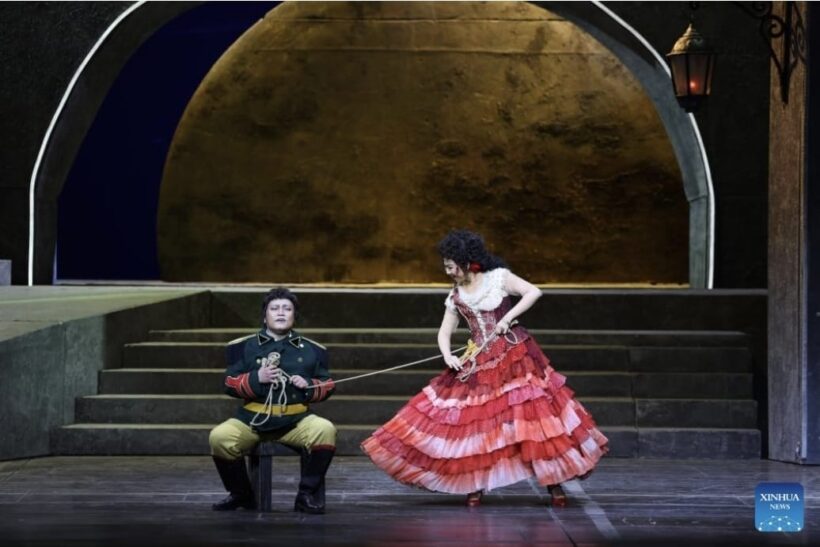
On September 4, 2025, at Riyadh’s King Fahd Cultural Center, the China National Opera House presented the opera for the first time on Saudi soil, as part of the Saudi Arabia–China Cultural Year 2025, commemorating 35 years of diplomatic relations between Beijing and Riyadh. The opening night gathered more than 2,500 spectators, including diplomats, artists, and local audiences, who witnessed a performance with a full orchestra and international cast. According to coverage from Xinhua and local outlets such as *Arab News*, the atmosphere was one of anticipation and excitement, with spectators celebrating the convergence of cultures embodied in the work: a nineteenth‑century Spanish tale, told in French, performed by Chinese singers, in the heart of the Saudi kingdom.
China’s state media emphasized the historic significance of the event, highlighting that the opera reflects the Kingdom’s cultural opening and both countries’ desire to strengthen artistic and academic cooperation. From a Saudi perspective, local media linked the performance to the Vision 2030 strategy, aimed at diversifying the economy beyond oil and expanding spaces for entertainment and culture in a society shaped by decades of restrictions.
Yet the symbolic weight of the evening cannot be measured merely in figures or in press releases. What unfolded in the theater—the audience, some dressed in Spanish‑inspired attire, applauding the heroine’s strength—pointed to another dimension: that of a community which, in welcoming *Carmen* to its capital, also welcomed the memory of struggles for freedom, the echoes of passions too vast for imposed moral codes, the resonance of a nineteenth‑century Europe carried by Chinese voices into the heart of the Gulf. An unexpected bridge stretched across the fault lines of the present: opera as a shared language among three worlds—France, China, Saudi Arabia—that have lived different histories, yet found themselves breathing as one on stage.
At a time when global powers are once again realigning into blocs, art offers a different geopolitics: not one of force or war, but of cultural interdependence. By applauding with fervor, the Saudi audience took part in that alternative politics, one where difference does not lead to collision but to recognition.
The premiere of *Carmen* in Riyadh does not suddenly alter the kingdom’s power structures or dissolve its authoritarian locks. But it does open a crack, a breath of fresh air, a question for the future: might it be possible, as Xi Jinping remarked days ago in Beijing, that “humanity rises and falls together” and that only encounters on equal terms can save us from repeating past tragedies? The ovation that night in the desert suggests that, even beneath the most closed skies, music still has the power to remind us of what we might yet become.