

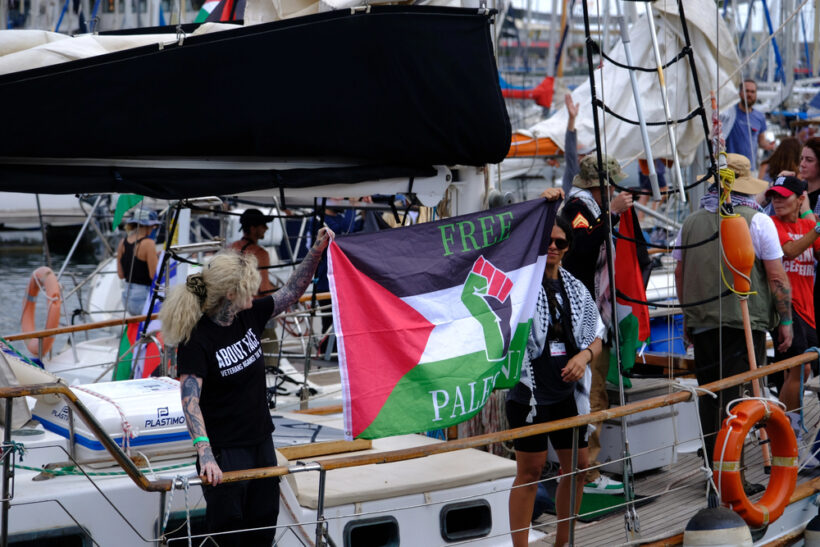
The sea opens paths that the powerful tried to close. From Barcelona sets sail the Global Sumud Flotilla, a flotilla of persistence, of constancy, of resistance. Half a hundred boats that do not carry bombs but food and medicine, that do not transport soldiers but doctors, artists, journalists and activists, that do not fire missiles but raise their voices to say “enough.” The Mediterranean receives them as both brother and judge. It welcomes them with calm waves and tests them with storms, as if to remind them that this journey is not a cruise but a battle of dignity. Every blow of water against the hulls is an oath repeated in silence, an oath that in this journey they are not fighting for territory or for power, they are fighting for dignity, for survival, for the right of an entire people not to be erased from the map. Gaza becomes a magnet that attracts the gaze of the whole world, a destination that is no longer just a place but a cry carried across the sea.
Sumud means firmness in Arabic. It is the word that Palestinians turned into a way of life, the persistence of continuing to sow, to raise children, to love in the midst of dispossession. That word now sails on every flag of the flotilla, on every face that chose to leave home to be part of this journey. The mission began with about two hundred people from forty-four countries aboard thirty boats that left Barcelona, and more vessels are expected to join from Tunisia and Italy until they reach nearly five hundred people and more than fifty ships. The average age stretches from young activists such as Greta Thunberg, only twenty-two years old, to veterans in their seventies who have turned their experience into resistance. There are doctors, lawyers, teachers, journalists, artists and volunteers who know they are not engaging in solidarity tourism, they are confronting a blockade. About sixty percent are women, many men complete the crews, there are families with children on board, and there is a significant group of doctors who know better than anyone what it means to work in hospitals under bombardment. Every cabin and every deck is a declaration of dignity turned into action.
The itinerary is drawn with the uncertainty of the winds and the constant surveillance of hostile drones. They left Barcelona on August 31, some had to stop in Menorca because of storms, others waited in Italian and Tunisian ports, adapting their course to the sea and to persecution. The sea turned into refuge and into threat, into pause and into push, into the element that at the same time protects them and exposes them. Each stop has been a page written with salt and with fear, a reminder that the crossing is not only geography but also politics, persecution and vigilance. Israel has already deployed ships and rehearsed maneuvers to make clear that interception will be its answer. But every day that the boats remain at sea is already a triumph, because every sunrise offshore confirms that hope is still floating. Their arrival to Gaza is foreseen for mid-September, if they manage to resist storms, surveillance and threats.
The cargo is humble and at the same time immense. On board they carry medicines, drinking water, diapers, powdered milk, basic food supplies and desalination equipment. Each box weighs more than the steel of a tank because inside it carries life itself. These boats do not carry contraband, they carry justice. They do not transport weapons, they transport relief. They do not bring speeches, they bring bread. They do not unload promises, they unload survival. The Mediterranean bears these boxes as if it knew that what floats on it is not merchandise but dignity, and each wave that rocks the ships seems to shield that fragile but unstoppable load. In those packages travel the voices of peoples who refuse to look the other way, voices that come from Europe, from Africa, from Latin America, voices that understand that to remain silent is to be complicit. Every sealed container beats with the certainty that solidarity can break down walls and blockades. Every bag of flour and every bottle of water is heavier than any missile, because they represent life where death has been imposed. That is why the cargo is not only humanitarian, it is political, it is symbolic, it is the most radical way of saying that Gaza is not alone.
The risks are real, and they are present in every mile of the crossing. Israel has already warned that those on board could be treated as terrorists, imprisoned, prosecuted or deported. The shadow of the assault on the Mavi Marmara in 2010 still resonates as an open wound in the Mediterranean. The sea does not forget those who were killed that night, and neither do the people who now embark. Each person who boarded knew what they were facing: drones following them, the possibility of being intercepted in international waters, the certainty of hostile propaganda labeling them as criminals. And yet they climbed aboard, because the greatest defeat would have been to stay at home watching Gaza die on a screen. Courage is not improvised, it is assumed. It is written on every deck like a logbook of honor, it is etched in every face that decided to exchange comfort for risk. Every activist, every doctor, every volunteer knows that this journey could end in prison or in violence, and still they chose to sail. That decision weighs more than the silence of governments and the speeches of diplomats. It is the kind of decision that exposes fear and dismantles the indifference of the powerful.
This flotilla does not seek to invade or to humiliate. It seeks to show Israel that the world is watching, that Gaza is not alone, that the Mediterranean is not the private property of an army. Each boat is a mirror that reflects the barbarity of a blockade that condemns one million children to hunger. The Mediterranean, so many times the frontier of empires, now turns into the stage of a peaceful rebellion. There are no cannons pointing from the decks, only voices that shout “enough.” There are no troops, only people determined to resist. What sails is not a navy, it is the dignity of the peoples that cannot be silenced. And that is why this crossing, more than a humanitarian action, is a political act, a denunciation, a cry that turns every wave into testimony and every mile into resistance.
The world reacts halfway. Governments remain silent, chanceries calculate, institutions hesitate. But the peoples listen and accompany. Every port where the boats dock turns into a tribune, every pier into a square of resistance. Europe observes from its beaches as if it had nothing to do with it, while Latin America feels the echo as its own. Iran, India, Pakistan, China, Korea, the whole of Africa know that what happens will mark global politics. The sea multiplies those voices like a global chorus, a chorus that no censorship can silence and no wall can contain. What governments hide, the sea proclaims. What television mutes, the waves repeat. And every time the flotilla sails out again, the silence of the powerful becomes more scandalous and the accompaniment of the peoples becomes stronger.
If they reach Gaza, it will not only be aid that they deliver. It will be pure hope. It will be the certainty that it is still possible to sail against power, to row against injustice, to prove that not everything is lost. The children of Gaza will see ships on the horizon and will know that not everyone in the world has forgotten them. If they do not arrive, if they are intercepted, the victory will be just as great, because it will expose the fear of a power that is more afraid of ships loaded with bread than of entire armies. The Mediterranean does not measure victories by landings, it measures them by courage. Every attempt to stop them will only make their message more visible. Every act of repression will only reveal the weakness of those who claim to be strong. What really arrives in Gaza, whether the flotilla docks or not, is the testimony that solidarity exists, that dignity still sails, that humanity has not surrendered.
The echo of this flotilla also reaches the Global South. It reaches Petare, Rocinha, Villa 31, all the slums where dignity drowns in poverty. Latin America recognizes in this journey the same abandonment, the same violence, the same resistance. The sea that now kisses the shores of Gaza also speaks to the coasts of the Pacific and the Atlantic. What is at stake in this voyage is not only the freedom of one people, it is the dignity of all peoples. The same hunger, the same dispossession, the same contempt that condemns Gaza is repeated in every periphery of the South. That is why each wave that propels these ships also touches the barrios, the favelas, the shantytowns of our continent. And that is why the arrival in Gaza is also the arrival in Santiago, in Buenos Aires, in Caracas, in La Paz. The flotilla sails for Gaza, but it also sails for every people who resist.
Each vessel carries on its bow much more than supplies. It carries a hymn to human dedication. It carries the certainty that the life of a child is worth more than the comfort of an adult. It carries the word Sumud written on every wave. Persistence, resistance, constancy. The Mediterranean is not only water, it is memory and it is mirror. And in its swell the same phrase is repeated again and again: Gaza is not alone. What travels on these decks is not just cargo, it is conviction. What sails across these waters is not just solidarity, it is defiance. Every plank of wood, every sail and every rope becomes testimony that indignation can be turned into movement, that compassion can be turned into resistance, that justice can be turned into a fleet. That is why these ships are more than boats, they are a collective voice made flotilla, a cry turned into journey, a hymn that no blockade and no army will ever be able to silence.
The Global Sumud Flotilla did not only break the siege of Gaza. It broke the siege of global silence. It did not come to deliver justice from a distant shore, it came sailing in every heart willing to shout “enough.” It crossed the Mediterranean not as a navy, but as a conscience made fleet. It confronted storms and threats not to provoke, but to remind the world that no power has the right to condemn an entire people to extermination. If they reach Gaza, they will have lit the torch of hope. If they are intercepted, they will still have won, because they will have shown that barbarism does not fear armies, it fears dignity.
The Mediterranean will always be companion and judge. It will always remember that on its waters sailed men and women who chose to risk everything so that others could live. That memory will weigh more than missiles and will travel further than propaganda. And as long as there are ships that dare to sail against injustice, there will be hope for humanity.
True power does not lie in the blockade. True power lies in the sea that never surrenders, and in the peoples who refuse to be silenced.



