

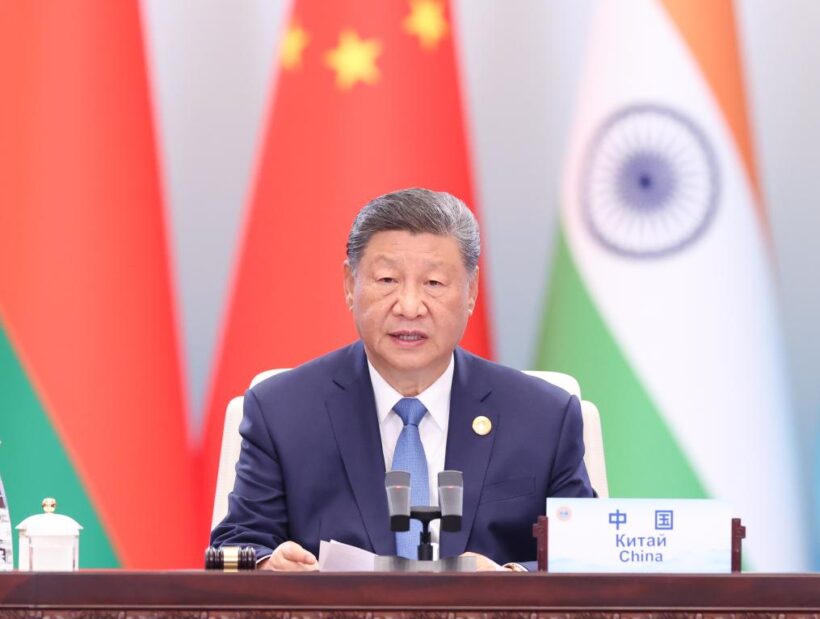
Thus declared Xi Jinping before the leaders of the Shanghai Cooperation Organization (SCO) at its 2025 summit, a two-day meeting in the city of Tianjin, China
In a global context dominated by tension, regional conflicts, and geopolitical disputes, the Chinese president not only outlined the spirit of the organization but also projected the philosophy of a superpower seeking to shape an alternative international order. The event, which demonstrated how cooperation is the cornerstone against competition, emerged as a key forum for dialogue in an ever-dynamic Eurasia.
The SCO summit on the geopolitical chessboard
From August 31 to September 1, Tianjin hosted the SCO leaders, an alliance that, since its founding in 2001, has become the largest regional bloc in the world in terms of population and area. Its 10 full members—China, Russia, India, Pakistan, Iran, Belarus, Kazakhstan, Kyrgyzstan, Tajikistan, and Uzbekistan—work together to combat terrorism, extremism, and separatism, as well as to promote economic development and connectivity through initiatives such as the Belt and Road Initiative.
More than just a forum, the SCO reflects the model of cooperation proposed by China. In contrast to traditional military alliances, its mandate focuses on stability and mutual development. As Xi Jinping noted in his speech: “Since its founding, the SCO has promoted the Shanghai spirit, strengthening solidarity, mutual trust, and practical cooperation; we are friends and partners.” A spirit aimed at integration rather than confrontation.
The Chinese leader did not limit himself to rhetoric; he also addressed the challenges the organization faces in a chaotic world. “Member countries face increasingly difficult tasks to ensure security and development in a chaotic and interconnected world,” he acknowledged. In this context, he emphasized that the SCO must be a pillar of stability: “Shared responsibility must be strengthened to promote peace, regional stability and prosperity, and deepen coordination against security threats, including terrorism.”
A platform for historic reconciliation
The summit not only strengthened ties among permanent members but also served as a vital space for invited countries. The participation of Armenia and Azerbaijan was particularly notable given their recent history of conflict. Their respective contacts with China, along with their presence in a regional security forum, underscore the SCO’s capacity to act as a neutral platform for diplomacy and reconciliation.
Countries like Turkey also attended, showing growing interest in linking to the security and development dynamics brewing in Eurasia.
Chinese diplomacy: partners, not rivals
President Xi Jinping used the summit framework to hold multiple crucial bilateral meetings, reinforcing China’s vision of a foreign policy based on cooperation and rejection of confrontation.
Perhaps the most significant meeting was with Indian Prime Minister Narendra Modi. After years of border tensions, especially following the clashes in the Ladakh region in 2020, the leaders agreed on the importance of restoring peace and dialogue. Both reaffirmed that India and China are “partners, not rivals,” and that disputes should be resolved through diplomacy without allowing differences to limit the scope of the relationship.
On a security issue concerning both, Modi raised the need to curb financing and radicalization of cross-border terrorism. Xi pledged China’s support and emphasized the importance of strengthening multilateral security “without applying double standards.” Economic cooperation was also discussed, focusing on India’s trade imbalance and tensions caused by U.S. tariffs in the global geopolitical context.
Other important meetings included Xi’s with Russian President Vladimir Putin, with whom he solidified the strategic alliance and coordination on global affairs. This meeting reflects the joint commitment to a multipolar order that serves as a counterbalance to Western influence. Xi also held dialogues with leaders from Turkey, focusing on economic cooperation and seeking regional stability in sensitive areas such as Gaza and Ukraine.
China’s promise and the SCO’s projection
During his speech, Xi Jinping reinforced China’s commitment to the region, announcing a substantial aid package. “This year, China will allocate 2 billion yuan in aid and 10 billion yuan in loans for projects within the SCO,” a gesture reflecting China’s commitment to promoting regional and global development.
Besides economic announcements, the Chinese president emphasized the importance of collaboration in key future areas. “We must leverage the huge market scale to facilitate trade and investment, and advance cooperation in energy, green industries, digital economy, and artificial intelligence,” he said. He also highlighted the importance of education and cultural exchange, noting that “we support education and technical training; China is committed to nurturing innovative talent and strengthening ties among peoples.”
The SCO, with its focus on multilateralism, represents a counterbalance to the Western-led global order. As Xi noted, “the SCO has established a new paradigm for international relations, insisting on genuine multilateralism that counters the Western-led global order.” As the alliance grows in members and influence, it consolidates as a key actor on the global stage, prioritizing mutual respect, joint development, and regional stability in an era of uncertainty.
Analysis and future perspectives
The Tianjin 2025 summit was not just a diplomatic gathering but a declaration of intent. The SCO, often viewed as a regional response to NATO, has evolved into a broader forum for economic and cultural cooperation, consolidating China’s and Russia’s influence in Eurasia. The focus on dialogue to resolve conflicts, such as between India and China or Armenia and Azerbaijan, demonstrates the organization’s aspiration to be a peace mediator beyond its security functions.
China’s philosophy of cooperation over competition projects a model of international relations seeking harmony and stability over confrontation. In a world increasingly divided into blocs, the SCO positions itself as a forum where nations can find common interests, build trust, and shape a multipolar order. The scale of its members and its strategic weight make this alliance a rising force whose impact will be felt far beyond Eurasia’s borders.