
A fine, misty rain pattered against the windowpane, a soft, relentless rhythm that did nothing to soothe the gloom settling in my chest. Each distant rumble of thunder felt like an echo of the dread tightening in my stomach. My phone, a cold, hard rectangle in my hand, glowed with images of a world dissolving into water. Social media, mainstream news—it was a single, screaming chorus of distress.
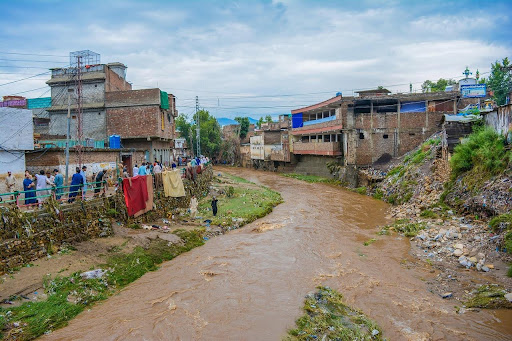
Out there, beyond my dry room, an entire province was drowning. Families huddled on strips of broken highway, their lives reduced to what they could carry. Animals, eyes wide with a terror they couldn’t understand, stood stranded on vanishing islands of high ground. The water was still rising. In the heart of Lahore itself, where gleaming cars were once navigating bustling streets, wooden boats now glided silently, ferrying a new, desperate reality. The Ravi river, for so long a neglected, shrunken thread, had awoken in a fury. It was angry, a primordial force ruthlessly reclaiming the land we had so arrogantly stolen from its bed.
And here I sat, useless. A man with nothing but a pen and a rising tide of helpless grief. All I could do was watch and write, trying to bleed this anguish onto the page.
Why does this happen? The question is a ghost haunting every Pakistani mind. We ask it every few years, as if the answer might have changed. But it hasn’t. I sifted through the images of submerged villages, of swollen rivers tearing through fields, and the root cause rose to the surface, ugly and undeniable. Not nature’s wrath, but human failure. A trifecta of greed, corruption, and a breathtaking, wilful short-sightedness.
They told us it was progress. They gave us glossy brochures for luxury housing societies, palaces built on a promise and a lie, right in the river’s ancient pathway. We forgot the very meaning of Punjab—the Land of Five Rivers. We forgot that these waterways have a memory far longer than our own. For forty years, we were lulled into a false sense of security, the rivers held in check by treaties and dams. We started to believe we were the masters. We built and built, pouring concrete over the very veins that gave this land life.
The property dealers, the development mafias—they became the new kings, enabled by authorities who slept in gilded beds, their palms greased, their vision blinded by profit. They sold dreams built on a floodplain, and we bought them. We all looked away, ignoring the simple, gravitational truth: water always wins. It always finds its way home.
And now, the river is taking its land back. It is a brutal, poetic justice. Those lavish homes, those symbols of new wealth, are now fish-filled ruins. The powerful men who built them, who now sit in air-conditioned ministries, must see the videos—their own investments submerged, the people they deceived asking angry, unanswerable questions on screens across the nation.
The water isn’t done. It’s moving south, a biblical force gathering its brothers from the Chenab and the Sutlej, converging at Panjnad to become a monster that will swallow everything in its path. Our systems, our barricades of concrete and greed, will be as nothing against it.
We learned nothing from 2010. We never learn. We just find new ways to monetize the disaster, to fool each other until the next cycle begins. We have placed profit at the very center of our world and pushed humanity to the periphery. This is our model. This is the engine of our destruction.
And I sit by my window, listening to the drizzle, and I write. It is all I can do. A feeble testament to a tragedy we built with our own hands.