
For nearly two years, Padma Joshi has been living with the same unanswered question—“When will my son come home?” Every day feels the same: she enters his room, stares at his neatly stacked books and folded clothes, and then sits quietly, wiping her tears. Friends say she often breaks down while holding on to his old photographs, whispering to herself that Bipin will walk through the door again one day
The Day Everything Changed
On October 7, 2023, when Hamas attacked Israel, 23-year-old Bipin Joshi from Kanchanpur, Nepal, was caught in the chaos. He had gone to Israel as part of Nepal’s “Learn and Earn” program to study agriculture at Kibbutz Alumim.
Witnesses recall that in the middle of the attack, Bipin acted with rare courage—he threw back a grenade, trying to protect his fellow students. Seconds later, armed men seized him and dragged him into Gaza.
Since then, almost nothing is known about him. A few months later, one video clip showed that he was alive, but since that glimpse there has been silence. For his family, that silence has been the heaviest burden.
A Family’s Journey of Pain and Hope
For Padma, the wait is unbearable. She has repeated the same words to journalists and officials again and again: “Please return my son to me. He is only a student. He has nothing to do with war.”
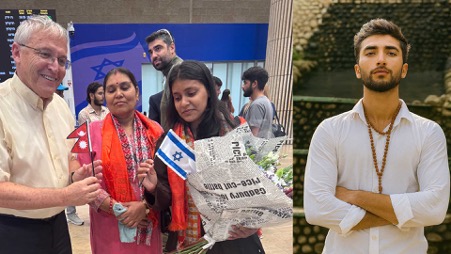
Her daughter, Pushpa Joshi, only 17, has taken on a role far beyond her years. She has knocked on the doors of Nepal’s leaders, and now she has traveled with her mother to Israel. Standing on the ground where her brother was kidnapped, Pushpa’s voice trembled but her message was clear:
“My brother came here to learn, not to fight. Please bring him back to us.”
Those who were there say it was impossible not to feel her pain. Her words carried both innocence and strength.
A National Pain, A Global Appeal
The Joshi family’s struggle is no longer just personal. It has become Nepal’s collective grief. Thousands of Nepalis have joined their voices on social media with hashtags like #FreeBipin and #BringBackBipin.
Israel has also planned to take Padma and Pushpa to the United Nations, where their appeal will be shared with the global community. Meetings with American leaders are being arranged, while Nepal’s government continues to push for Bipin’s safe release.
At Kibbutz Alumim, the ground still carries scars of that dark day. When Padma and Pushpa visited, they wept together. Pushpa later said, “My mother cried ‘Save my son’ again and again. I could not stop my own tears. But I will keep speaking until my brother comes home.”
Today, Padma still sits in her son’s empty room, holding his photographs close. She whispers the same words every night: “I believe my son will return. Until my last breath, I will wait for him.”
This is not just the story of a missing student. It is the story of a mother’s tears, a sister’s unwavering plea, and a nation’s hope. Bipin Joshi must come home—because no war should ever steal away the love of a family.