
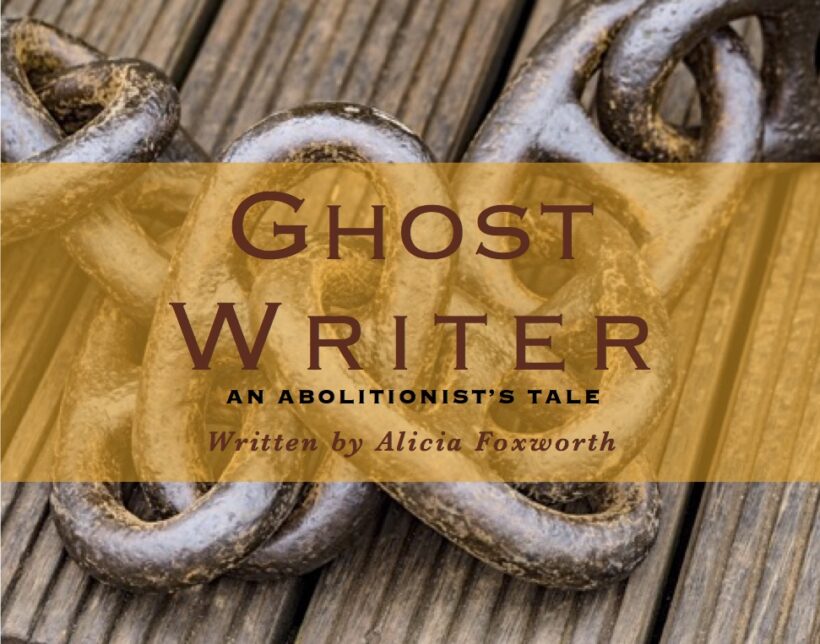
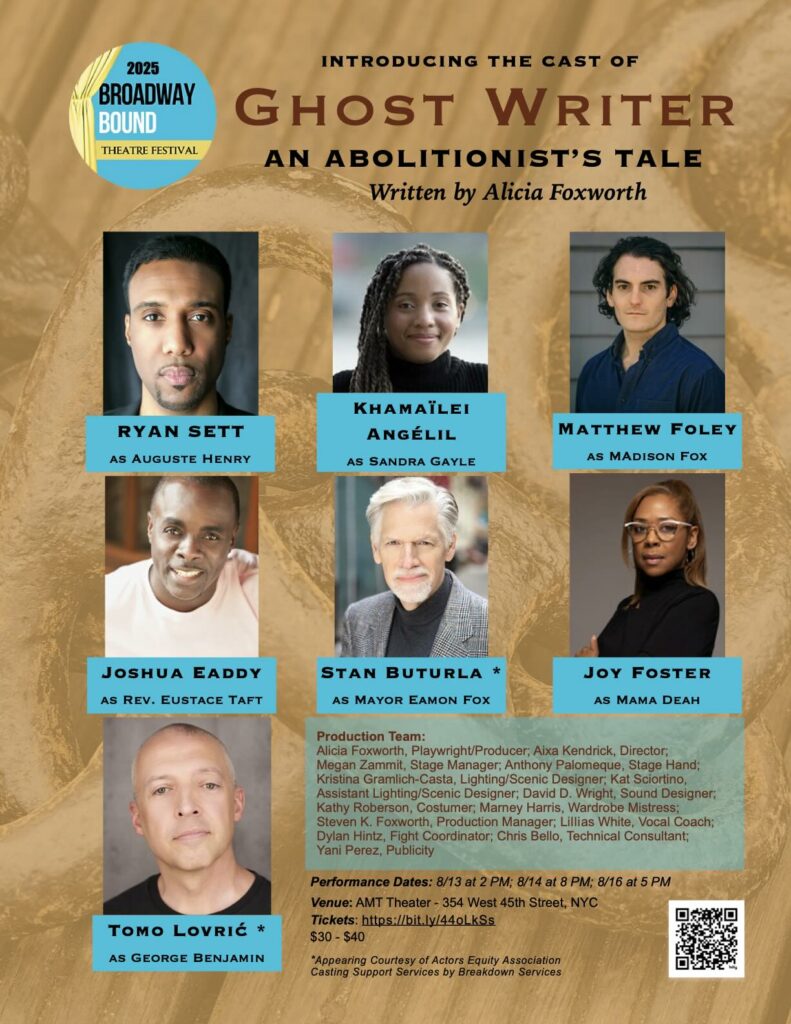
I’m attending the Broadway Bound Theatre Festival after speaking with playwright Alicia Foxworth about her piece Ghost Writer, an Abolitionist’s Tale. BBTF’s 2025 season spotlights four new musicals and eight original plays making their New York debut—works that champion “story, substance, and stagecraft.” Now in its ninth season, the festival continues its mission to foster “a collaborative, competition-free space where playwrights are given the tools, feedback, and community to bring their work to life—and beyond.”
This summer’s lineup includes stories of identity, power, and historical memory. In this realm enters Ghost Writer, “a drama that addresses ongoing efforts to enforce the gradual abolition laws to slavery in New York State in 1833. Just a few days before the Independence Day celebration, our characters locate Negro slaves slated for sale, and mount a dangerous rescue, revealing secrets of freedom fighter and foe alike, that may turn back the hand of time and progress.”
Alicia describes her plays as “life-affirming stories,” and I think those two words take on a deeper meaning when we read, watch, or talk about history. History has to be our history. Once we frame it in a different possessive—his, hers, theirs, mine—we begin to disown something we are building every day. We slip into social irresponsibility, seeing our society, our institutions, our neighborhoods—and ourselves—as if from another universe where my being doesn’t touch yours, where nothing we do affects our surroundings.
You’ll have the chance to see Ghost Writer, an Abolitionist’s Tale at the AMT Theater in Times Square on Wednesday, August 13 at 2 PM; Thursday, August 14 at 8 PM; and Saturday, August 16 at 5 PM. While you prepare to buy your tickets, I invite you to sit, let the sun warm your skin, and think about the meaning of the title—how this story is not just yours or mine, but ours.
Now, let’s talk to Alicia Foxworth about Ghost Writer, an Abolitionist’s Tale.
JS: Tell me about yourself—how did someone like you become an actor and playwright? Or—just guessing here—maybe a Brooklynite, inspired by brownstones and your Garden Reading Series in Brooklyn, who’s also a bit of a playwright-activist with your work through Brownstone Steps?
AF: So I wrote comics as a kid and studied art in high school but by college, I took a common route and went to business school. It was years later after I was laid off that I even remembered writing as a kid. When I was laid off from a job, an actor friend told me that background work can help pay some bills so that’s what I did, for TV and film sets around NYC. Eventually, I saw a breakdown for performing community theater and was cast and later, I began to write again. As to brownstones, my father and I used to sit outside on the steps after dinner, and talk, read, etc. It was our ritual I guess, and he was quite the storyteller himself. It’s how I remember him now that he’s transitioned.
JS: How would you describe your plays? Do you see yourself working within a particular tradition or tendency in playwriting, or do you like to explore different forms and other kinds of writing?
AF: I would describe my plays as life affirming stories that widen the lens of the Black experience. It’s important to be a part of telling my own stories, especially about that which predates the arrival of Africans to America for slavery. We were here before that and have lived rich, vibrant lives in many cultures around the world for thousands of years. Whether writing about a particular period of human history or specific events, I find the exploration of my ancestry and the interconnectedness of others, engaging. I hope it comes across in my writing.
JS: Let’s talk about Ghost Writer, an abolitionist’s Tale, which was selected for the Broadway Bound Theatre Festival through a rigorous double-blind process. How was this story born, and how did it evolve into a piece that also became a semifinalist in the 2019 Eugene O’Neill National Playwrights Conference?
AF. After I started performing, I played with the idea of what I thought was a period love story. Of course, a bi-racial marriage was illegal during the American slavery era, but along with the idea of escape, it raised the stakes and gave me different scenarios to explore. It wasn’t until I attended an exhibit about slavery in New York that I began to look into how emancipation took effect here. I’m a native New Yorker, so I continued to explore and after workshops and excerpts presented for Readings or Festival, I submitted to the Eugene O’Neill National Playwrights Conference and placed in the sem-finals. Afterwards, I spent a while of getting no traction, so of course, I moved on to other stories and then I saw the post for Broadway Bound Theatre Festival. I really wasn’t sure, but my husband encouraged me to apply and then what do you know, I got in!
JS: I haven’t read the script yet, but the title— Ghost Writer, an abolitionist’s Tale —feels particularly meaningful now. Before you answer, I’d like to share my own interpretation: African Americans, enslaved and excluded from what the Constitution calls “the people,” also shaped the history of the United States. Yet, that history was often authored— written—by someone else. What does the title mean for you?
AF: When you read a book written by a ghost writer, it benefits someone that didn’t do the work. Of course the actual writer gets paid for one’s labor but that has not been the case for many African Americans whose creative works have been stolen, exploited or just misrepresented as poor quality. At least in this story, the characters have found a way to derive a ghost benefit that supports the abolitionist’s movement, despite the author and the fans being white.
JS: Again, I shouldn’t impose too much of my own view, but I think stories like yours feel even more urgent under a political climate—like during Trump’s presidency—that denies diversity, erases history, and with a Supreme Court majority that adheres to an “originalist” interpretation of the Constitution, which often becomes selective, even convenient, history. What’s your perspective?
AF: They had me at the burning of books. Knowledge is power and pretending American slavery didn’t happen or that slaves were treated well is not denial. It’s simply untrue. All men are created equal, period. I hope my play helps people remember how far we’ve come so that we do not forget. In Ghost Writer, I have a character that cozies up to ‘those do-gooder Republicans,’ but after election to office, seeks to withdraw the people’s rights. It’s a good old fashioned ‘bait and switch,’ and people must pay attention.
JS: History is messy. Humans are contradictory. Does your play reflect that complexity, and if so, how?
AF. It does. In the quest for freedom, the pain of love and loss clouds a character’s view and concessions are made to achieve vengeance. The ultimate price has to be paid and our freedom fighters are left to chart a course in uncertain waters.
JF: I want to express my gratitude for this interview and for your work—you’ve clearly poured immense effort into this piece, and we’ll get to experience it in just 85 minutes on stage. So, what’s next for you? And what do you hope audiences will take away from Ghost Writer?
AF: I hope the take away from Ghost Writer is a willingness to remember, to learn, to study and explore not only our painful past but, also the ways to protect our liberties. Each of us has a role to play and each one is significant. What’s next? I am off to the Atlanta Black Theater Festival to present a Reading of my play, The Last Rise of Akhenaten about the 18th dynasty in Kemet and how a young Pharaoh upended the economic power structure when he closed the religious center at Karnak. It is my fictional interpretation of true historic events with a few comedic beats throughout. Thank you for your time and coverage of my work. Have a good day.
Come see GHOST WRITER, an Abolitionist Tale, part of the Broadway Bound Theater Festival:
August 13th at 2 PM; August 14th at 8 PM (talkback to follow); August 16th at 5 PM||
Get your tickets today! https://bit.ly/44oLkSs – https://www.broadwayboundfest.com/
Alicia Foxworth
Brownstone Steps Entertainment
Alicia is actor, playwright and producer. She studied media communications at Fordham University and has performed on stage, on screen, and on pen; producing and hosting Rehoboth For You TV and various plays. Her love of storytelling hails from her childhood spent listening to her father’s stories on the Brownstone steps (for which her work is affectionately named).
For her work in producing theater Alicia has received the 2023 NY League of Independent Theater Caffe Cino Award and was named Artist in Residence for Bedford-Stuyvesant by The Laundromat Project in 2024.
Jhon Sánchez: A Colombian-born writer, Mr. Sánchez arrived in NYC seeking political asylum, where he is now a lawyer. His most recent literary publications include “ ‘My Love Ana’—Tommy,” available on Bio-Sci-Fi Fiction on the Web, Volume 4 (Audible Anthology), “Without Scars,” in Dark Horses Magazine (2024), “The Fragrant Flavor of the Strawberry Rhubarb Pie” in the anthology Put Out the Lights and Cry, Diner Noir (2023), “Tigui” in the anthology I Used to Be an Animal Lover (2023), “Handy” on Baseline Feed (Podcast) and in Teleport Magazine(Defunct), “The Chocolate Doll Cake” in Landing Zone Magazine (2022), “A Weekly Call” in Everybody Press Review (2022), and “On Writing” in the other side of hope (2021). He was awarded the Horned Dorset Colony residency in 2018 and the Byrdcliffe Artist Residency Program in 2019. His collection Enjoy a Pleasurable Death and Other Stories that Will Kill You, edited by Helen Evrard, will be published by Broken Tribe Press. For updates, please visit his Facebook page @WriterJhon, Instagram @jhon_author, and Twitter @jhon_author. You can also find his articles on Muck Rack