

Group Presses for Regulatory Action to Prevent Dumping of Non-compliant Products
11 August 2025, Quezon City. The toxics watchdog group EcoWaste Coalition urged government regulators to craft product safety standards for reusable stainless steel water tumblers after finding violative levels of lead, a long-recognized developmental neurotoxicant, on the exterior paints of 16 out of 40 samples.
As part of its continuing campaign to promote awareness and action on preventable sources of lead exposure, especially among children and youth, the group purchased 40 stainless steel tumblers of different brands, designs and colors from various retail outlets in Metro Manila and nearby provinces with prices ranging from P99 to P320 each.
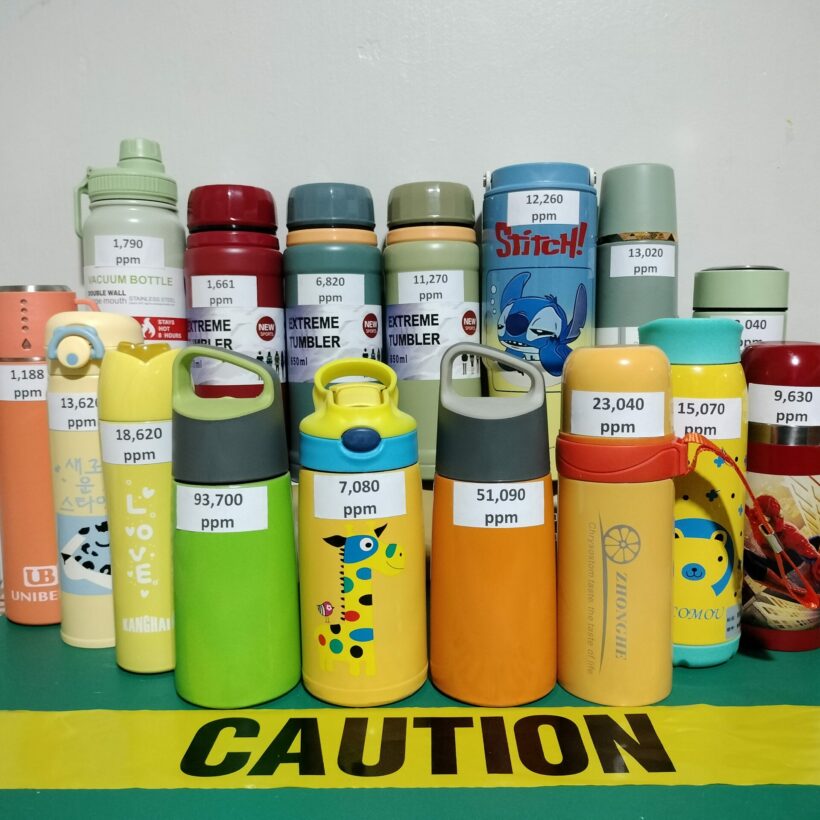
Sixteen of the 40 samples were found coated with lead-containing paints as determined with the aid of a portable X-Ray Fluorescence (XRF) analyzer. As defined in DENR A.O. 2013-24, lead paints are paints or other similar surface coatings containing lead in excess of 90 ppm.
Of these 16 lead painted tumblers, nine were analyzed to contain lead ranging from 11,270 ppm to 93,700 ppm. The rest had 1,188 ppm to 9,630 ppm of lead.
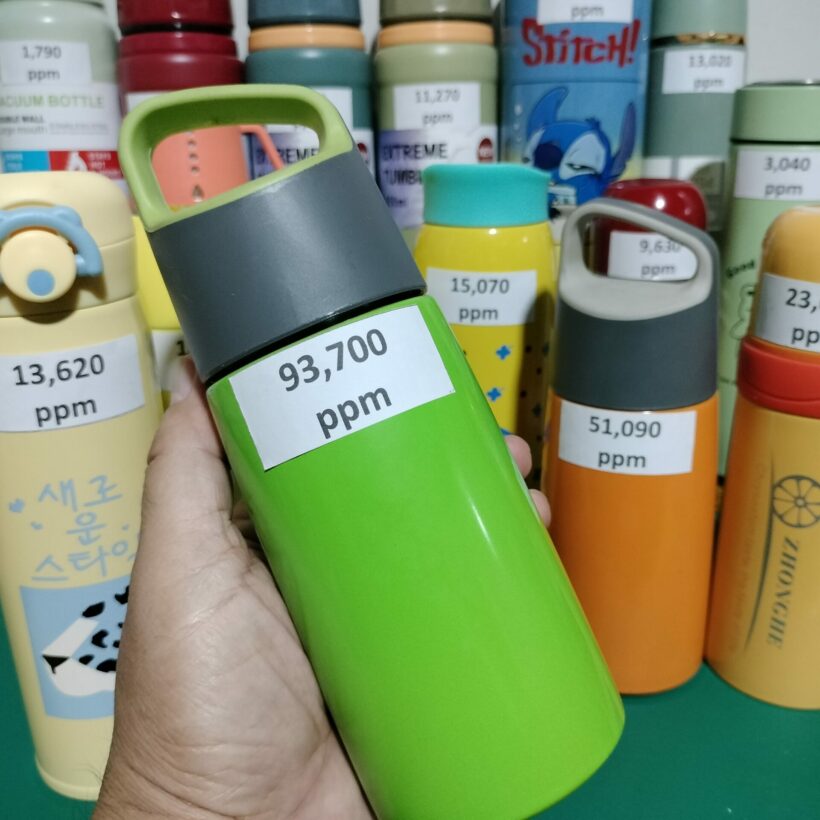
This green paint on the exterior part of this stainless steel tumbler contains 93,700 ppm of lead, way above the maximum limit of 90 ppm.
These tumblers may later pose lead exposure risks as the lead-containing paint will wear out and chip over time with frequent use. Children who are not aware of the risks are exposed to lead when they handle or ingest peeling paint chips and dust containing lead.
The non-detection of lead on the exterior coatings of 24 other tumblers provides concrete proof that such products can be decorated with lead-safe paints, which will not pose lead exposure risks to users.
To protect children’s health, the EcoWaste Coalition called on the government to order an immediate withdrawal from the market of non-compliant lead painted tumblers.
The group also urged product importers and distributors to require certificates of analysis and conformity to the 90 ppm lead in paint limit from their suppliers, as well as mandatory “lead-safe” labeling information to assist consumers in making informed choices about the tumblers they buy.
The group further urged government regulators to draw up the required safety standards for stainless steel water tumblers to prevent the dumping of substandard products, which are often sourced from foreign manufacturers such as those based in China.
The group insisted that only tumblers that have passed third-party material, insulation, temperature retention, corrosion resistance, leak-proof and durability tests should be permitted to enter the domestic market.
Aside from ensuring that tumblers sold locally are safe for lead in paint and solder, the group pointed to the need to guarantee that other materials used on the tumbler are safe from harmful substances through the use of food-grade stainless steel, and by ensuring that non-steel components are safe from bisphenol A, an endocrine disrupting chemical (EDC) like lead.
As stated by the Partnership for a Lead-Free Future: “Children are exceptionally vulnerable to the harmful effects of lead poisoning, as their rapidly developing brains and bodies absorb lead at rates four to five times higher than adults. Even the lowest levels of lead in the bloodstream can cause irreversible damage. Lead exposure can cause serious health consequences, including neurological damage, reduced IQ, attention deficits, and behavioral problems. Even low blood lead levels have been linked to cognitive decline in children.”
According to the World Health Organization (WHO), “there is no level of exposure to lead that is known to be without harmful effects.”
https://chemical.emb.gov.ph/wp-content/uploads/2017/03/DAO-2013-24-CCO-Lead.pdf
https://www.who.int/news-room/fact-sheets/detail/lead-poisoning-and-health
Health Impacts | Partnership for a lead-free future