

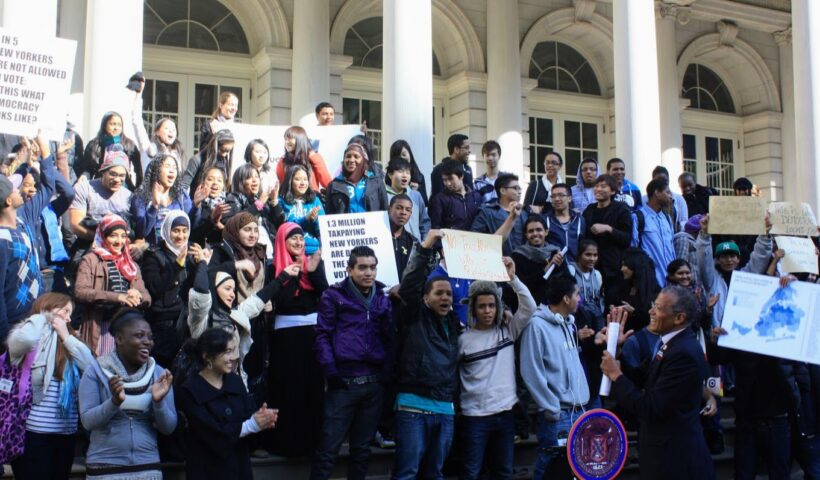
I’ve been working on what we commonly call “diversity” in cultural terms for decades. I co-founded the Diversity Center of Queens and published DiverCity newspaper and magazine in Jackson Heights—widely recognized as one of the most diverse neighborhoods in the United States.
At the same time, as a humanist, I’ve been deeply influenced by Silo’s teachings, particularly his concept of consciousness as a “space of representation”—the internal mental space where we construct meaning, interpret reality, and build our sense of self and others. Yet, until recently, I had never made a dynamic connection between cultural diversity and the structure of consciousness.
A few days ago, after my wife Yolanda was interviewed by ABC Latino about her ceremonial work at the Hudson Valley Park of Study and Reflection, she suggested I reach out to Enrique Roberto Lunski, the host of the show. While browsing ABC Latino’s website, I stumbled upon this YouTube episode (in Spanish): Reflections on the Importance of Diversity as an Attribute of Growth in Human Consciousness.
Only a few minutes into Roberto’s reflection, I was struck by a profound yet simple insight: diversity is a tool to expand consciousness. That idea opened a whole new space in me. It reshaped how I viewed my own experiences and many of the projects I’ve been part of over the years. It allowed me to re-see my personal and collective journey through a new lens—one where diversity is not just a social or political objective, but a transformative internal force.
It also helped me better understand the current backlash against DEI (Diversity, Equity, and Inclusion) policies, especially under Trump’s administration. This resistance isn’t merely about fear, discrimination, or political control—it’s about blocking consciousness itself. It’s about suppressing the natural expansion of human understanding and connection. That, historically, is what fascism has always attempted: to halt the evolution of consciousness by suppressing diversity—whether religious, racial, sexual, gender-based, or even economic.
Diversity: The Ultimate Weapon of Human Development
Consider a few recent historical examples where diversity has been used to expand consciousness and open up new possibilities:
- Japan, during its postwar reconstruction, sent delegations around the world to observe, learn, and bring back knowledge—sparking an economic and technological revolution.
- China, after centuries of poverty, invested in sending millions of young people abroad to study. Many returned to help build one of the most dynamic economies on Earth.
- LGBTQ+ communities, once marginalized, emerged from invisibility and helped transform societies by introducing new expressions of love, identity, and solidarity.
A recent interview with Princeton professor Agustín Fuentes, author of Sex is a Spectrum: The Biological Limits of the Binary, adds further weight to this perspective. He challenges rigid notions of biology, stating, “Saying that human beings are binary is a failure. It’s not biology. It’s philosophy.” Read the article.
Throughout history, human development has advanced by acknowledging and integrating difference—of thought, form, culture, language, and expression. What we call “diversity” has never been merely a matter of external variety—it has always been a source of internal renewal and transformation.
In Silo’s humanist framework, consciousness is not passive—it is intentional and dynamic, always moving toward meaning-making. Our representations are not fixed; they can evolve, deepen, and expand. Diversity, in this context, becomes essential fuel for consciousness. It stretches us beyond the limits we have inherited. It introduces new meanings, new ways of feeling, and new possible futures. Seen this way, diversity is not about political correctness—it is an evolutionary necessity.
So how do we shift direction? How do we open the future of humanity?
We begin by recognizing that diversity is not an external accessory—not a folkloric dish, a colorful garment, or a checkbox in a strategic plan. It is a conscious choice. A way of approaching life that values complexity, embraces ambiguity, and refuses to reduce the human being to narrow identities. Diversity requires us to rework our own representations, to break the automatisms of perception, and to actively choose understanding over fear. It is the path of intentional transformation—the kind of process that leads not just to better societies, but to more complete human beings.
In a world so fractured by division and dehumanization, embracing diversity in this deeper way becomes one of the most radical, healing, and necessary acts of our time.



