

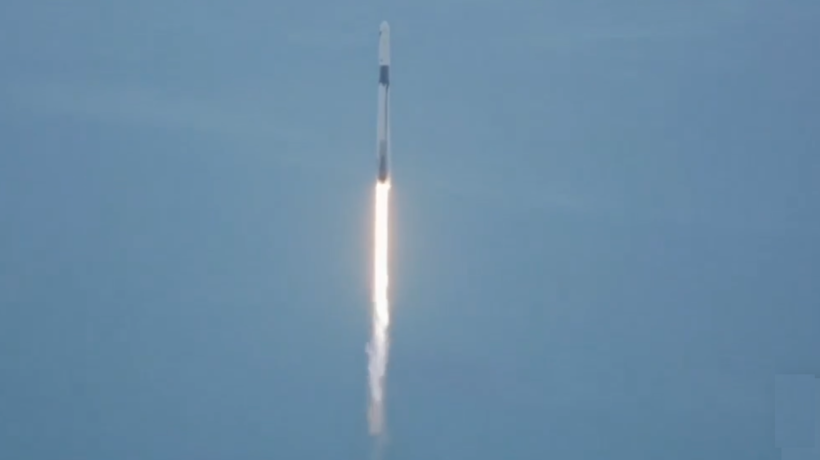
The sky opened not only over Florida. It opened over my chest.
I saw it live, on the screen, but with the intensity of someone witnessing more than a launch: a reaffirmation of what we are still capable of doing with beauty, precision, and meaning. I was left speechless watching the flawless return of the Falcon 9 first stage, as if gravity itself bowed before human genius. And when I saw the image from inside the service module, with Earth in the background—small, intact, blue—I understood that there are moments when the soul kneels, unseen by anyone.
The Crew-11 mission, launched on August 1, 2025, at 12:09 PM (ET) from the Kennedy Space Center, marks the eleventh crewed flight under the NASA-SpaceX Commercial Crew Program. The Dragon Endeavour capsule, mounted on a reused Falcon 9 rocket, carries four astronauts to the International Space Station: Zena Cardman and Mike Fincke (NASA), Kimiya Yui (JAXA), and Oleg Platonov (Roscosmos). They do not only embody the technical excellence of their respective agencies. Together, they represent the persistent possibility of cooperation among nations, even in times of geopolitical tension.
But what truly moved me—there is no other way to say it—was seeing the Russian cosmonaut smiling, filled with genuine joy, floating beside his crewmates. In that moment, I understood that science, when not captured by petty interests or dragged down by flags, can be a sublime form of redemption.
The launch had been rescheduled from the day before due to bad weather. It was followed live by thousands of people on NASA and SpaceX’s official channels and coincided symbolically with the countdown toward the 25th anniversary of continuous human presence on the ISS, which will officially be marked on November 2, 2025. Crew‑11 will replace Crew‑10 aboard the station, with a planned stay of at least six months, possibly extending to eight depending on technical evaluations of the hardware.
The mission is not only carrying humans. It also carries experiments in cellular biology, artificial intelligence in orbit, climate observation from the stratosphere, and adaptive materials for future lunar missions. But none of that alone explains what it felt like to hear the voices of the four astronauts sending their greeting from Earth’s orbit. No interference. No noise. Just a human voice—and another, and another—floating in space, speaking back to Earth.
The history of spaceflight is full of epic feats, propaganda, and tragedies. But also of shared silences, like the one you feel when, in front of a screen, you see a module floating toward docking, with Earth slowly rotating behind it. There are no borders there. No markets. No ideology.
Only humanity.
When I saw the vertical return of the first stage, it felt like a slow-motion poem. When I saw the planet’s glow from the service module, I understood that technology can be a form of contemplation. When I saw Platonov’s expression—and couldn’t help imagining what he must be feeling—I knew we were witnessing a form of redemption.
Science, in its purest form, is not neutral: it is profoundly ethical. It compels us to collaborate, to be rigorous, to think in terms of the common good. What I witnessed today, and what millions saw with me, was not just the success of a mission. It was the demonstration that we are still capable of rising—literally and symbolically—above the wreckage we’ve left on Earth.
I don’t have words to describe the serenity left in me by that image of Earth from space. But I do have certainty: this launch wasn’t just an astronautical event. For those of us who saw and felt it, it was a reminder of the path we could still take as a species.
If we ever dare to look to the future with hope again, it will be because we learned to look at Earth from afar… and didn’t like seeing it broken.
August 1, 2025



