

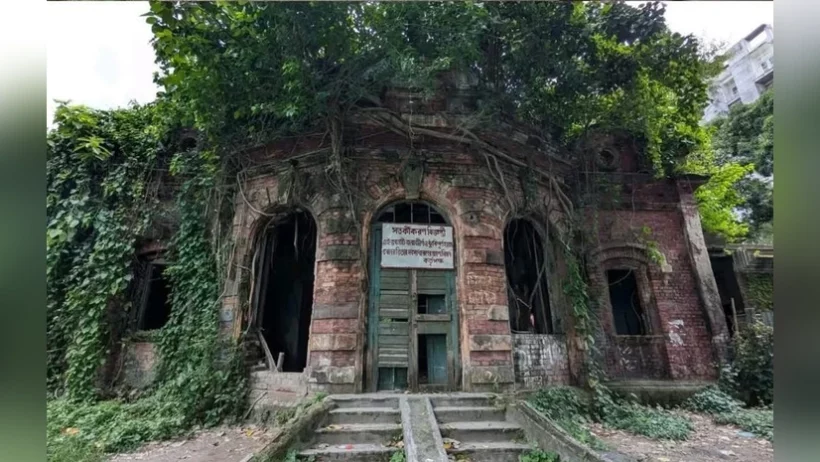
Amid confusion and controversy surrounding its historical significance, Bangladesh halted the demolition of a century-old house next to “Shashi Lodge” in Mymensingh (in the first lane of the “Hari-Kishore Ray Road”). Some claim the house belonged to the ancestors of legendary filmmaker Satyajit Ray, while others contend it was the temporary residence of Tangail philanthropist Ranada Prasad Saha.
The legendary Ray family was a part of a lineage that changed Bengali literature forever.
Satyajit Ray’s grandfather, Upendra-Kishore Ray Chowdhury (1863–1915), was a trailblazer in the fields of children’s books, illustration, and printing. His fanciful tales and artistic talent have made his books, such as Tuntunir Boi (1911) and Goopy Gyne Bagha Byne (1915), which Satyajit later adapted to the screen in 1969, beloved to this day. Sandesh, a children’s magazine that was equally entertaining and educational, was also launched by Upendra-Kishore. Additionally, his innovations in half-tone printing made books more accessible to all, particularly the younger generation, by bringing stories to life in a new visual language.
This artistic passion was passed down to Satyajit’s father, Sukumar Ray (1887–1923). He created a new kind of whimsical, beautiful, nonsense poetry with works like Abol Tabol (1923), which is still read to kids today. Many Bengali households have characters like Kath Buro and Kumro Potash in their lexicon. Sukumar was also involved with the Brahmo Samaj, a reformist organization that advocated for societal advancement and logical thought.
Calcutta was the birthplace of Satyajit Ray (1921–1992), the most famous of the Ray family. Although he is better recognized outside of Bengal for his filmmaking, he continued his family’s literary tradition. Days before he died, in 1992, he received an Oscar for Lifetime Achievement for his critically praised career.
Confusion erupted when two leading Bangladesh newspapers- ‘The Daily Star’ and ‘Prothom Alo’ reported with the headline ‘Satyajit Ray’s ancestral home being demolished’, resulting statements from the chief minister of West Bengal and representatives of the Indian government, raising concern over the building’s reported link to Satyajit Ray, who is loved by all on both sides of the border.
However, historical records indicate that- century ago in Mymensingh, there was a wealthy man named ‘Hari-Kishore Ray’. After his name, a road was named ‘Hari-Kishore Ray Road’. ‘Hari-Kishore Ray’ adopted his friend Kalinath Dev’s son ‘Kamda-Ranjan Dev’ and renamed him as ‘Upendra-Kishore Ray’ (Satyajit Ray’s grandfather).
‘Hari-Kishore Ray’ had a house in the ‘Hari-Kishore Ray Road’ where both his biological son ‘Narendra-Kishore Ray’ and adopted son ‘Upendra-Kishore Ray’ (Satyajit Ray’s grandfather) grew up. ‘Hari-Kishore Ray’ distributed all his belongings equally to his two sons. Thus, ‘Upendra-Kishore Ray’ got the house’s ownership, and later he renamed the house as ‘Purno-laksmi Vaban’ (after his wife’s name).
In 1879, ‘Upendra-Kishore Ray’ went to Kolkata (India) to study and later shifted there permanently with his family. In 1948, ‘Narendra-Kishore Ray’ sold the house. The founder of ‘Muminunnesa College’, Durlov Khan’s son bought the house and after some construction renamed it as, ‘Durlav-Dalia Tower’, which is presently situated in the 3rd lane of the ‘Hari-Kishore Ray Road’.
The Satyajit Rays were never connected to the century-old structure in the first lane of “Hari-Kishore Ray Road,” which the Bangladeshi government partially dismantled. A local landlord named “Maharaja Shashi-kanto Acharya” had initially built this structure in the late 18th century, and gifted to ‘Ranada-Prasad Saha’. From 1965 to 1971, Ranada-Prashad’s manager used it as his residence. After he died in 1972, govt. acquired it as entrusted property and later allotted in favor of ‘Bangladesh Shishu Academy’.
Archival records and statements from cultural historians have confirmed the case. Archaeological researcher Swapan Dhar has asserted that the house, which has already been mostly demolished, is connected to Ranada, not the Ray family.
He explained, “In 2016-17, the German government funded a research and exhibition project named ‘Mymensingh Urban Heritage Management Plan”. Under this project, 320 historic homes were studied and identified in collaboration with French archaeologist Rumen Larcher. “The house in question was classified as a second-tier heritage site under an urban preservation plan, and no one had the right to demolish it”.
Even though the house being demolished in Mymensingh did not belong to the Rays, international observers and cultural activists denounced the destruction of any heritage monument. Without a question, the Bangladesh Department of Archaeology needs to use greater caution when it comes to protecting historical places.
Besides this, print, electronic, and social communication media must also ensure responsible roles of not spreading false or unverified news, which can seriously damage a country’s image.
Dr. Mohammad AsaduzzamanProfessor, Department of Linguistics, University of Dhaka and Director General International Mother Language Institute



