

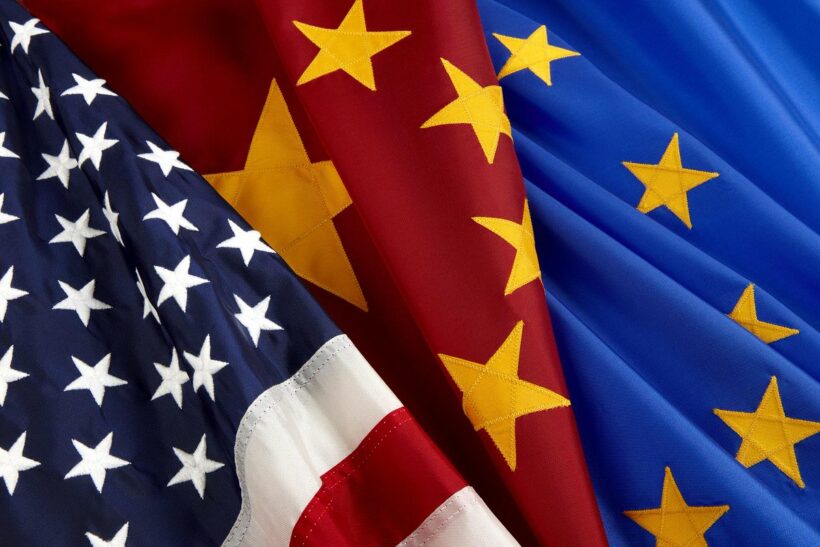
Are we seeing the situation clearly? In recent days, the United States, the European Union, and China have signed a series of agreements and imposed new tariffs. As analysts scramble to determine who the winners and losers are, we risk missing the larger picture.
First, let’s acknowledge one crucial fact: these accords were achieved without the use of force. In a time when conflict is often used as leverage, the fact that these global powers reached agreements through negotiation—not war—is significant. Collectively, the US, EU, and China account for roughly half of the global economy. Everyone else, directly or indirectly, depends on their cooperation to keep the global engine running.
Second, while these blocs differ profoundly in history, culture, and politics, they operate within a single economic system. The US, with its dominant financial and corporate infrastructure, has long shaped global economic narratives. The European Union evolved from the 1957 European Economic Community, which sought to create a common market by eliminating internal trade barriers. China’s 2001 entry into the World Trade Organization marked a major step toward global integration.
Over the past 20 years, the transformations have been massive. China’s economic rise was fueled in large part by U.S. corporate investment—Apple alone likely invested over $600 billion between 2005 and 2025. Multiply that by thousands of companies, and you begin to grasp the scale of interdependence. Today, China is replicating a similar investment-driven model across Africa and South America, while Europe appears to be losing influence in the Global South.
We can’t judge these events as a snapshot—we have to see the full motion picture. These are not isolated events, but part of a monumental process of transformation, setting the stage for a new global era. The world is more interconnected than ever.
The old model of bombing or bullying one’s way to dominance has clearly reached a dead end. Our survival depends not on dominance or nostalgia but on the capacity to negotiate, adapt, and evolve.
Personally, I don’t care whether Europe conceded more than the US or whether China played its cards more skillfully. What matters is whether the system itself works— whether it enables us to move forward instead of freezing in fear or clinging to ideological rigidity The pace of change is accelerating, and adaptation is not optional. What matters now is functionality: Is it working? And if not—what can we do to make it work?
That question extends beyond geopolitics. It applies to our everyday lives: Are your relationships healthy? Is your workplace growing or stagnating? Are your communities resilient? Everything is energy—and energy needs to circulate. When it becomes blocked, systems decay. People grow isolated, societies become unstable, and conflict erupts. Yet too much unregulated energy—without coherence or purpose—leads to floods, short circuits, and chaos.
In the end, our challenge is not about choosing sides—it’s about learning to move with the current without being swept away. It’s about finding coherence within flux. If we can manage that, then maybe the real winners of this game will be all of us.



