

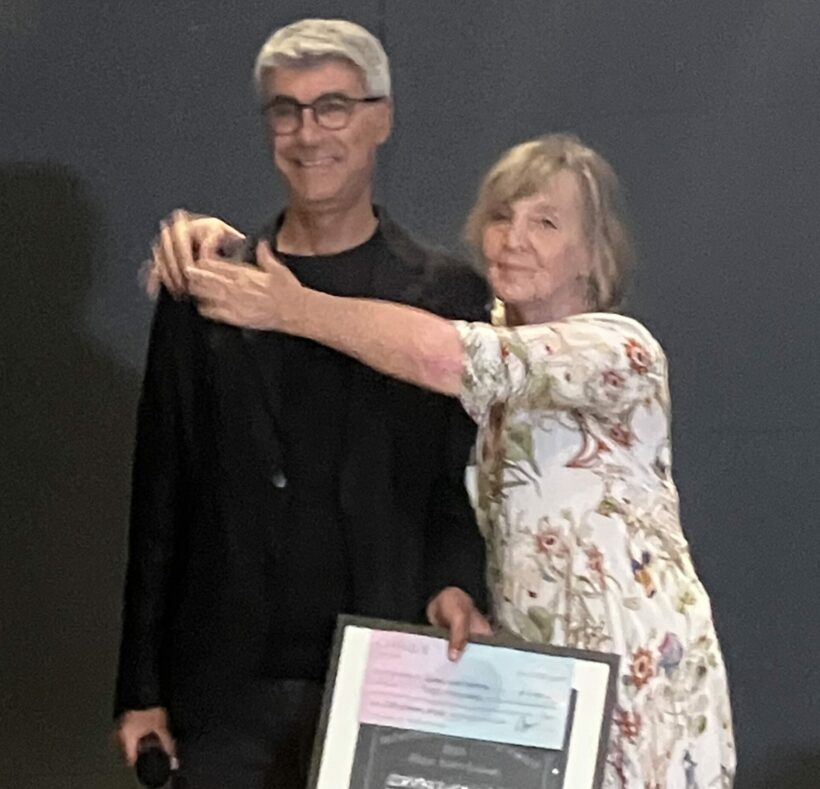
Ilhan Sami Çomak, the Kurdish poet, was recently honored with the Jack Hirschman Poetry Prize, presented by the Poets of Planet Network. This recognition not only celebrates the life and legacy of the renowned American poet Jack Hirschman but also uplifts the poetic and human values he championed—social justice, international solidarity, and peace.
Ilhan, who was imprisoned for thirty years, three months, and eight days under charges deemed illegal by the European Court of Human Rights, finally gained his freedom on November 26, 2024. During his incarceration, he published eight books of poetry and received several literary accolades. However, this was the first time he was able to attend an award ceremony in person.
Jack Hirschman, an American poet and translator, passed away in 2021, leaving behind a towering legacy of over one hundred books of poetry and a lifelong commitment to activism, peace, and justice.
At the ceremony on June 26, Ilhan received the prize from Agneta Falk, Jack Hirschman’s wife and a poet herself. The other two finalists for the award were Tishani Doshi and Warsan Shire.
You can read more about the finalists here. Below is Ilhan Çomak’s acceptance speech, delivered during the ceremony.
Dear Friends, Honored Guests,
We all know that at the heart of our lives lies a web of dreams, woven from values, unfulfilled desires, and the relentless effort to meet inherited expectations—a continuous struggle to prove our worth. For many, the pursuit of happiness ends in defeat before it ever truly begins.
And yet, we fall—and we rise again.
The world offers few certainties—and no god we can truly rely on. In the end, everything begins and ends with us, human beings. It is also within us that the effort to gently uphold the values threatened by power—its long, dark hand, both cold and burning—finds its final test.
They offer us a world stripped of distinction. They try to convince us that truth and better days are nothing but distant echoes of an impossible past. But we know—through a legacy passed down with great hardship, unrelenting pain, and resistance—that there are immutable values born of truth, of reality, and without doubt, of imagination. We, the great majority, have drawn a line—by thinking, by insisting on remembering in the face of enforced forgetting, and by defending values rooted in human dignity. We have voiced again and again that we stand with the truth, and in doing so, we have taken a stand against the powerful.
This line signifies an awareness of the spread of evil—consciously shaped by powers that exploit the hesitation in the human soul. It reveals the visibility and audibility of that evil—always ready to raise its hand and speak—and points toward the necessity of gaining the awareness to choose equality, happiness, and the beauty that dreams can offer.
Dear Friends,
It is through poetry that we can transcend the world’s cruelty. In my view, Jack Hirschman—with both his poetry and the life and activism that support his words— stands as a clear, unmistakable, and undeniable expression of this idea. His poetry and life have long been a steadfast refuge for the humble, the oppressed, and the wronged—yet, above all, a fearless voice rising against the towering powers and rigid hierarchies that endlessly warp the essence of life, society, and the very freedoms of the individual. Therefore, it would not be wrong to say that Hirschman’s creative force is as much rooted in confronting the evils of today as it is in imagining a beautiful, free future. Perhaps that’s why Jack Hirschman’s poetry refused to stay bound within books—it roamed the streets, crossed vast seas and oceans, and reached me in the dark, silent depths of my prison cell.
Though he was a true “people’s intellectual,” the voice he gave me also revealed his profound embrace of the mysterious depths within the human spirit.
Dear Friends,
It was the early days of the pandemic. Because of a campaign led by PEN Norway, I had started corresponding with many internationally known poets. The project itself radiated with vibrant energy. These poets illuminated my cell, carrying the world’s heartbeat and the flowing rhythm of unbounded time. Jack Hirschman was among the first to send a poem—offering his “Ladder.” I began to climb, with a renewed longing, upon the steps he gently lowered into the shadows of my cell.
I had, of course, heard of Jack Hirschman by name, but due to the harsh and restrictive nature of imprisonment, I had never had the opportunity to read his poetry. What a strange coincidence that the first poem I read by such a great poet was one written to me! I responded with a poem of my own. And Hirschman did something that still stirs my heart—he read my poem.
On this occasion, I would like to share with you a longing that has remained with me. I wish I could have responded to Hirschman with a poem written in my mother tongue, Kurdish. Sadly, under prison conditions, writing in Kurdish still poses a serious threat. And not only in prison—outside the prison walls, Kurds are still deprived of the opportunity to receive education or conduct official affairs in their native language.
Dear Friends,
At last, after 30 years, 3 months, and 8 days, my imprisonment came to an end, and today I am able to speak to you as a free poet. I’ve been honored with many awards during my incarceration, but this is the first time I am able to attend a ceremony in person. I have come out of a world I could never grow used to and returned to my loved ones, to the world I always dreamed of. I know life is not easy here either. And the struggles Jack Hirschman dedicated his entire life to confronting are still with us.
Yet, I am not without hope. Because truth, and even more so, the human search for justice, are more stubborn and more ancient than the darkness crafted by those in power. And still, my mind and my feelings are stirred each day—by the vastness of it all, by the diversity of human faces, the multiplicity of voices, the power of colors to enclose the senses. Everything still gives me the feeling of spring. Everything still feels light and fresh.
At the age of 21, I was imprisoned as an ordinary Kurdish young man. Now, in my early 50s, I have emerged as a poet known around the world. I am no longer as unarmed in the face of the regime of cruelty. If my voice was able to reach you despite the prison walls, it cannot be explained by talent alone. This must be the power of poetry—the declaration, again and again, of the value gifted to us by imagination, which defies barriers and never tires.
Poetry gave me the strength and the determination to understand myself, to resist, and to take my place—on the side of truth, of the oppressed, of those who amplify kindness. Poetry is truth. And it stands with truth. The power of poetry is sacred. How fortunate I am that this power accepted me. Now, being deemed worthy of this award is a deep honor. And it increases the weight of my responsibility.
I thank you all, with all my heart.
İlhan Sami Çomak
June 8th, Moda İstanbul



