

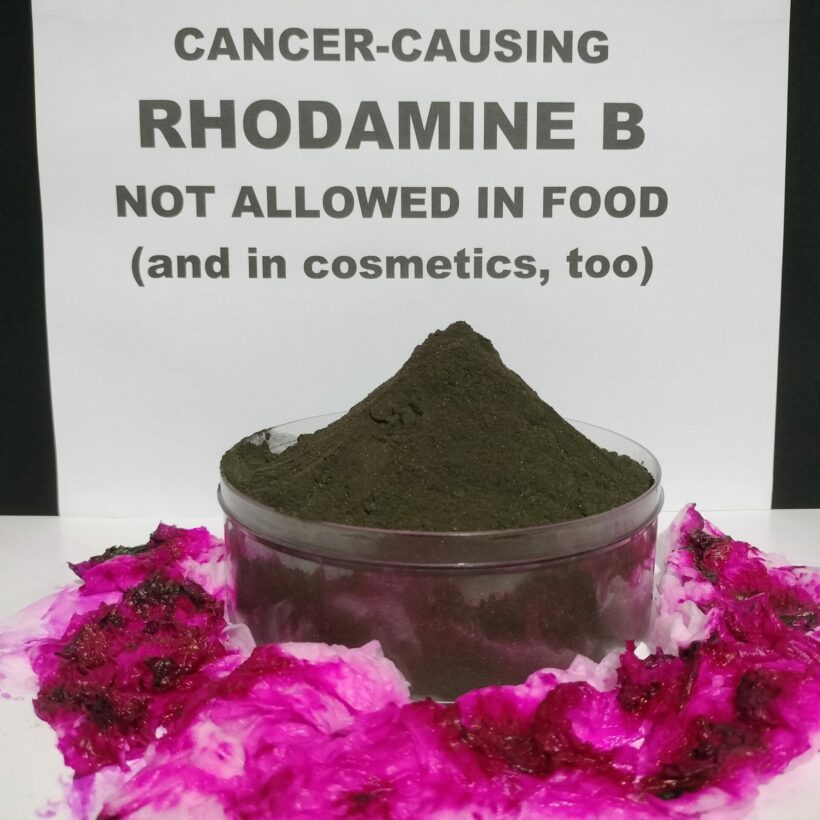
16 July 2025, Quezon City. The EcoWaste Coalition and the Consumer Rights to Safe Food (CRSF) appealed to the Food and Drug Administration (FDA) to expedite its investigation on Rhodamine B, a non-permissible and carcinogenic food colorant, used to give fermented shrimp paste or “bagoong alamang” a brilliant pink color.
In a press statement, the groups urged the FDA Center for Food Regulation and Research (CFRR) to hasten the ongoing probe to uphold the consumer right to safe “bagoong alamang,” a popular Filipino condiment from North to South.
The groups’ appeal for expedited action came on the heels of a food coloring scandal in Tianshui City, China after the kitchen staff of a kindergarten school used lead paint pigments to color steamed red date cakes and sausage corn buns, resulting in abnormal blood lead levels in 233 children. “Exposure to even small amounts of lead can cause long-term damage to children’s developing bodies and brains,” UNICEF said in reaction to the lead poisoning incident.
“Some bagoong makers may not be aware of the prohibition against the use of non-food synthetic colorants such as Rhodamine B and its ill effects to human health,” said Aileen Lucero, National Coordinator, EcoWaste Coalition, noting that the well-liked condiment is often made by micro-, small- and medium- enterprises. “We therefore appeal to the FDA to speed up the ongoing probe and act on our other recommendations to ensure consumer health and safety.”
“The issue of Rhodamine B found in a very common food as ‘bagoong alamang’ that was brought to the FDA’s attention three months ago is an urgent matter of public concern. To prevent the banned coloring dye in food from taking its heavy toll on hapless and unwitting citizens, we join the call for an expedited probe so corrective measures can be immediately carried out,” said Rene Pineda, President, CRSF.
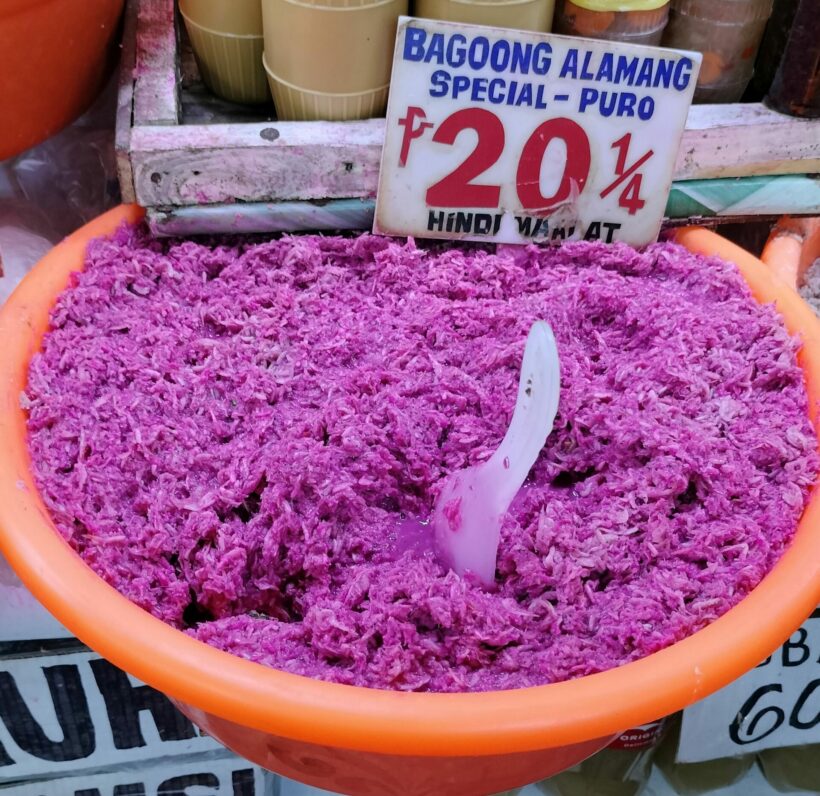
On April 14, 2025, the EcoWaste Coalition reported to the FDA the results of laboratory tests it commissioned on five samples of “bagoong alamang” procured from market vendors selling it in “takal” or “tingi” and from an online seller. The agency’s e-Report team then referred it to the CFRR on April 28 for action. The CFRR’s Food Safety and Quality Division (FSQD) acknowledged receiving the report on May 5, expressing “this office highly appreciates your concern, and would like to thank you for bringing this matter to our attention.” Following the submission of additional information, the FSQD on May 28 assured the EcoWaste Coalition that it is “actively investigating the matter to verify the presence of non-permissible food color Rhodamine B” on the analyzed “bagoong” samples.
According to the test reports forwarded to the FDA, Rhodamine B ranging from 1.7825 mg/kg to 4.285 mg/kg was detected on the analyzed products. As a non-permissible food colorant often used for dyeing leather, textile and paper, Rhodamine B should not be present in processed and unprocessed foods.
One product, a subject of FDA Advisory No. 2025-0114 for being adulterated with Rhodamine B and for not being registered, contained 4.285 mg/kg of the non-food colorant.
According to the said advisory, “Rhodamine B is a synthetic dye and is prohibited in food since it is carcinogenic. Possible side effects of exposure are infections of the eyes, skin, gastrointestinal tract, and respiratory tract.”
To address this public health threat, the EcoWaste Coalition listed the following recommendations in their letter to the FDA last April 14:
- Issue an advisory reiterating the ban on Rhodamine B as a food colorant and the rationale behind the ban, including the health effects of consuming food with Rhodamine B and other non-permissible colors. To deter violators, it would be necessary to specify the fines and penalties for violations.2. Conduct an expanded sampling of “bagoong” for Rhodamine B, including samples from sellers in other public and private markets in Metro Manila and other regional hubs, as well as from online retailers.3. Launch a public information drive targeting market vendors and micro-, small- and medium- enterprises making “bagoong.”
4. Coordinate with the management of online shopping sites for the removal of Rhodamine B-containing food products in their platforms.
“We look forward to the results of the investigation being conducted by the FDA and the steps it will take to enforce the ban on hazardous food colorants in line with its commitment to safeguard public health,” the EcoWaste Coalition and the CRSF said.
Reference:
https://www.fda.gov.ph/fda-advisory-no-2025-0114-public-health-warning-on-the-presence-of-rhodamine-b-in-unregistered-food-products/
https://www.unicef.org/china/en/press-releases/unicef-statement-reported-lead-poisoning-among-children



