

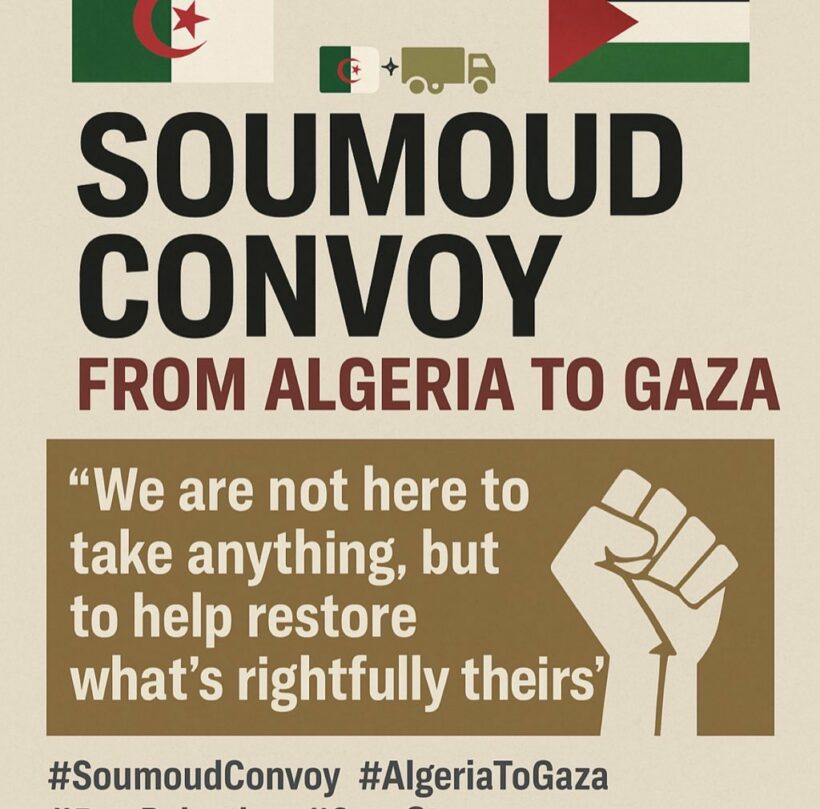
At the break of dawn on June 19th, the Soumoud Convoy crossed the border back into Tunisia from Libya. It was more than just a return—it was a homecoming charged with revolutionary spirit. The convoy, the last remaining pillar of the Global March to Gaza’s overland attempt, had carried its defiant message across borders: end the siege, stop the genocide, and stand unwavering with Palestine.
We drove through the night to reach Ras Jedir by dawn, just as the buses began to make their way through the border crossing. The spirit of the convoy was unmistakable—a powerful blend of electrifying determination and quiet relief. Though they had not reached Rafah, the mission pulsed on, alive in every step and every face. There was a deep sense of purpose still charging the air, intertwined with the undeniable relief of having made it back safely after being detained in Libya.
As the convoy wound its way north through the heart of Tunisia, we rode alongside them, bearing witness to an operation as meticulously planned as it was passionately carried out. This wasn’t a mere group of activists—it was a disciplined, intersectional force. Teams worked in harmony: logistics, medical, media—all flowing with a precision rarely seen in grassroots efforts. Supervisors calmly coordinated across the convoy, keeping pace with the rhythm of a movement that knows its purpose.
In Ben Gardane, the convoy stopped for breakfast, and the town’s response was anything but ordinary. The streets overflowed. Families, elders, youth—they lined the roads, clapping, chanting, celebrating. These weren’t just spectators—they were co-strugglers, affirming their stake in the liberation of Gaza.
By the time the convoy reached Sfax, it was clear: this was a national event. A full parade welcomed the buses. Traditional drummers, musicians, and speakers electrified the streets. You could feel it—the shared heartbeat of a people saying, without hesitation: “Palestine will be free. “They weren’t cheering a performance; they were saluting a moral force.
As the convoy moved through Sousse and on to Tunis, the energy never waned. At every stop, the same chant, the same fire. This wasn’t just support—it was alignment. North Africa is not a bystander in this struggle—it is a living, breathing front line of international solidarity. The next morning, June 20th, the Soumoud Convoy held a press conference in Tunis—not as a victory lap, but as a battle cry. The mission, they said, is not over. It is regrouping. It is growing stronger. In exceptional attendance was UN Special Rapporteur Francesca Albanese, whose presence alone spoke volumes. She told the gathered crowd: “I wish you to be well and to besafe, because you are taking on a responsibility that shouldn’t be yours. “Her words were a sobering reminder of what this moment demands of us: not just courage, but unity.
Global March to Gaza participants from across the world, along with representatives from the Freedom Flotilla Coalition, have now arrived in Tunis. Rafah may still be closed, but this city has become a temporary capital of resistance. Over the coming days, the international delegation—about 75 strong—will hold crucial meetings and workshops, reflecting, regrouping, and re-strategizing.
We are learning from the Soumoud Convoy. From their discipline. From their community-based approach. From their political clarity.
In the shadows of escalating war and international silence, we are reminded: Gaza is still being bombed. Children are still dying. And the world, by and large, is still looking away. But here, among these buses, these people, and this movement, the fire is still burning.
We are not done.
We are reorganizing.
And we are coming back.
Palestine is not alone. And never will be.
Cecilia Canazza is an Italian writer and activist currently based in Tunis. She previously worked in international communications within large-scale sporting events before shifting her focus to humanitarian and decolonial causes. Her work now centers on the interconnectedness of human rights, environmental justice, and liberation struggles—particularly in Palestine. Cecilia works in Italian and English, and brings an interdisciplinary lens to her writing and advocacy.



