

(Moscow Bureau) – Unbelievably, Russia is no longer at the geopolitical and economic crossroads. Kazan, the famous city in the autonomous Republic of Tatarstan, and St. Petersburg, known as the second largest city in the Russian Federation, for the past few years, have become the most frequently visited by foreign guests, elite politicians, academic scholars and corporate entrepreneurs. Kazan and St. Petersburg are described as transformative platforms for driving business growth and investment in Russia. In practical terms, Russia is no longer at the crossroads, but it has noticeably been evolving into a strategic economic landscape, where unprecedented potential foreign visitors, majority originating from Africa, Asia and Pacific regions. While those from the United States have seemingly disappeared, few European business executives are not prominently seen, playing active focus roles with traditional aspects of business proposals.
St. Petersburg was booming in early April 2026. It attracted entrepreneurs, investors, policymakers and industry leaders with keen interests in transport and logistics, which organizers say the April 2026 edition provided a platform for networking, deal-making, and discussions on emerging opportunities across key sectors in the changing global economy. Discussions at the plenary sessions, outline diverse geographical regions where huge deficits in transport facilities and the need for upgrading logistics, further highlighted strategies for expanding access to finance and capital, as well as supporting medium and large-scale enterprises.
With participation from wide geographical regions, foreign and Russian stakeholders experienced a unique scale of entrepreneurial community, increasingly exhibited quality-approach in their presentations, fostering understanding of transport innovations, shifting investment and possibility for economic growth.
Forum Participants include Unfriendly Countries
“The MTLF has become a platform for open international dialogue amid the current challenges facing the global transport industry. The first Forum brings together over 6,000 participants from 82 countries, including 14 unfriendly countries: Belgium, Great Britain, Germany, Italy, Latvia, Poland, the Republic of Cyprus, the Republic of Korea, the United States, Finland, Switzerland, Estonia, and Japan. Russia strives to build an equal and constructive dialogue with members of the international community and continues to generate significant interest from the global business community,” said Anton Kobyakov, Advisor to the President of the Russian Federation and Executive Secretary of the MTLF Organizing Committee.
In promoting comprehensive cooperation in diverse spheres, Minister of Energy and Infrastructure of the United Arab Emirates, Suhail Mohammed Al Mazrouei, spoke of his country’s decision to invest significant money in the development of its railway infrastructure, with work already underway to connect to Oman by rail and open up new opportunities for freight transportation to Africa and Asia.
“We continue to invest in the development of our country’s logistics network and alternative routes. Russia is an important exporter of raw materials, and development in its regions will contribute to economic growth across the globe. Central Asia is also emerging as a key player, and we are investing in the region’s infrastructure and connecting China to the global economy through Russia and the Middle East,” he said.
Minister Delegate for Maritime Economy of the Ministry of Maritime Economy, Fisheries, and Coastal Protection of the Togolese Republic, Kokou Edem Tengue, spoke of the importance of understanding the African perspective on changing maritime routes as the situation around the Suez Canal and the Strait of Hormuz creates new opportunities for West Africa.
The Port of Lomé, the largest container port in Sub-Saharan Africa, handles approximately 30 million tonnes of goods annually, and its importance for the region is difficult to overstate. “We are actively working with Mali, Burkina Faso, and Niger, the Port of Lomé is a key logistics hub for the landlocked nations of the Sahel,” he said. “It should be noted that Africa relies on chemical fertilizers and grain produced in Russia. We believe that the Port of Lomé could be a part of new sea routes between Africa and Russia.”
Brazil and Russia Within BRICS+ Framework
Within the framework of the discussions, Russia and Brazil reviewed a new stage of transport and logistics cooperation, and adopted joint approaches to the development of legislation of unmanned and digital technologies. The Russian–Brazilian Commission on Cooperation emphasized the growing interest of the Brazilian side in Russia’s experience in maritime transport, digitalization, aviation, railways, and unmanned technologies. “Russian legislation in this area is among the most advanced in the world. We understand Brazilian colleagues are actively developing interest in this area. We are ready to share our developments to integrate our legislation into the BRICS framework so that it becomes consistent,” Minister of Transport of the Russian Federation, Andrei Nikitin, said at the meeting.
Russia is a global leader in unmanned technologies and is eager to share its experience with its Brazilian counterparts, particularly in launching and operating drones for agriculture, driverless trains, trucks, taxis, and delivery rovers. Russian legislation, in this area, is among the most advanced in the world. The Minister noted that cooperation in the maritime sector is already picking up pace, with shipments reaching 16 million tonnes last year. One potential new project is the launch of a direct container service between St. Petersburg and Brazilian ports, which will make it possible to transport additional freight volumes within convenient timeframes. An important issue for the Russian maritime industry is the recognition of insurance documents issued by Russian insurers and reinsurers and the creation of protection and indemnity clubs, including within BRICS.
Brazil is interested in studying Russia’s experience in high-speed railway construction, especially given the unique climatic conditions in which the project is being implemented in Russia. Resuming air travel between the two countries continues to be an important step. One possibility that is being discussed is having Brazilian airlines operate flights, with the necessary facilities for access to Russian airports and transit services.
Further, the BRICS Extended Advisory Council on Civil Aviation is seriously considering cooperation in the export of transport infrastructure technologies, the exchange of existing know-how, and transport education. Russian transport universities are ready to participate in training personnel for the implementation of joint projects.
Andrei Nikitin also held working meetings with representatives of Brazilian transport agencies. Following the talks, the Russian side presented a draft transport cooperation plan, which will consolidate the agreements reached and outline practical steps for their implementation.
Russian University of Transport to Play Leading Role
Minister of Transport of the Russian Federation, Andrey Nikitin; Minister of Science and Higher Education of the Russian Federation, Valery Falkov; and Minister of Industry and Trade of the Russian Federation, Anton Alikhanov, tabled a motion for engineering and transport education in Russia, to become a platform for scientific and engineering teams, scientists, and students from around the world who are working on cutting-edge solutions for the transport sector.
In his speech, Falkov spoke about the development of a network of advanced engineering schools. Fifty of these schools have already opened their doors, and another 50 will do so by 2030. “Numerous schools serve the needs of the transport industry. A prime example is the school opened by Transmashholding and Russian Railways at Emperor Alexander I St. Petersburg State Transport University,” the Minister explained.
According to Falkov, leading engineering schools serve as talent magnets, platforms for experimentation, and the ultimate hub for interaction between universities and employers. They create unique conditions for the development of innovative projects, allowing students to bring their ideas to life almost immediately.
Another key programme mentioned by Falkov is Priority 2030, in which the Russian University of Transport plays a leading role. The programme helps universities strengthen their positions in a competitive environment and provides additional resources for implementing unique scientific and educational projects. In order to ensure the global competitiveness of Russia’s transport corridors, implementing decrees as part of Russia’s national goals up to 2030 and for the period up to 2036.
New mobility technologies are turning into the main driver of the restructuring of the global economy and everyday life. Autonomous driving, transport electrification, and the integration of artificial intelligence are blurring the boundaries between the physical and digital worlds, creating a seamless transportation environment. Today, Russian developers are offering comprehensive solutions for smart cities: from driverless vehicle control systems to hi-tech infrastructure for electric and hydrogen transport.
Andrey Nikitin pointed to the fact that the transport system both ensures the movement of people and goods, and influences the development of cities and towns. The lack of necessary transport links can cause the degradation of localities, while developing these areas contributes to economic growth.
One of the key steps on this path is the transition to digital technologies. Digitalization allows artificial intelligence to be integrated into management processes, improving the quality and effectiveness of decisions. For example, the introduction of driverless technologies in road construction allows for real-time process monitoring, creating digital twins of objects. Decades from now, will be able to see how the road was built, what materials were used.
Another important area is autonomous transport. “Today, we are moving from experiments and trials to the formation of a fundamentally new way of life. It will be based on digital platforms and unified standards, as the entire system must operate on principles that everyone can understand. And this, of course, must be safe for people. We need to adhere to cybersecurity requirements. A critical mass of knowledge and experience is accumulating that allows us to clearly see the path ahead and move forward with confidence,” Andrey Nikitin said.
Putin’s Message to the Forum
Russian President Vladimir Putin, vehemently, underscored those points above in his message to participants. As the first International Transport and Logistics Forum, the overwhelming large crowd indicated the vitality, and resilience of transport and supply chains, and extent to which the challenges are becoming decisive factor in global economy. In Putin’s own words, “Russia can offer such solutions to the world and play an important role in forming a new architecture of global logistics and international trade. For our partners, Russian logistics routes can be advantageous both economically–by reducing delivery times–and from the point of view of diversifying global transport flows.”
The current technological revolution in transport and logistics, including the expanding use of digital solutions based on artificial intelligence, is another long-term challenge. Naturally, these processes be taken into account in planning for decades ahead. This concerns the development of core logistics corridors at a whole new technology level and, of course, the introduction of cutting-edge modes of transport.
For example, the use of robotics and autonomous systems is opening up broad opportunities for cargo delivery. They are replacing routine operations at airports and railway stations, in warehouses and terminals, while in urban environments small rovers are being used for so-called last-mile delivery.
According to Putin’s characterization of the sector, Russia intends to use digital platforms as the foundation for integrating all elements of the transport services market, establishing unmanned systems and logistics management, introducing unified transport documents for international shipments, and monitoring the condition of infrastructure and vehicles on a near-constant basis. In addition, Russia is ready to share its experience through joint science and technology programmes and, of course, by training specialists able to ensure the development of transport and logistics in the 21st century, using this new technological foundation.
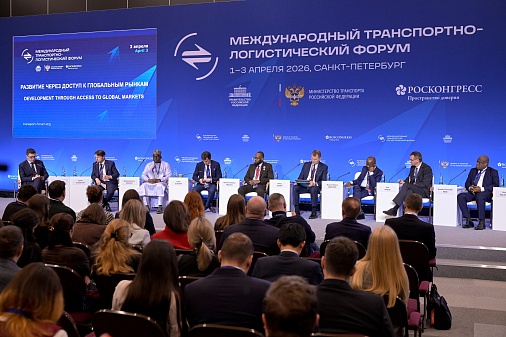
The Transport and Logistics forum, the biggest industry-focused event for the first time in Russia, was held under theme “Development Through Access to Global Markets” and was organised by the Ministry of Transport of the Russian Federation, with the support of the Government of the Russian Federation, and serving as the operator was Roscongress Foundation, in St. Petersburg, second largest city in the Russian Federation.



