

by Sherwin David
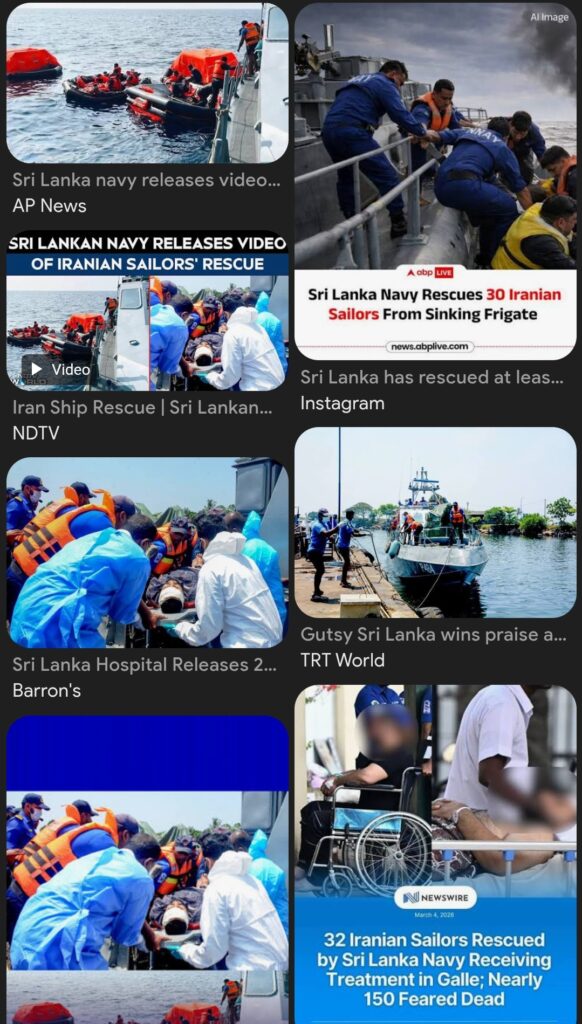
In early March 2026, the Indian Ocean witnessed a dramatic humanitarian incident that brought together war, neutrality, and international maritime law. Off the southern coast of Sri Lanka, an Iranian naval ship was sunk during escalating conflict in the Middle East, leaving dozens of sailors injured, many missing, and others struggling to survive at sea. What followed was not a political response—but a humanitarian one.
A Tragedy at Sea
According to international news agencies, the Iranian warship was sunk about 40 nautical miles off Sri Lanka’s southern coast, near Galle. The vessel had more than 180 crew members on board. Sri Lankan naval authorities immediately launched a search-and-rescue operation after receiving a distress call.
Despite the incident happening outside Sri Lanka’s territorial waters, it occurred within the country’s official maritime search-and-rescue zone—meaning Sri Lanka had a legal responsibility to respond.
Sri Lankan officials later stated clearly: the rescue was not political—it was humanitarian.
Humanity Before Politics
In the middle of a growing global conflict, Sri Lanka chose neutrality. The government emphasized that international maritime conventions require any country to assist people in distress at sea, regardless of nationality, military status, or political alliances.
The rescued sailors were taken ashore and given medical treatment in Sri Lankan hospitals. Even more remarkable, the Sri Lankan Navy also evacuated over 200 crew members from a second Iranian vessel that requested help soon after the first incident. The sailors were safely brought to shore and placed under humanitarian protection.
This action reflected a powerful message: when lives are at risk, humanity must come first.
What International Maritime Law Says
The response by Sri Lanka was not only compassionate but also fully aligned with international maritime law.
Under global conventions:
> Any country must rescue people in distress at sea
> Rescue operations must happen regardless of war or nationality
> Injured sailors must receive medical treatment
> Survivors must be treated humanely and protected
Sri Lankan naval officials themselves stated that their duty was “to rescue them as first responders under international maritime obligations.” This principle has long been considered one of the most important rules of maritime civilization: no one is abandoned at sea.



