

by Asif Showkat Kallol (Dhaka Bureau)
Bangladesh has moved to secure emergency fuel supplies as escalating geopolitical tensions involving Iran, the United States, and Israel threaten global energy stability, raising concerns over potential domestic shortages.
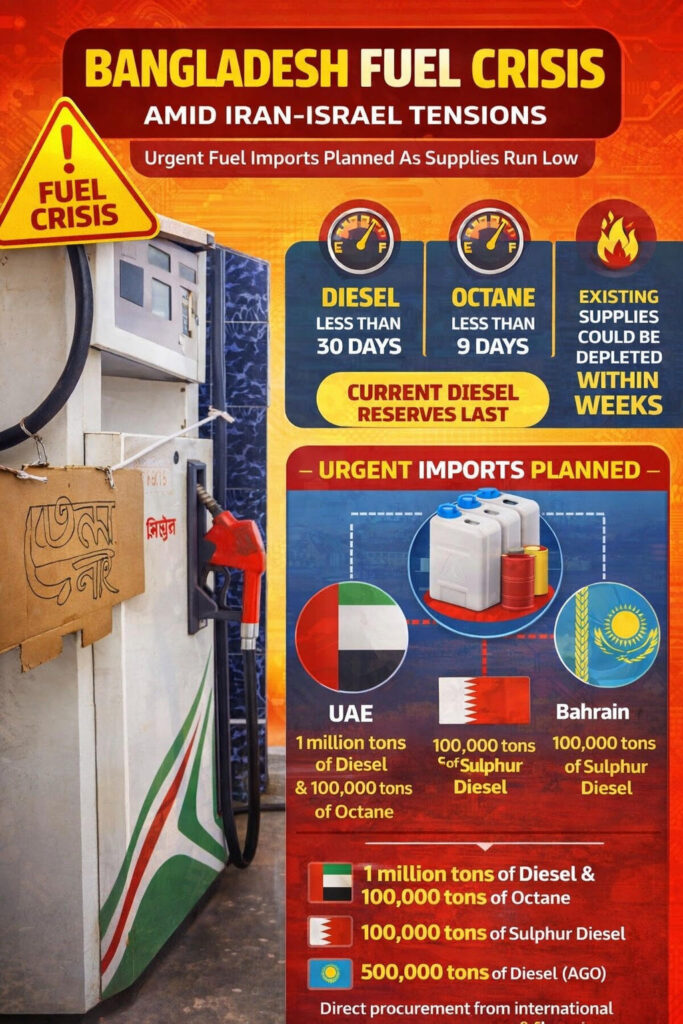
Officials warn that existing fuel stocks could be depleted within weeks if supply disruptions persist. Current diesel reserves are expected to last less than 30 days, while octane stocks may run out in as little as nine days. The state-owned Bangladesh Petroleum Corporation (BPC) relies heavily on imports from Oman, the United Arab Emirates, and Kazakhstan to meet domestic demand.
A key meeting of the Cabinet Committee on Government Purchase is scheduled for 4 April to approve urgent imports of diesel and octane, according to an official notice issued by the Cabinet Division.
The meeting- the 42nd of the 2025-26 fiscal year and the 14th of 2026- will be held at 5:15 pm and chaired by the minister overseeing the finance and planning portfolios.
At the centre of the agenda are three proposals aimed at rapidly securing fuel through direct procurement from international suppliers- a mechanism often used in times of market volatility to bypass lengthy tender processes.
Under the first proposal, Bangladesh plans to import 1 million metric tonnes of diesel (EN590-10 PPM standard) and 100,000 metric tonnes of octane from UAE-based DBS Trading House FZCO.
A second proposal involves the import of 100,000 metric tonnes of 50 PPM sulphur diesel from Maxwell International SPC.
The third proposal seeks to procure 500,000 metric tonnes of high-speed diesel (AGO) from Kazakhstan’s KAZAKH GAS PROCESSING PLANT LLP.
Officials from the Energy and Mineral Resources Division, which has placed the proposals, argue that advance procurement is essential to cushion the country against supply disruptions in an increasingly uncertain global market.
All three proposals rely on direct purchase agreements, reflecting the urgency of the situation as global energy markets remain highly sensitive to conflict-driven shocks.
Tight supply and rising demand
Bangladesh’s fuel supply situation has already come under pressure in recent weeks, driven by both geopolitical uncertainty and panic buying.
In the 2024-25 fiscal year, BPC sold approximately 6.83 million tonnes of petroleum products. Diesel remains the most in-demand fuel, with monthly consumption of around 380,000 tonnes- equivalent to roughly 12,000 to 12,700 tonnes per day. Furnace oil demand also remains high, particularly for power generation and industrial use.
As of 23 March 2026, diesel stocks stood at around 185,000 tonnes- just 29% of total storage capacity- sufficient for approximately 12 to 14 days under normal demand conditions. Furnace oil reserves were estimated at 70,833 tonnes, enough for nearly 29 days.
Earlier in March, diesel reserves fell below 10 days due to panic buying, forcing authorities to impose sales limits and ration supply, at times reducing daily distribution to around 9,000 tonnes. Bangladesh’s total petroleum storage capacity stands at approximately 1.57 million tonnes.
To stabilise the situation, BPC has planned emergency imports for April and May, including 300,000 tonnes of diesel and 50,000 tonnes of furnace oil, in an effort to rebuild buffer stocks.
Octane and petrol under pressure
The supply of petrol and octane has also tightened amid rising demand.
During FY2024-25, petrol demand reached approximately 662,000 tonnes, all of which was met through domestic production. Octane demand stood at around 415,000 tonnes, with roughly 234,000 tonnes imported.
Combined daily demand for petrol and octane is estimated at 1,100 to 1,200 tonnes. Domestic refineries supply between 600 and 700 tonnes per day, with the remainder covered by imports.
As of late March, petrol stocks were estimated at around 16,600 tonnes- enough for roughly 11 days- while octane reserves stood at approximately 10,700 to 11,000 tonnes, sufficient for about nine days.
The tightening supply, exacerbated by panic buying, prompted BPC to impose temporary sales limits- including caps of 10 litres for cars and 2 litres for motorcycles- although supply has since been increased by around 10% in divisional cities.
Additional imports are planned for the coming months to restore supply buffers, while retail fuel prices have remained unchanged, with petrol priced at Tk 116 per litre and octane at Tk 120.
A fragile balance
Analysts warn that prolonged instability in the Middle East could further disrupt supply chains and push global fuel prices higher, placing additional strain on import-dependent economies such as Bangladesh.
The government’s move to secure emergency supplies is being seen as a strategic effort to stabilise the domestic market. However, its success will depend on how quickly imports can be arranged- and how the global energy crisis unfolds in the weeks ahead.
The Author:
 Asif Showkat Kallol: Works for a German-based online outlet, The Mirror Asia, as Head of News and Contributor, Pressenza- Dhaka Bureau.