

by Asif Showkat Kallol
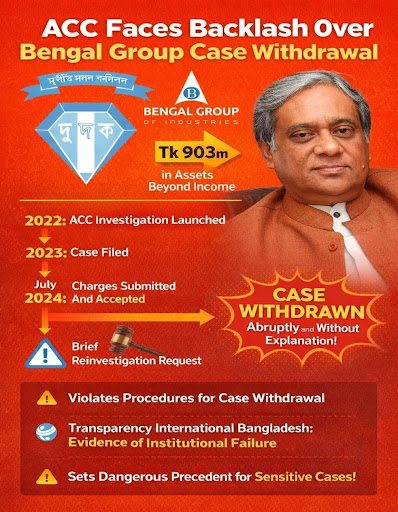
Bangladesh’s Anti-Corruption Commission (ACC) is facing mounting criticism after it abruptly withdrew a corruption case against Bengal Group chairman Abul Khair at the final stage before trial, raising serious concerns over the independence and integrity of the country’s anti-graft body.
The case, which accused Khair of amassing illicit wealth worth more than Tk 903 million, had already passed through every major procedural stage of prosecution: formal investigation, filing of charges, submission of a charge sheet, and judicial acceptance of the indictment. Yet, just as formal trial proceedings were about to commence, the ACC moved to withdraw the case- without publicly presenting any substantive legal justification.
Legal experts and anti-corruption advocates say the move is highly irregular and potentially unlawful.
Under standard legal procedure, any withdrawal of a pending corruption case requires prior court approval for reinvestigation. Such a reinvestigation must establish that the original case was baseless, malicious, unsupported by evidence, or filed on incorrect information. Only then can prosecutors seek withdrawal.
But in this instance, the ACC requested reinvestigation during the charge-framing stage and, only three days later- without completing any reinvestigation- filed an application to withdraw the case altogether.
‘This demonstrates that the ACC has failed to exercise its legal mandate properly,’ Dr Iftekharuzzaman, executive director of Transparency International Bangladesh, told local media. ‘Such a decision could only have been taken under unethical pressure, with dishonest motives, or to conceal institutional failure. It sets a dangerous precedent.’
The controversy stems from a case first opened in March 2022, when the ACC began investigating allegations that Abul Khair had acquired wealth beyond known sources of income. After more than a year of inquiry, the commission concluded there was sufficient evidence to proceed and formally filed a case on 17 April 2023.
Investigators alleged that Khair had accumulated illegal assets worth Tk 903.23 million. A further year of investigation followed, during which officials reportedly seized documents, collected witness testimony, and assembled supporting evidence before submitting a charge sheet to Dhaka’s Metropolitan Senior Special Judge’s Court on 15 July 2024.
The court accepted the charge sheet a month later.
However, on 1 September, the ACC unexpectedly sought further investigation, stating only that the commission had decided to reinvestigate the matter, without disclosing any reasons. The court scheduled a hearing for 15 October to review the request.
Yet before that hearing could take place, the ACC reversed course again. On 4 October, it applied directly to withdraw the case. The following day, the court granted the application under section 494 of the Criminal Procedure Code, acquitting the absconding defendant.
Notably, the ACC’s withdrawal petition cited no rationale beyond internal commission approval.
Legal scholars argue that such conduct undermines due process and raises questions about whether the commission’s original investigation and prosecution were politically or institutionally compromised.
‘If there was no major procedural or factual error, there should be no scope to withdraw such a case,” one legal expert said. “Every ACC investigation, prosecution, and charge sheet requires commission approval. If the case lacked merit, why was it approved at every stage? Without reinvestigation, withdrawal is indefensible.’
Multiple ACC insiders have alleged that the then-commission rushed to withdraw the case for ‘special purposes,’ though no official explanation has been offered.
The episode has intensified longstanding criticism that Bangladesh’s anti-corruption watchdog remains vulnerable to political and elite influence despite repeated promises of institutional reform.
For many observers, the withdrawal of such a high-profile case without reinvestigation or transparent explanation is more than a procedural anomaly- it is a test of whether the ACC can function as an independent guardian of accountability, or whether it remains subject to pressures from the country’s most powerful business and political interests.
————————————————————————————————————————————————————————
The Author:
 Asif Showkat Kallol: Works for a German-based online outlet, The Mirror Asia, as Head of News and is a Contributor, Pressenza- Dhaka Bureau.


