

What will it take for the world to call things by their name? How many houses were demolished? How many schools shut down? How many Palestinians have been killed with no one held to account? How many villages emptied into silence?
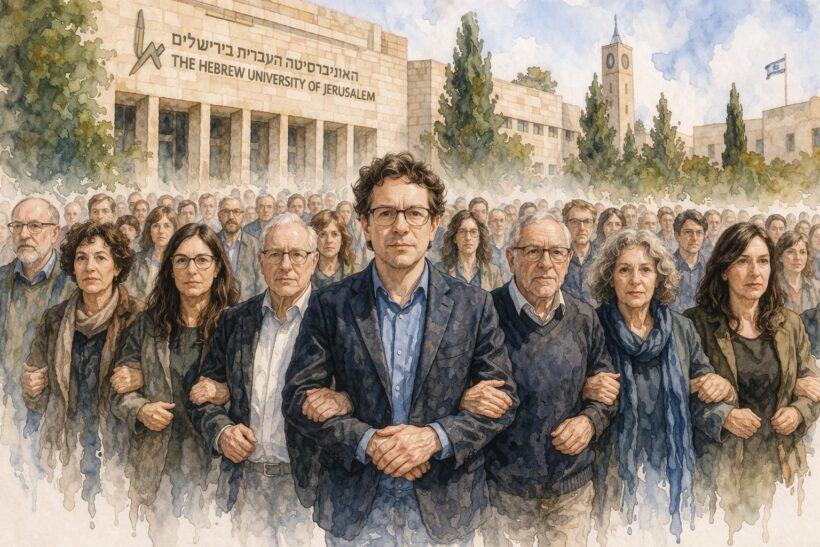
On March 30, 2026, more than 600 Israeli academics — university professors, researchers, intellectuals from Israel’s most prestigious institutions, among them a Nobel Prize winner — signed a petition that shakes the foundations of official Israeli discourse. They did not sign it in Geneva or Washington. They signed it from within. From the Hebrew University of Jerusalem. From the very heart of the State whose conduct they denounce.
What they said is not minor. It is devastating.
“Our government has not only failed to protect Palestinian communities, but has enabled those responsible for the violence.”
That sentence, spoken by Israeli academics on Israeli soil, in the midst of a war against Iran, with Benjamin Netanyahu’s government in a state of crusade, is not an abstract declaration of principles. It is an act of political courage that deserves to be read in its full dimension. And in all its legal consequences.
Because what those professors described — without using the term, but drawing it with surgical precision — is state terrorism.
The letter: what they said and what they risked
The document was drawn from the Hebrew University of Jerusalem. One of its organizers, Dr. Yiftah Elazar, a political science lecturer with a doctorate from Princeton, told Haaretz that the deterioration of the situation had reached a point of immediate urgency. His exact words: “This has long been a source of moral disgust and outrage for us, but it has now become a matter of immediate urgency.”
The letter describes a sustained pattern of coordinated attacks by extremist Israeli settlers aimed at eradicating the Palestinian presence from rural areas of the West Bank. It denounces the fact that Israeli police and military forces have refused to intervene and, in some cases, have collaborated directly with the attackers. It notes that there have been no significant arrests. That impunity persists despite the evidence. That dozens of Palestinians have been killed in this context by armed Israeli settlers.
It links all of this to Netanyahu’s government policies: settlement expansion, the de facto annexation of the West Bank, and judicial reforms that, by weakening the Israeli judiciary, have further reduced the State’s capacity to investigate and punish these crimes.
And it concludes with a demand for direct international intervention: to protect Palestinian communities, strengthen the documentation of abuses, and impose sanctions on individuals and entities involved in systematic human rights violations.
What does it mean to sign this document in Israel today? It means risking one’s career. It means facing public condemnation from a government that has demonstrated its willingness to criminalize dissent. It means being targeted by ministers such as Itamar Ben-Gvir — who celebrated with champagne the passage of a law expanding the death penalty applicable almost exclusively to Palestinian prisoners — and Bezalel Smotrich, who at the funeral of a killed Israeli settler openly called for the “collapse” of the Palestinian Authority and total Israeli control of the West Bank. It means speaking out in the same Israel that has passed laws to silence organizations defending Palestinian rights, that has classified international humanitarian NGOs as “national security threats,” and that on January 20, 2026, demolished UNRWA’s headquarters in East Jerusalem with bulldozers and police forces, in front of the cameras of the world.
Those 600 Israeli academics knew all of that. And they signed anyway.
At the same time, more than 2,000 Israeli artists and cultural figures did the same in a parallel petition demanding decisive action against Israeli settler violence. And more than 3,000 members of the global Jewish diaspora — including former British Foreign Secretary Malcolm Rifkind, alongside religious leaders, diplomats and academics from Europe, North America, Africa and Australia — sent an open letter to Israeli President Isaac Herzog describing the attacks by extremist Israeli settlers as an “abomination.”
Inside Israel itself, former Prime Minister Ehud Olmert publicly stated his intention to appeal to the International Criminal Court in an attempt to, in his own words, “save Palestinians and Israelis” from what he describes as Israeli settler violence backed by the State. Even prominent political analyst Amit Segal — a central voice in Israeli public discourse and close to the settler movement — said on camera: “There is no question that this is terrorism.”
Those words, in that country, at that moment, are an earthquake.
What is happening in the West Bank: the facts
To understand why 600 Israeli academics broke their silence, one must look at what is happening on the ground.
Since the war against Iran began in March 2026, Israeli settler violence in the West Bank has escalated systematically. Human Rights Watch documented that in just 11 days, armed Israeli settlers — three of them in military uniform — shot and killed five Palestinians. The UN reported that between March 1 and March 27, more than 150 attacks by Israeli settlers resulted in casualties or property damage in approximately 90 communities: more than six attacks per day.
The most revealing figure came from the UN Office for the Coordination of Humanitarian Affairs (OCHA) on March 27, 2026: in less than three months, Israeli settler violence and access restrictions displaced nearly 1,700 Palestinians, already surpassing the total recorded throughout all of 2025. Since 2023, 38 Palestinian communities have been completely emptied of their populations.
These are not isolated incidents. The UN Human Rights Office (OHCHR) report covering the period through October 2025 documented 1,732 incidents of Israeli settler violence resulting in casualties or property damage, an increase from the 1,400 of the previous period. In 2025, at least 240 Palestinians were killed, either by Israeli settlers or by the army.
The attacks carried out by Israeli settlers include live-fire shootings against unarmed civilians, burning of homes and vehicles, destruction of olive harvests, theft of livestock — in one case documented by OCHA, Israeli settlers stole 150 sheep after beating and tying up a Palestinian shepherd —, desecration of agricultural land, and graffiti in Hebrew reading “death to Arabs.” In a village in the Nablus region, a Palestinian survivor recounted to PBS News how twenty Israeli settlers attacked his entire family: “They tied everyone up, except a four-month-old baby girl who was asleep. They beat everyone, including the children.”
The Israeli army confirmed, in its own internal statistics, a 27% increase in what it calls “nationalist crimes” in the West Bank in 2025 compared to 2024, with serious incidents rising by more than 50%.
And yet: since 2022, not a single Israeli settler has been criminally convicted for the murder of a Palestinian civilian in the West Bank. Of 1,500 killings documented between 2017 and September 2025, Israeli authorities opened 112 investigations. One conviction. One.
What do you call that, if not structural state impunity?
What Israel destroys: schools, hospitals, the right to exist
The physical violence of Israeli settlers is only one dimension of the pattern. The other is the methodical destruction of the infrastructure that makes Palestinian civilian life possible, carried out directly by the Israeli State.
On January 20, 2026, Israeli bulldozers demolished UNRWA’s headquarters in the Sheikh Jarrah neighborhood of East Jerusalem, while Israeli security forces raised an Israeli flag over the ruins. UN Secretary-General António Guterres condemned the operation as an “unlawful entry” into United Nations property. Days earlier, on January 12, Israeli forces had stormed UNRWA’s Jerusalem Health Centre and ordered it shut for 30 days, also demanding the removal of UN insignia.
On January 27 and 28, Israel cut water and electricity to multiple UNRWA facilities across East Jerusalem, directly affecting schools, health centers and service points for Palestinian refugees in the city’s camps. The legislation authorizing these cuts was passed by the Knesset in December 2025.
In May 2025, the Israeli Ministry of Education, accompanied by police officers, closed six UNRWA schools in the West Bank, hanging closure orders on their doors and forcing students and teachers to evacuate, depriving more than 800 students of education. In October of the same year, Israeli forces raided Kisan Secondary School east of Bethlehem, alleging that the school’s broadcast had addressed the cause of Palestinian prisoners.
In March 2026, Israel notified 37 international non-governmental organizations that they would be expelled from Gaza and the West Bank for refusing to hand the Israeli government complete lists of their staff, in what Human Rights Watch described as a politicization of humanitarian requirements threatening to cut off vital assistance to the Palestinian civilian population.
What is destroyed when a school is demolished? What is erased when water is cut from a hospital? What is cancelled when a family is expelled from its home by a State-issued order? The future is destroyed. Memory is erased. The very possibility of a people remaining on their land is cancelled. And when that destruction is systematic, planned, legislated and carried out with impunity, it ceases to be collateral damage. It becomes policy.
The legal framework: the crimes that have a name
This is where the petition of the 600 Israeli academics acquires its greatest political weight. Because what they describe is not only morally unbearable. It is legally actionable, under multiple normative frameworks simultaneously.
The International Court of Justice has already spoken, with the full authority of the world’s highest tribunal, in July 2024. Its advisory opinion is precise and devastating.
The ICJ established that Israeli settlements in the West Bank and East Jerusalem, along with the regime associated with them, have been established and maintained in violation of international law. That Israel’s policies — forced evictions, mass demolitions of homes, restrictions on residence and movement, confiscation of land for reallocation to Israeli settlements — violate the prohibition on the forcible transfer of the protected population under Article 49 of the Fourth Geneva Convention. That Israeli laws implement a separation between Palestinians and Israeli settlers in the occupied territories that violates Article 3 of the International Convention on the Elimination of All Forms of Racial Discrimination, which prohibits racial segregation and apartheid. That Israel must withdraw all Israeli settlers from the occupied territories, dismantle the sections of the wall built in the West Bank, pay full reparations and allow the return of all Palestinians displaced since 1967.
And it established something even more grave: that all other States in the world are legally obliged not to recognize the Israeli occupation as lawful and not to render aid or assistance in maintaining it.
The catalogue of legally actionable violations is as follows:
War crimes, under international humanitarian law: the deliberate killing of civilians, the destruction of protected property — schools, hospitals, UN facilities —, the forcible transfer of civilian populations, the excessive use of force, and the intentional deprivation of water, electricity and basic services to the population under occupation.
Crimes against humanity, under the Rome Statute of the International Criminal Court: the persecution of a civilian population on ethnic or racial grounds, deportation or forcible transfer of population, acts of extermination and other inhumane acts of a similar character committed as part of a widespread and systematic attack against the civilian population.
Apartheid, under the International Convention on the Suppression and Punishment of the Crime of Apartheid and the Rome Statute: the maintenance of an institutionalized regime of systematic oppression and domination by one racial group over another. The ICJ has already established the discriminatory separation between Palestinians and Israeli settlers; the UN Special Rapporteur and multiple human rights organizations have concluded that the system as a whole constitutes apartheid.
Forcible transfer of population, explicitly prohibited by Article 49 of the Fourth Geneva Convention, codified as a war crime at Nuremberg and applied directly by the ICJ to Israeli practices in the West Bank. The UN Human Rights Office concluded in March 2026 that the displacement pattern “appears to indicate a concerted Israeli policy of mass forcible transfer throughout the occupied territory, aimed at permanent displacement,” raising concerns of ethnic cleansing. Since 2023, 38 Palestinian communities have been completely emptied.
Genocide: the UN Commission of Inquiry issued a report in September 2025 concluding that Israel committed genocide in Gaza. The International Court of Justice has the case filed by South Africa open under the Convention on the Prevention and Punishment of the Crime of Genocide. The UN’s independent human rights experts noted in September 2025 that “the collective and far-reaching nature of the ongoing genocide has become undeniable.”
The consequences in a world that applied its own law
What would happen if international law were applied with the same energy with which it was written?
Netanyahu would face the execution of the arrest warrants issued by the International Criminal Court in November 2024 for war crimes and crimes against humanity. Those warrants remain in force — the ICC rejected Israel’s request to withdraw them in July 2025 — and oblige the 124 States party to the Rome Statute to detain him if he sets foot on their territory. The same applies to former Defense Minister Yoav Gallant.
Ministers Smotrich and Ben-Gvir would face, in addition to ICC mechanisms, individual sanctions under the human rights regimes of the European Union and the United Kingdom, and could eventually be prosecuted for incitement to genocide, forcible transfer and crimes of apartheid. Their public statements — Smotrich calling for the “demolition” of Palestinian communities, Ben-Gvir celebrating the death penalty for Palestinian prisoners — are already part of the international evidentiary record.
Israel as a State would face, in a world that applied its own norms: immediate suspension of all arms transfers, established as an obligation by the Geneva Convention and reaffirmed by the ICJ; an embargo on trade with illegal Israeli settlements; suspension of preferential association agreements with the European Union; full reparations to the Palestinian population, including restitution of land and property since 1967, financial compensation and the return of the displaced; and mandatory cooperation with ICC investigations and UN mechanisms.
And the States that continue to support the Israeli occupation — selling it arms, blocking resolutions in the Security Council, maintaining preferential trade with Israeli settlements — would be, according to the ICJ itself, at risk of becoming complicit in internationally wrongful acts.
What the Israeli academics put into words
There is something in this letter that goes beyond the catalogue of violations. It is the acknowledgment, from within Israel, that Israeli settler violence is not a problem of “bad apples.” It is State policy.
International law experts are precise on this point. Academic Mais Qandeel, from Örebro University, argues that sanctioning individual Israeli settlers while the State continues to operate is a mistake of legal attribution: the responsibility is that of the State, not of individuals. The Lieber Institute at West Point recalls that Article 43 of the Hague Regulations obliges Israel, as an occupying power, not only to refrain from violence but to actively protect the occupied population and to not tolerate such violence from any third party.
The UN’s independent human rights experts expressed it with a clarity rarely heard in diplomatic language: “The forced mass displacement and brutal attacks by armed Israeli settlers cannot be dismissed as the actions of a few rogue officials. They are being aided and abetted by the State at every level. Every branch of the Israeli State — the Executive, the Parliament and the Courts — has failed to restrain or remedy this abuse of power.”
What does that mean in practical terms? It means that when an Israeli settler shoots a Palestinian farmer in the West Bank, the State of Israel bears direct legal responsibility. When that settler is not prosecuted, the responsibility deepens. When a government minister celebrates that impunity, the responsibility reaches the level of active complicity. And when the legislative apparatus constructs the normative framework that makes all of the above possible — the law authorizing the cutting of water to UNRWA, the one expanding the death penalty for Palestinian prisoners, the one expelling humanitarian NGOs — we are looking at the operational definition of state terrorism.
The world watches. Humanity takes note.
There is a moment in the history of every great crime of the twentieth century when the documentary record existed, the witnesses had spoken, the jurists had classified the facts, and yet the world did not act. That moment — the moment when impunity became the norm — is the one that subsequent generations have never been able to forgive themselves for.
We are, right now, in that moment.
Six hundred Israeli academics, a Nobel Prize winner among them, know this. And that is why they signed. Because they understand the weight of that signature. Because they know that silence carries a cost that history always collects.
The question they return to all of us — to governments, to international institutions, to the press, to the citizens of the world who watch — is simple and devastating: if even the intellectuals of the aggressor State itself can no longer remain silent, what are the rest of us waiting for?



