

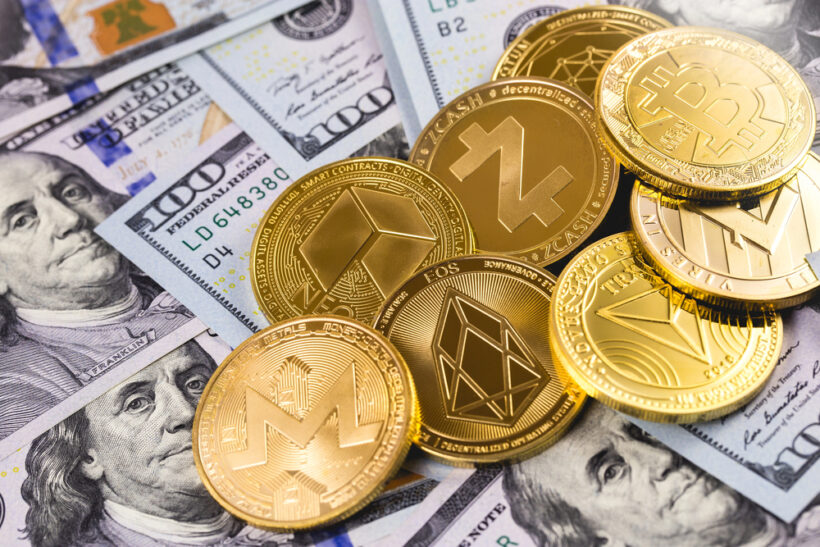
The dollar, cryptocurrencies and artificial intelligence in the struggle for global power.
“The power is not only in what is produced. It is in who decides in which currency it is paid.”
The dominance of the dollar is not collapsing, but it is being challenged. Between digital currencies, geopolitical tensions and new financial architectures, the global monetary system is entering a phase of transition whose outcome will redefine global economic power.
The currency that governs without armies
The U.S. dollar is not just a currency. It is the invisible architecture of global power. More than 70% of international trade is conducted in dollars, even between countries that have no direct relationship with the United States. This means that much of the world not only produces goods, but values them, exchanges them and settles them in a currency it does not control. The result is a structural asymmetry in which the issuer of the dollar holds a unique advantage. It can finance its economy, influence markets and project power without the need for direct intervention.
The system that sustains the dollar
The dominance of the dollar is not accidental. It is supported by a global financial network that includes banks, capital markets and clearing systems such as SWIFT. More than 58% of central bank international reserves are denominated in dollars, equivalent to several trillions of USD distributed across the global financial system. This structure allows the dollar to function as a store of value, medium of exchange and unit of account. It is not just a strong currency. It is the financial language of the world.
The exorbitant privilege
The French economist Valéry Giscard d’Estaing defined decades ago the dominance of the dollar as an “exorbitant privilege.” The United States can issue debt in its own currency and finance deficits exceeding USD 1 trillion annually without facing the same constraints as other countries. This capacity is not infinite, but it is exceptional. It allows sustained spending, projection of military power and absorption of global crises with a margin no other economy possesses. The dollar does not just reflect power. It amplifies it.
The world trying to escape
However, this system is beginning to show cracks. BRICS countries and other emerging economies seek to reduce their dependence on the dollar. China promotes the use of the yuan in international trade, while Russia has accelerated the de-dollarization of its transactions following Western sanctions. Bilateral agreements in local currencies, alternative payment systems and new financial institutions point in the same direction. It is not an immediate rupture, but it is an accumulative process.
The geopolitics of sanctions
The power of the dollar becomes more visible when it is used as a tool of pressure. Financial sanctions imposed by the United States can isolate entire economies from the global system. Access to dollars, to international banks and to payment mechanisms becomes an instrument of control. Countries such as Iran, Russia and Venezuela have experienced this effect. In this context, the dollar ceases to be just a currency and becomes a geopolitical lever. And that accelerates the search for alternatives.
The limits of change
Despite these movements, replacing the dollar is not simple. No other currency simultaneously possesses the market depth, liquidity and institutional trust necessary to assume that role. The euro faces structural limitations, the yuan is not yet fully convertible, and emerging currencies lack global scale. The current system has inertia. Changing it requires not only political will, but decades of financial construction. The dollar will not fall quickly. But it will not remain intact either.
Money as the infrastructure of power
The world tends to focus on resources, energy or territory. But the true nervous system of global power is financial. Every international transaction, every energy contract, every capital flow passes through a system in which the dollar is dominant. This means that even countries that produce strategic raw materials still depend on an architecture they do not control. Wealth is generated in multiple places. The power to define its value is concentrated in few.
A transition underway
Economic history shows that no monetary system is eternal. The British pound dominated the 19th century before being replaced by the dollar in the 20th. Today, the world may be entering a phase of transition toward a more fragmented system. Not necessarily a direct replacement, but a coexistence of currencies and systems. This scenario implies greater complexity, less stability and new forms of competition. Financial power will no longer be absolute. It will be contested.
Hard data of dominance
The U.S. Treasury bond market exceeds USD 25 trillion, functioning as the main liquidity refuge of the planet. Every day, trillions of dollars circulate in markets that depend on this structure. These figures are not just statistics. They are evidence of a system that has defined the global economy for decades.
Cryptocurrencies, AI and the possible new system
Cryptocurrencies and digital currencies open a scenario that begins to challenge the traditional architecture dominated by the dollar. Today, the global crypto asset market exceeds USD 2 trillion, while central banks advance in their own digital currencies that could redefine the financial system.
In a horizon toward 2040–2050, the integration of artificial intelligence into payment systems, validation and monetary issuance could give rise to an ecosystem where transactions are automated, instantaneous and global, reducing dependence on traditional intermediaries.
In that scenario, power would no longer be concentrated exclusively in a country, but in a distributed, efficient digital infrastructure difficult for a single actor to control. The promise is clear: greater speed, lower cost and universal access, but also a new type of governance where control does not disappear, it only changes form.
The power of the system
Cryptocurrencies and digital currencies are opening a transition that goes beyond traditional currencies and the state logic of money. With a market already exceeding USD 2 trillion and with central banks developing their own digital currencies, the financial system begins to shift toward a technological infrastructure where intermediation is reduced and speed becomes total.
In a horizon toward 2040–2050, the integration of artificial intelligence into monetary management could automate global capital flows, eliminating frictions and redefining control. In that scenario, power will no longer belong to States, it will belong to the system, a digital network that operates above borders. The question will not be who issues the currency, but who controls the architecture that makes it function.
Cryptocurrencies today and their impact on the economy
Cryptocurrencies have moved from being a marginal experiment to a relevant component of the global financial system, with a capitalization fluctuating around USD 2 to 3 trillion depending on the market cycle. Millions of users across all continents use digital assets not only as speculative investment, but as a means of value transfer in economies with high inflation or exchange restrictions.
Companies, funds and financial platforms have integrated these assets into their operations, generating a new ecosystem where decentralization competes with traditional banking. Although their volatility remains high, their impact is undeniable: they have introduced an alternative to the classical monetary system. And in that process, they have opened a door that can no longer be closed.
The global business of the dollar and currencies
The foreign exchange market is the largest in the world and the true heart of the global financial system, with daily transactions exceeding USD 7.5 trillion according to the Bank for International Settlements. In this market, the dollar participates in nearly 88% of all operations, consolidating its role as the dominant currency in global exchange.
Banks, funds, corporations and States operate continuously in this system, not only for trade, but for speculation, hedging and arbitrage. This constant flow of buying and selling currencies generates profits, stability and also vulnerability, depending on who controls access. The business is not only in producing wealth, but in intermediating it, moving it and valuing it at the exact moment.
A single currency for a single system
In a scenario toward 2040–2050, the global financial system could converge toward a single digital currency managed by artificial intelligence, adopted by the world economy as a common standard of exchange. In that context, China and India are projected as economic superpowers, shifting the historical axis of power toward Asia and reducing the centrality of the dollar as a global reference.
The monetary infrastructure would operate in real time, without frictions and with expanded access at a planetary scale, eliminating arbitrage and asymmetries associated with national currencies. The result would be a more efficient, integrated and universal system, where value circulates without depending on a single nation. Power would cease to
The governance of global architecture
Control of a monetary architecture based on artificial intelligence could not rest in a single country without generating structural distrust in the rest of the planet, so its legitimacy would depend on an agreement among major economic powers such as China, India, the United States and the European Union. In that scenario, the architecture would not be the property of a State, but a shared infrastructure, regulated by principles of transparency, balance and global stability.
Trust would not arise from force, but from participation and consensus, where each relevant actor has representation in the design and supervision of the system. The result would be an unprecedented form of economic governance, where currency ceases to be an instrument of unilateral power and becomes a common good of humanity.
The silent displacement of the dollar
Digital currencies, decentralized payment systems and new financial architectures are shaping an environment where monetary sovereignty no longer depends exclusively on States. In that context, technology introduces a variable that the traditional system does not fully control.
Toward 2040–2050, it is plausible that a global digital currency will emerge, not necessarily linked to a country, but to a technological architecture with distributed governance assisted by artificial intelligence. It would not only be an instrument of exchange, but a system capable of managing rules, validating transactions and adjusting parameters in real time. In that scenario, monetary power would cease to be exclusively political and would also become systemic.
The change will be gradual. And if it consolidates, it will redefine one of the fundamental pillars of the international order. And as in all structural processes, when the outcome becomes evident, the transformation will already be underway.
Who Designs the Future of Money
“The 21st century will not be defined only by who produces more, but by who designs the system where that value exists.”
“The wars of the future will not be fought only over territory. They will be fought over control of money.”
“As Charles Darwin noted, the species that survive are not the strongest, but those that best adapt to change. The global financial system is no exception. The dollar has been the dominant species for decades. But in a changing environment, adaptation becomes essential. The result will not be an abrupt fall, but an evolution. And in that evolution, power will not disappear. It will be redistributed.”
- Charles Darwin
“Modern States rest on the administration of finance; whoever controls the credit of a nation directs its policy and, ultimately, its destiny.”
- Karl Marx
“Money, in its purest form, is the universal symbol of value. Where it dominates, everything becomes interchangeable, even what was once inalienable. Whoever controls that symbol does not only regulate the economy, but the very way in which society is organized.”
- Georg Simmel
“Power does not need to own everything. It only needs to define the rules under which everything else circulates.”
- Michel Foucault
Author: Mauricio Herrera Kahn
Brief bibliography
- Barry Eichengreen
Exorbitant Privilege: The Rise and Fall of the Dollar (2011)
Analysis of the role of the dollar as the dominant currency and its structural tensions.
- Eswar Prasad
The Future of Money (2021)
Study on digital currencies, cryptocurrencies and the redesign of the global monetary system.
- Benoît Cœuré
Essays and reports on central bank digital currencies (CBDC)
Institutional analysis of the impact of digital currencies on monetary policy.
- International Monetary Fund
Digital Money Across Borders
Evaluation of the impact of digital currencies on the international financial system.
- Bank for International Settlements
CBDCs: An Opportunity for the Monetary System
Study on the development of sovereign digital currencies and their global architecture.
- Yuval Noah Harari
Homo Deus (201



