

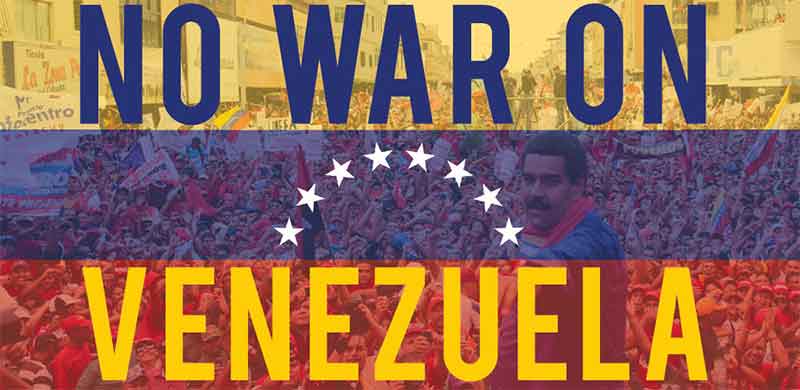
In the wake of Washington’s January 3 military attack and then problematic détente with Caracas, corporate media suggest a meaningful shift in Venezuela policy, implying relief for a country long subjected to economic coercion. However, far from dismantling the sanctions regime, the US has merely adjusted its application through licensing mechanisms, leaving the core structure of coercive measures fully intact.
By Roger D. Harris
Reuters reported “US lifts some Venezuela sanctions,” followed by news of sanctions being further “eased.” Both NBC News and ABC News likewise reported sanctions “eased,” while the Financial Times wrote that Washington “relaxes sanctions.” Reuters later found that “US waives many of the sanctions,” and the Los Angeles Times noted “targeted relief from sanctions” The Washington Office on Latin America (WOLA) described a “huge easing of sanctions.”
Not a single sanction has been rescinded
In fact, there is no evidence of any revocation of executive orders, removal of Venezuela-related sanctions authorities, and certainly no formal termination or suspension of Washington’s sanctions regime.
At a February 21 meeting I attended in Venezuela, Anti-Blockade Vice Minister William Castillo described sanctions as a “policy of extermination.” These measures, “the most cruel aggression against our people,” had been renewed the day before by Trump. To do so, he had to certify the original mistruth first fabricated by Barack Obama in 2015: that Venezuela poses an “extraordinary threat” to US national security.
Castillo cited 1,087 measures imposed by the US and another 916 by its echo, the European Union. These unilateral coercive measures have a corrosive effect on popular support for the government, which is precisely the purpose of this form of collective punishment, illegal under international law.
In 2023, Castillo described Washington’s economic aggression as a means to destroy Venezuela without having to invade. The Bolivarian Revolution’s successful resistance, including positive GDP growth while under siege, suggests why the US felt compelled to escalate with a military incursion on January 3, killing over 100 and kidnapping the country’s lawful head of state and his wife.
In Castillo’s words, the US escalated from “a war without gunpowder…against the civilian population” to an actual one. As grave as the direct US military aggression has been – including 157 fatalities since last September in alleged drug interdictions of small craft in the Caribbean and eastern Pacific – the body count from the coercive economic measures has been far higher. Former UN Special Rapporteur Alfred de Zayas estimated that sanctions have caused over 100,000 excess deaths.
There is even a literal playbook on how to apply sanctions to inflict “pain” on civilians for “maximum effectiveness.” The author of The Art of Sanctions is Richard Nephew, a former US State Department senior official in the Biden administration who was responsible for implementing such policies.
Licenses vs. sanctions
What has happened in practice is a much more limited form of relief under the sanctions regime. The Treasury’s Office of Foreign Asset Control (OFAC) has issued broad licenses allowing certain dealings primarily with Venezuela’s state oil (PDVSA) and gold (Minerven) sectors.
OFAC licenses carve out limited exceptions principally benefitting US and other foreign corporations, not necessarily the Venezuelan people. Activities are authorized that would otherwise be illegal under US law, even though such activities are lawful under international law. They come with conditions, limits, and reporting requirements and can be revoked at any time.
In practical terms, sanctions remain in place, although certain transactions are temporarily allowed under strict licensing rules. “The result is a hybrid scheme in which formal sanctions and operational licenses coexist, enabling limited flows of economic activity,” according to Misión Verdad.
This flexible arrangement of sanctions combined with licenses allows US and other foreign corporations to make a profit off of the coercive system. Under sanctions alone, the targeted people overwhelmingly suffer but, secondarily, US and other corporations are shut out. Under this hybrid system, control is maintained and money is made.
However, most foreign investors are reluctant to make important investment decisions when there is uncertainty, especially given Mr. Trump’s mercurial reputation. A temporary license does not provide the security that corporations normally require. Recuperating the Venezuelan oil industry would necessitate “a gigantic investment.” Such investments will be unlikely if Venezuela is sanctioned, the licenses notwithstanding.
Media framing and blaming
Meanwhile, Venezuelan President Nicolás Maduro and “First Combatant” Cilia Flores remain in a New York City jail, reportedly in solitary confinement.
Regarding what happened on January 3, corporate media sources overwhelmingly use relatively anodyne terms such as “downfall,” “removal,” or “ouster,” rather than the more pointed “kidnapping” or “abduction.” When the legality of this clearly illegal act of war is questioned by either the media or by the Democrats, it is mainly confined to whether President Trump required congressional approval.
Likewise, application of international law regarding the illegality of unilateral coercive measures is largely absent from media coverage. Where legal issues appear, they tend to address mechanics (e.g., the US-controlled fund arrangement), rather than whether sanctions themselves violate international law.
When media outlets express concern about Washington’s restrictions, it is often that easing them would “reward Maduro loyalists.” While the plight of the Venezuelan people may be acknowledged, the blame is mainly attributed to corruption and economic mismanagement, with little if any opprobrium for sanctions.
As former political science professor at the Universidad de Oriente Steve Ellner (pers. comm.), notes, corruption and mismanagement do exist. But the overwhelming factor has been the sanctions regime. The blockade targeted Venezuela’s oil industry – at one point accounting for 99% of foreign-exchange earnings – forcing the country out of normal dollar-denominated markets and into black markets to survive.
What Alfred de Zayas dubs the “human rights industry” similarly exhibits a convenient blind spot regarding sanctions. WOLA, for example, advocates “addressing the complex humanitarian emergency.” Yet the NGO strongly opposes sanctions relief for the people, because the coercive measures are such an effective “pressure” tool on the leadership.
Former WOLA staffer David Smilde is preoccupied with “restoring” American-style democracy by imposing pressure on the “regime.” He argues: “The democratic transition in Venezuela…requires the support of international organizations.”
In contrast, acting President Delcy Rodríguez views ending interference by foreign actors in Venezuela’s internal affairs as a precondition for credible elections. In particular, she calls for the US “blockade and sanctions against Venezuela [to] cease.” With sanctions still in place, the US remains the biggest obstacle to free and fair elections in Venezuela.
Roger D. Harris is with the Venezuela Solidarity Network, Task Force on the Americas, and the US Peace Council. He recently visited Venezuela.



