

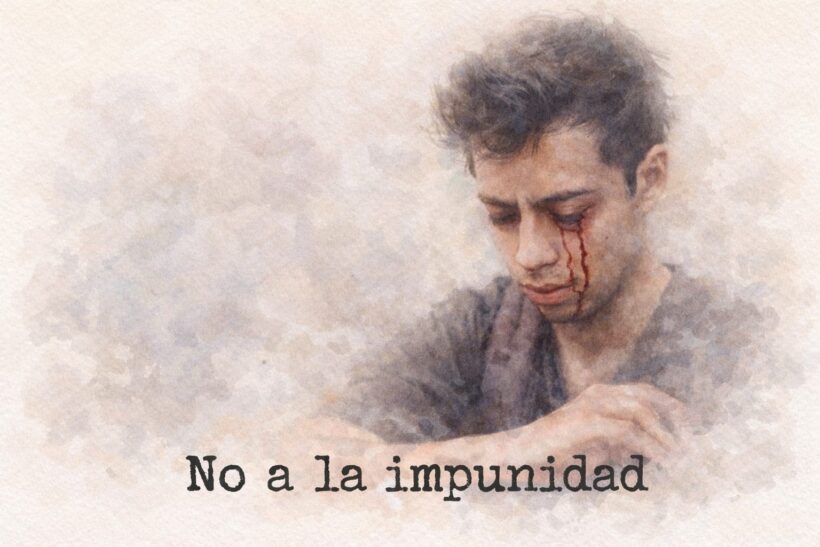
The United Nations system warned Chile about the international illegality of pardoning state agents convicted of human rights violations. Far from being a technical debate, the proposal opens an ethical, legal, and human fracture that repositions political power in front of its own victims.
The warning was neither ambiguous nor excessively diplomatic. Through its Special Procedures, the United Nations system expressed “deep alarm” over announcements by the Executive regarding the possibility of granting individual pardons to security officials sanctioned for their actions during 2019. This is not an isolated opinion nor an ideological reading. It is an institutional, precise signal that points to a limit: there are decisions a State simply cannot make without violating international law.
The message is clear. There is a strict prohibition against measures of clemency in cases of this gravity. This is not a recommendation; it is a standard. International human rights law leaves no room for ambiguity when it comes to torture, cruel treatment, or serious violations committed by state agents. Granting pardons in that context is not mercy. It is impunity.
The warning goes further. It stresses that such decisions erode the independence of the Judiciary and violate the right to truth, justice, and reparation for victims. This is not a technical detail. It is the core of the problem. Because when a court convicts, it does not only punish. It recognizes. It names the harm. It restores, in part, the dignity that was taken away.
The pardon intervenes at that moment.
It dismantles it.
It makes it fragile.
And in that gesture, the State does not only modify a sentence. It intervenes in the process of reparation of those who were harmed.
The international warning itself introduces another element that should deeply trouble any democracy: the risk of creating spaces of “de facto impunity.” That expression is not rhetorical. It accurately describes what happens when a conviction exists on paper but loses its effect in reality.
And that is where the proposal ceases to be just another political debate.
Because what is at stake is not only the fate of those who were convicted. It is the very meaning of having convicted them.
Faced with this scenario, the mandate of the universal system is unequivocal: States have the duty to ensure that those responsible are held accountable without exceptions. Without exceptions. That phrase alone should be enough to close any honest discussion.
But the discussion does not close.
It opens.
And it opens because the proposal to pardon state agents convicted does not arise in a vacuum. It arises from a narrative that seeks to reconfigure perpetrators as victims. That suggests persecution where there was judicial sanction. That attempts to shift the focus from the harm caused to the discomfort of the one who was convicted.
This operation is not new.
But it remains dangerous.
Because it introduces a crack in the collective perception of state violence. It blurs responsibilities. It relativizes abuse. And, above all, it installs a disturbing idea: that power can, in the end, protect itself.
This is where the problem ceases to be only legal.
It becomes human.
Behind each of those convictions are people who went through a long, often exhausting process to obtain something minimal: that the State recognize that what happened to them was unjust.
It is not easy to report the State.
It is not easy to sustain that report over time.
It is not easy to face doubt, exposure, emotional exhaustion.
And yet, many people did it. They went to trial. They obtained a conviction.
And at that moment —that precise moment— something fundamental happens: the State stops being only the aggressor and begins, timidly, to become a guarantor.
The pardon breaks that transition. And what it produces is not reconciliation.
It is disorientation.
From the psychology of trauma, this has a name even if it is not always said so bluntly: revictimization.
Because the victim does not relive only the initial event. They relive the feeling of helplessness. The idea that, even after having spoken, after having proven, after having endured, the outcome can be reversed by political decision. They relive, ultimately, the experience that power remains on the same side. And that has consequences. Not only individual. Collective.
A society also learns from these gestures. It learns what justice means. It learns what value the law has. It learns whether institutions uphold what they declare or whether, when the moment comes, they negotiate it.
When a State sanctions its agents, it establishes a limit.
When it pardons them, that limit becomes blurred.
And when the limit becomes blurred, violence finds space.
That is why the United Nations warning is not just another diplomatic procedure.
It is a signal of alarm.
Not about the past. About the future.
Because what is at stake is not only whether these pardons are granted or not. It is what kind of society decides it is willing to do so. And what it is willing to sacrifice to achieve it.
Because in that calculation —cold, political, apparently rational— there is something that is not always measured.
The human cost.
The cost of telling a victim that their pain can be relativized.
The cost of telling society that justice can be corrected when it becomes inconvenient.
The cost of eroding, once again, the fragile trust between citizens and the State.
That is why this is not a technical discussion. It is a line.
And what the UN warning makes evident is that crossing it not only puts Kast in the international dock.
It puts Chile face to face with itself.



