

by Asif Showkat Kallol
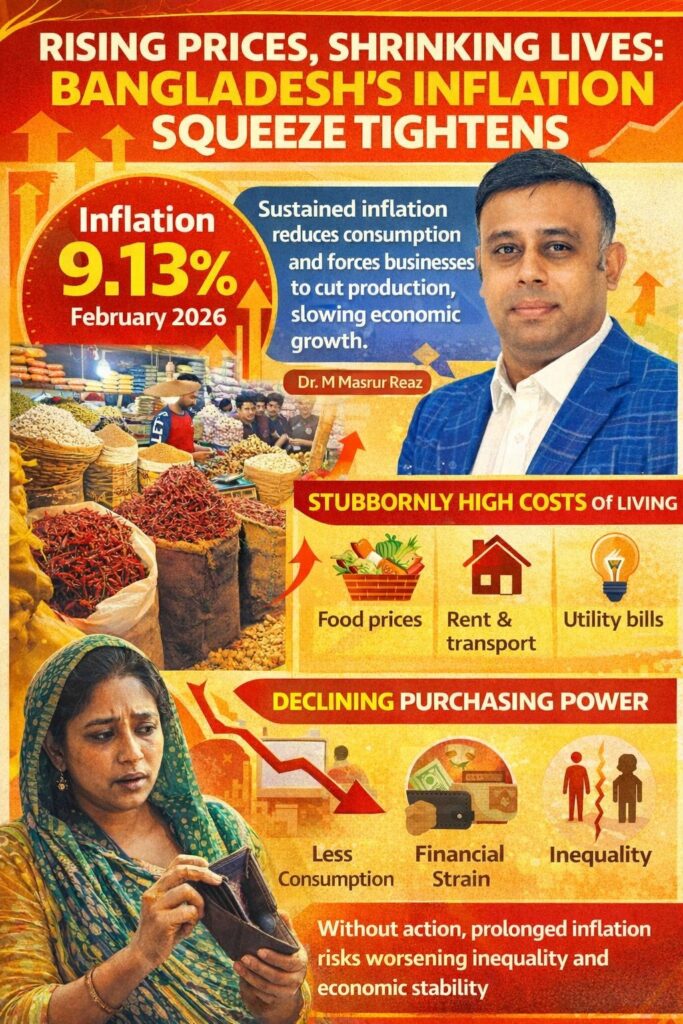
The cost of living in Bangladesh is rising once again- and with it, a growing sense of distress among ordinary people. Inflation has crossed the 9% threshold, reaching 9.13% in February 2026, according to the latest data from the Bangladesh Bureau of Statistics (BBS). Although slightly lower than the 9.23% recorded in February 2025, the figure still reflects persistent price pressure and signals continued hardship for households already struggling to cope.
For low- and middle-income families, inflation is no longer just a statistic- it is a daily reality. A simple visit to the market now involves difficult trade-offs, as people carefully calculate every purchase to stretch limited incomes. Private sector employee Baten Khan says that saving money is no longer possible; even managing expenses until the end of the month has become a serious challenge. Government employee Abdul Al Masud shares similar concerns, noting that stagnant incomes and rising costs are steadily eroding purchasing power.
This widening gap between income and expenditure is pushing many households to the brink. Essential expenses- food, rent, transportation, and electricity- are consuming an ever-larger share of earnings. What remains is often insufficient, leaving families financially vulnerable and uncertain about the future.
Economists warn that prolonged high inflation can have far-reaching consequences. Dr. M. Masrur Reaz, a noted economist and public policy expert, argues that sustained inflation reduces overall consumption while sharply diminishing purchasing power. As demand weakens, businesses and traders are forced to scale back production. This, in turn, slows economic growth, reduces employment opportunities, and discourages investment- creating a self-reinforcing cycle of economic slowdown.
The drivers of inflation are both global and domestic. Rising fuel prices in international markets- partly influenced by ongoing tensions in the Middle East- have significantly increased Bangladesh’s import costs. As an import-dependent economy, these higher costs quickly translates into increased transportation and production expenses, which are ultimately passed on to consumers. This cost-push inflation, combined with internal inefficiencies and market distortions, has intensified the overall crisis.
Beyond economic factors, there is a growing sense of frustration tied to governance and accountability. Over the years, governments have changed, yet meaningful relief for ordinary citizens has remained elusive. Allegations of corruption, misuse of power, and capital flight continue to shape public discourse. Promises of development often appear disconnected from the lived realities of the people.
At the same time, the economy continues to rely heavily on the tireless efforts of workers, farmers, and migrant laborers. Their contributions sustain production, drive remittance inflows, and help stabilize foreign exchange reserves. Yet the benefits of this resilience remain unevenly distributed, leaving many of them still burdened by rising costs.
Bangladesh now stands at a critical economic juncture. If inflation continues unchecked, it risks undermining not only economic stability but also social cohesion. As Dr. Reaz cautions, persistent inflation can weaken even strong economies over time, disrupting growth at a structural level.
The question is no longer whether inflation is rising- it clearly is. The real challenge lies in how long ordinary people will be forced to absorb the pressure, and how quickly effective, transparent policy measures can be implemented.
Without urgent and well-targeted intervention, the quiet struggle of millions may soon define the country’s economic reality.
————————————————————————————————————————————————————————
The Author:
 Asif Showkat Kallol: Works for a German-based online outlet, The Mirror Asia, and as Head of News and Contributor, Pressenza- Dhaka Bureau.


