

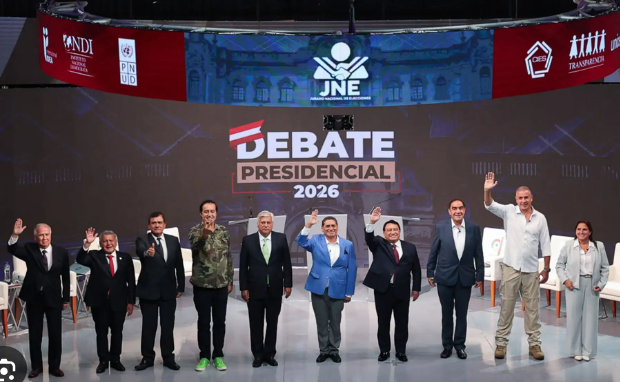
With less than three weeks to go before the general elections for the five-year term, Peru held the first round of the 2026 presidential debate, featuring 11 presidential candidates at the Lima Convention Center; The event was organized by the National Elections Board (JNE) and was marked by confrontation and attacks among the candidates, with proposals that offered little in the way of innovation and lacked a clear commitment to resolving the country’s major problems.
Participating in this first session were candidates Marisol Pérez Tello (Primero la Gente party), Alfonso Lopez Chau (Ahora Nación), Carlos Alvarez (País para todos), Rafael Lopez Aliaga (Renovación Popular), Cesar Acuña (Alianza para el Progreso), Wolfgang Grozo (Integridad Democrática), José Luna (Podemos Perú), Fernando Olivera (Front of Hope), Yonhy Lescano (Popular Cooperation), Alex Gonzales (Green Democratic Party), and José Williams (Avanza País).
The debate was divided into four segments: “Public Safety and the Fight Against Crime,” “Citizen Questions,” “Public Integrity and the Fight Against Corruption,” and “Closing Remarks.”
Among the issues highlighted by the candidates—which often lacked specifics on “how” they would be implemented—were: support for young people through investment in education, university scholarships and loans for young people, and graduate scholarships abroad; creation of a National Transparency Authority, life imprisonment for corrupt officials, civil death for corrupt individuals, special economic zones, the fight against illegal mining, an open economy and industrialization, and modernization of the state through technology, among others.
Two more dates for debates
To complete the debate among the 35 candidates for the Presidency of the Republic, the next session will be held tomorrow, Tuesday, March 24, featuring the following candidates: Charlie Carrasco (United Democratic Party of Peru), Avaro Paz de la Barra (Faith in Peru), Ricardo Belmont (Civic Works Party), Francisco Diez-Canseco (Peru Action), Fiorella Molinelli (Strength and Freedom), Armando Masse (Federal Democratic Party), George Forsyth (We Are Peru), Carlos Espá (SíCreo), and Carlos Jaico (Modern Peru); as well as Vladimir Cerrón (Free Peru), Roberto Sánchez (Together for Peru), and Walter Chirinos (PRIN).
And on Wednesday, March 25, the following candidates will conclude their presentations: Ronald Atencio (Venceremos), Paul Jaimes (Progresemos), and Antonio Ortiz (Salvemos al Perú), Enrique Valderrama (Peruvian Aprista Party), Roberto Chiabra (National Unity), and Mario Vizcarra (Peru First); Jorge Nieto (Good Government Party), Keiko Fujimori (Fuerza Popular), and Mesías Guevara (Purple Party), Herbert Caller (Patriotic Party of Peru), Rafael Belaunde (Popular Freedom), and Rosario Fernández (A Different Path).
Proposals with commitment?
It should be noted that the democratic conditions for Good Governance, proposed in the Historic Citizens’ Agreement (AHC), as well as by other organized civil society organizations, were adopted by some candidates who proposed: scholarships for university students, life imprisonment for corrupt officials, eco-industrialization, among others. However, many of the proponents have not yet signed the Historic Agreement, which casts doubt on their commitment to its implementation.