
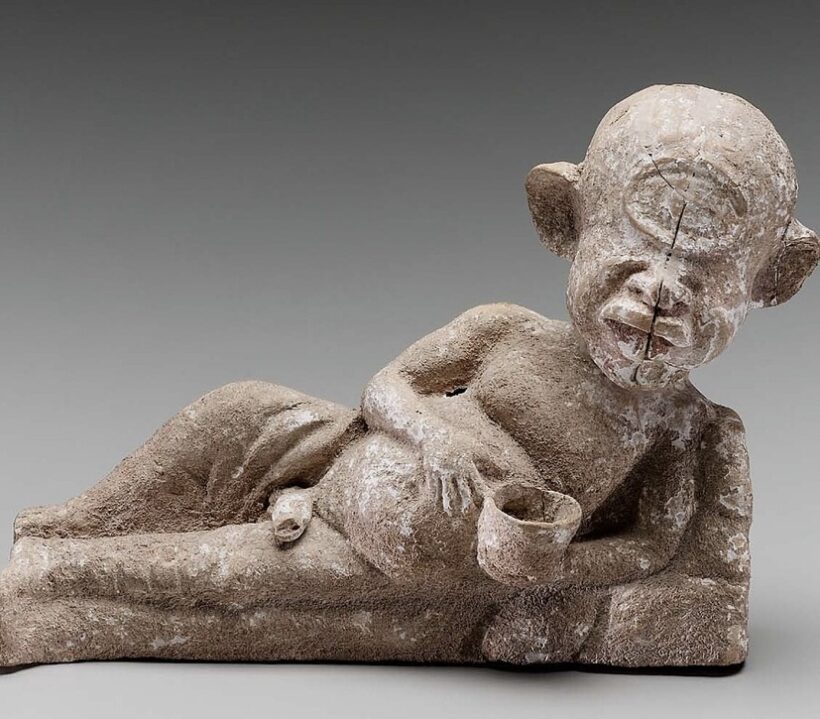
(Credit image Wikipedia: patriarchal ancestors, the cyclops monsters drinking wine)
Today most occidental organizations are rooted in historical European, Greco-Roman, and Judeo-Christian traditions. Even though the women’s movement has succeeded to bring great changes in the world, these organizations and structures still influence the world and events with a monocular vision – (a cyclops’ vision). In fact, throughout centuries these organizations and ways of thinking created monsters, wars and destruction.
For thousands of years political, religious and economical structures enforce the domination of one gender over public life while the other parts of humanity, ‘women’, were relegated to the domestic and reproductive sphere.
In recent history a huge equality movement generated a moral force that never stopped since a few centuries. It is the feminist movement that addresses issues such as the right to vote, property rights and education for women. Over the last century we saw the rise of diverse voices, such as women of color and indigenous women advocating for social and cultural equality.
More recently with the introduction and the use of digital platforms for activism issues, sexual harassment, body positivity, and gender identity gained momentum as various groups used those devises and struggle against sexual violence and discrimination. The used of digital platforms gained momentum for the liberation of women living under fanatical religious and authoritarian regimes.
In our book Swinden explains that the great paradox of the liberation of women has been that as women have struggled for equality in order to be accepted and heard in situations other than their roles as mothers and wives. Women had to show that they could do the same things and the same job as men. It was only through these various demonstrations that they start the process of equality in the world
While many Western societies were undergoing shifts toward equality, the foundational and historical structure of the patriarchy and its structure of thinking remain a powerful influence on modern organization. This phenomenon is possible because it is deeply embedded in history. In fact, the patriarchal structure is normalized and internalized by men and women and therefore difficult to perceive and to challenge.
For Michel Foucault, French philosopher, power, or what I would call patriarchalism is not concentrated in a specific “place,” in the State, as communists believe, or in capital, as capitalists believe: power is everywhere. In the various social institutions, in religions and in the families, it is linked to the specific knowledge with which it has historically been constituted. This power is linked to men and women’s bodies and minds. Power-knowledge possesses constructive, not merely repressive, disciplinary techniques and strategies through which it is reproduced and internalized, that is, transformed into various actions.
Thus, for Foucault the individual ends up believing that they are free. The “subject” (man and woman) becomes a product of domination, an instrument of power. Power and these olds ways of thinking, therefore, not only represses, but also shapes, trains, and constructs objects, structures, and organizations, models to follow, rituals of truth, and disciplined individuals. (Salvador Pulleda, p. 213)
The patriarcal power remains as it was 300 years ago, and as it was 3,000 years ago.
But today as everything is moving rapidly and we are witnessing the beginning of the first planetary civilization once again we see that the old ways of thinking remain and blocked the planetary civilization advancement. In fact, we witness the struggle between giant ‘cyclops’ and the patriarchal structure with the biggest stick wins spaces and resources around the globe.
But for the first time in history the struggle between these patriarchal political and religious structures, (the cyclops with monocular vision) has the ability to destroy the planet and contrary to our ancestors we don’t have nowhere to run – but only into our collectives and individual reveries which, will not save us from a global collapse.
Today the patriarchal structures are completely detached from the global sensibility of the present moment. They are detached from human suffering and from the vital necessity of the human consciousness to amplify its operatives in response to the gestation of the first planetary civilization!
We need to comprehend that for millennia, humankind has been conditioned by patriarchal power. This way of thinking is similar to a monocular vision. Since millennia’s human existence is perceived through the characteristics of one gender and its neural biases. Yet the human species is composed of two genders: men and women.
Maybe by starting to celebrate the slight difference that exists between male and female thinking processes we could change the old monocular ways of seeing and thinking. Seeing with only one eye reduces the depth perception of the human mental space. In fact, the monocular field of vision is approximately 170° instead of 200° with a binocular vision. Consequently monocular vision thinking reduces the ability to judge and to adapt to a new landscape.
According to Swidden, the separate sources of seeing of our species is not capable of producing important change. But by joining them we come with a similar process of the binocular vision, where two slightly different images produced by the left and the right eyes overlap and result in a new quality of images.
In her essay, Rohn goes in the same direction as Swinden and explains the most important themes of our time: the conditioning of women and men to a way of being that limits their progress and the advancement of humankind. Rohan explain how in way of being of the subject-consciousness-world structure has persisted for millennia and limits the expansion of the space of representation in order to resolve increasingly complex problems and situations.
In fact, the binocular vision would produce a new quality of images and reveal to our species a new mental space. But the first step toward this change lies in better understanding how imagery can serve as a support for joining our separate monocular vision.
We have evidence that our ancestors developed a binocular vision. Archaeologists found several objects dated 300,000 that reflect this way of thinking. Rhon establishes the historical moments where determining situational factors formed the original spiritual, mental and psychosocial experiences and the human tendency that continues moving within the depths of our personal and collective landscape. But this moment also pinpoints the moment when this original tendency became damaged with the consequences of a fissure and rupture that continues to grow without halting.
Rhon mentions that certain internal sensibilities have become blocked, absent, but not lost and proposes a type of psychosocial spiritual transference that could recover our original essence and liberate its expression without limitations or deformations. It is quite possible that the blockage of our internal sensibilities is due to the development of the monocular view of our species.
Rhon explains: to be in contact with the whole potential of our tendency, our species needs to live and move on common ground. In the last era, the sacred feminine which was previously undoubted, slowly became denied and eliminated as a presence in our landscape. The rupture in our shared collective tendency weakens and halts the evolution of our species. We cannot advance together as our tendency is about the “we,” it is the tendency of the species. The signs are within us and all around us demonstrating so very clearly that we are moving down the wrong track.
In a globalized world, when we try to apply solutions to complex situations from the perspective of the patriarchal monocular way of thinking, it simply doesn’t work and creates more problems and ‘cyclops’ struggles among monsters. The world has changed. We have learned to live in a globalized world, we have learned from other cultures and religions but most of all we have learned to live together as one common species.
To open a new horizon of evolution we must quickly consider the possibility to integrate a binocular vision that will open a new mental space and liberate the human being from the old ways of thinking. This new mental space will enable the human consciousness to amplify its operations and give new responses to complexity of our global world.
———————————
Sources:
Puledda, Salvatore, 2000, Interprétations de l’humanisme, collection Nouvel Humanisme, Paris, 235 p.
Rohn Karen, 2018, Reflections on a text in a personal letter from Silo, Parks of Study and reflections, Argentina.
Swinden, Silvia, 2006, From Monkey Sapiens to Homo Intentional. The Phenomenology, Adonis & Abbey publisher, UK, 253 p.