

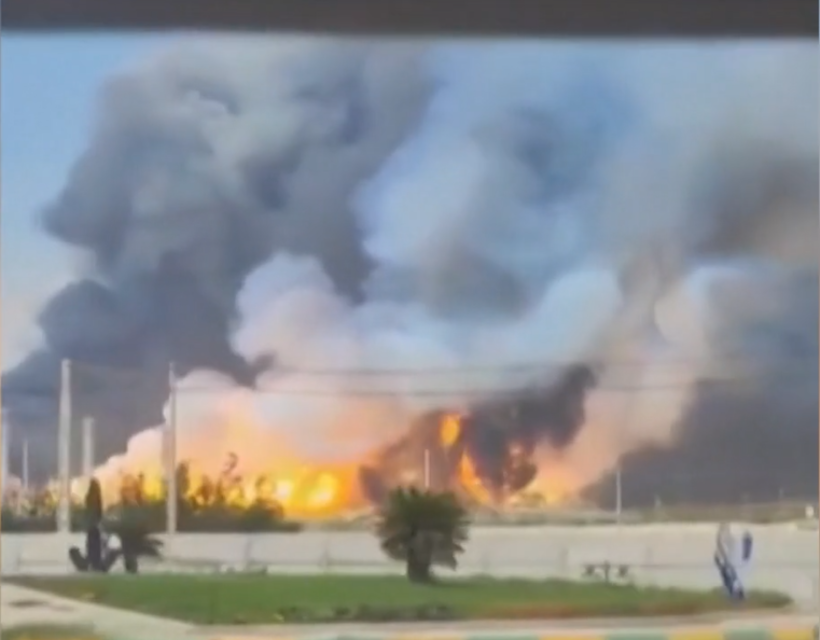
The ecological destruction and the poisoning of the population continue with the attacks by the U.S. and Israel on Iran, as well as with Iranian attacks on the Gulf states.
By Klaus Moegling
The Current Situation
The Iranian mullah regime is hostile toward its own people and obsessed with the idea of destroying Israel as a state.
Yet negotiations were underway that were aimed at defusing the nuclear and missile programs. Despite this negotiated solution, which was considered both possible and realistic, an attack was launched on February 28, 2026. Once again, a U.S. administration is destabilizing the Middle East. The Israeli government—which in parts is far-right extremist—stands by its side.
Both states are causing immeasurable suffering and exacerbating the situation of the already oppressed people in Iran. The military escalation between Israel and Iran, as well as Iran’s militant allies—Hamas, Hezbollah, and the Houthis—is dragging the Middle East into yet another human and ecological catastrophe. The Iranian regime, prepared for and organized to counter Israeli and U.S. attacks, launches counterattacks against the infrastructure of more than a dozen oil-producing nations. Oil refineries and oil fields go up in flames, polluting the air, causing acid rain, and poisoning the groundwater.
Once again, thousands of people die from the direct impact of missiles, drones, cluster munitions, and grenades. An entire region is forced to take constant refuge in bunkers and basements or is fleeing the cities. The global economy is in crisis due to the—already foreseeable—blockade of the Strait of Hormuz for oil shipments. Gas, oil, and gasoline prices are skyrocketing, and most stock market values are plummeting.
And all of this because a U.S. president lost patience and refused to wait for the largely existing outcome of negotiations?
Certainly, this was not merely a matter of Donald Trump’s lack of patience; behind it lay the geostrategic and economic interests of the U.S., as well as a mix of Israel’s imperialist and security-related motives.
U.S. and Russian oil companies, as well as the international arms industry, are currently realizing above-average returns and are the winners of this destruction.
The Madness of Ecological Destruction in Iran, the Gulf States, the Gaza Strip, and Ukraine
Journalist Angelique Chrisafis reports in The Guardian on apocalyptic conditions in Iran—and particularly in Tehran—following the attacks on Iranian oil storage facilities:
“The state environmental agency is advising people to stay indoors. The Iranian Red Crescent is warning of possible acid rain caused by toxic chemicals and recommends not turning on air conditioners. Additionally, food supplies should be given special protection. The governor has been urging people for days to wear masks as soon as they step outside.”
People are left to fend for themselves. There are hardly any masks or inhalers available.
But the Iranian regime, too, does not care about the ecological destruction and the associated health risks to the population, and it is deliberately targeting oil storage facilities and oil tankers belonging to Gulf states.
Journalist Susanne Aigner writes in ‘Telepolis’:
“The toxic legacy of the burning oil tanks is already a warning to the world that the price of war could also be the destruction of our shared future. The full consequences of the environmental disaster in Tehran will likely only become fully apparent in the coming years. For when the smoke has cleared, the toxins will remain in the soil and water and in people’s bodies.”
Nor do we know what else to expect due to the ongoing attacks on Iran’s nuclear facilities and how much radioactive radiation this will cause.
The Israeli government’s response to Hamas’s brutal attack in Israel was completely disproportionate. The military retaliation in the Gaza Strip claimed approximately 70,000 lives—more than half of whom were women and children. In addition to the horrific suffering of the surviving Palestinians, this retaliation also caused catastrophic environmental destruction.
German journalist Marisa Becker (2026) speaks of an ecocide in Gaza—that is, the attempt to systematically destroy a population’s natural living conditions in order to annihilate their existence.
In this context, she refers to the United Nations Environment Programme (UNEP), which estimates the rubble pile to reach approximately 61 million tons by September 2025. This rubble is reportedly laced with unexploded ordnance, asbestos, and chemicals. Untreated wastewater flows into the ground and into the sea unfiltered. Furthermore, Becker cites documentation from the NGO ‘Forensic Architecture’: Approximately half of the wells in Gaza have been destroyed. Two-thirds of the water tanks are no longer usable. 83% of the vegetation has also been destroyed. 70% of agricultural land is no longer usable. Nearly half of the greenhouses have been destroyed.
Olena Melnyk and Sera Koulabdara (2024) estimate that approximately one-third of Ukrainian soil has been contaminated by the war with toxic substances such as lead, cadmium, arsenic, and mercury. Soil and its fertile layer were formed over thousands of years and have now been poisoned and rendered unusable for agriculture within just a few years of war.
The war in Ukraine is leaving behind a devastated environment, for which the Russian Federation—which launched an attack in violation of international law—would have to pay billions of euros in reparations, though ultimately only the surface damage could be repaired. The profound impacts on human health resulting from inhaled emissions, the consumption of contaminated water, and exposure to radiation cannot be paid for with money.
Hungarian climate researcher Bálint Rosz (2025) summarizes the CO2 emissions caused by the war in Ukraine during the first two years of the conflict up to February 2024 and compares this to the annual emissions of 90 million vehicles with internal combustion engines:
“As more and more experts are trying to point out, the Russia-Ukraine war is also causing significant environmental and climate damage. The latter could be a particularly worrying development, as human civilization itself is fighting its own war on climate change. According to preliminary estimates by De Klerk and colleagues, during the first 24 months of the war (from February 24, 2022, to February 23, 2024), military activities and the destruction of related infrastructure resulted in significant excess greenhouse gas (GHG) emissions, further exacerbating global climate change. Cumulative emissions over this period are estimated to be around 175 million tonnes of carbon dioxide equivalent (tCO2e), equivalent to the annual emissions of an advanced industrialized country.”
The criminal offense of ecocide—a charge that is likely to be met in all three cases (Iran, Gaza, Ukraine)—refers to the systematic and deliberate destruction of the natural foundations of life as part of warfare. Certainly, the states involved—in addition to other war crimes—could be charged with ecocide before international courts. Yet the states involved do not recognize this jurisdiction, as they are well aware that they will be systematically violating the ecological integrity of the planet, international law, and human rights.
Furthermore, the military is one of the largest global polluters not only during military operations—i.e., in war—but also in its day-to-day military operations, i.e., in regions not yet affected by war. The global military can be regarded as one of the most dangerous institutional contributors to climate damage, causing massive harm even during normal operations. One can assume that the climate damage caused by the normal global operations of the U.S. military is comparable to the greenhouse gas emissions of three medium-sized countries. It is estimated that routine military operations alone already account for 5.5% of global climate-relevant emissions. This figure does not yet include the ecological damage caused by wars.
Conclusion: Fossil Fuels Are a Driving Force Behind War
The natural world ranks very low on the priority list of those who make decisions about war and peace. First, these warlords do not care about the natural world, and second, they also do not care that people (and animals) suffer as a result of the destruction of nature.
These decision-makers are completely detached from the planet’s ecology; they think in purely instrumental terms, and their priorities are power, oppression, oil, rare earths, and money.
Perhaps humanity will not be able to defend itself against these obsessed rulers, but the planet will do so thoroughly in the medium term—and those who suffer the consequences will be all those who are not responsible for this.
Nevertheless, it is important not to give up and to do everything possible to ensure that things turn out differently. A peaceful and sustainably developed world is (still) possible.
The crisis in the global supply of fossil fuels triggered by wars holds—in addition to the negative consequences it causes—opportunities for an ecological shift toward the increased use of renewable energies. The peace- and ecology-oriented journalist and author Franz Alt therefore writes in his article “Sun and Wind Don’t Need the Strait of Hormuz”:
“One of the most crucial questions for the future is: War for oil or peace through the sun? The Iraq War, the Afghanistan War, the war over Venezuela, and now the Iran War: All these wars were or are wars over fossil fuels. Sun and wind, however, are gifts from heaven. They are energies of peace.”
Klaus Moegling is a political scientist with a postdoctoral qualification and a university professor; he has taught at various universities and teacher-training institutions, including the Universities of Hamburg and Marburg, and most recently at the University of Kassel, and has been active in the peace and environmental movements as well as in educational initiatives. He is the author of the book “Neuordnung. Eine friedliche und nachhaltig entwickelte Welt ist (noch) möglich” (Reorganization: A peaceful and sustainably developed world is (still) possible), published open access.



