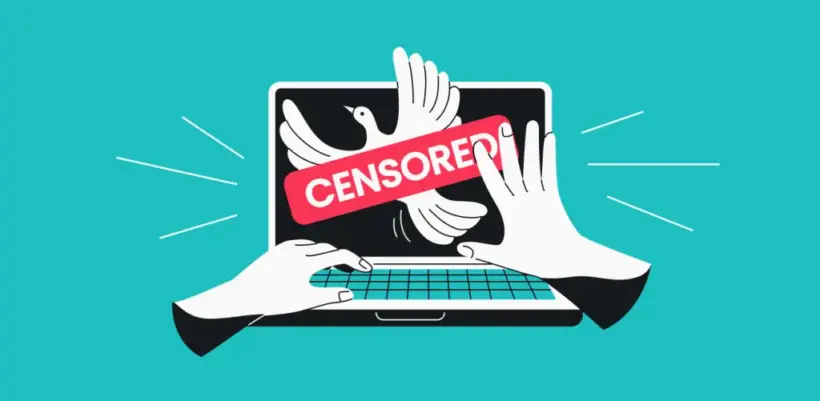
“We witness the attempted abolition of the West’s relatively free media and open democratic debate about international affairs.
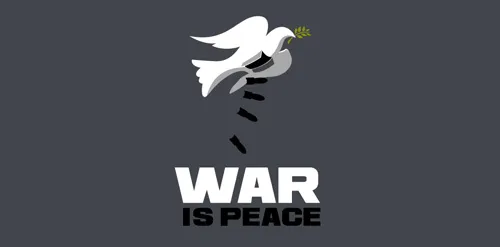
War is peace, aggression is defence.
The Internet and social media are no longer the open, decentralised public sphere they were twenty years ago. They have become curated, filtered, and politically manipulated information systems that deserve to be ignored.
TFF now navigates around that.”
Jan Oberg, TFF director and co-founder
Over the last decade, we at The Transnational Foundation have witnessed a profound transformation in the global information environment. What once felt like an open, pluralistic digital space has gradually become a tightly managed, politicised system in which certain narratives are amplified while others are quietly pushed aside.
This shift did not happen overnight. It unfolded in waves, beginning around 2016 and accelerating dramatically in 2022. And because TFF works precisely in the fields where narrative control has tightened the most — peace, conflict analysis, neutrality, and critical geopolitics — we have felt these changes directly.
As we have maintained for long, peace has been disappeared in media, research and politics. It’s fading…
Furthermore, to deliberately deprive citizens of their right to choose the information they need to shape their opinions and worldviews is an act of violence, and it is a human rights violation too.
2016–2017: The First Turning Point
The year 2016 marked the beginning of a new era. The US presidential election and the Brexit referendum triggered a political and media panic about “fake news,” “misinformation,” and “foreign influence.”
In Washington, the US Congress held a series of high‑profile hearings in 2016–2017 where Facebook, Google, and Twitter were publicly pressured to “take responsibility” for political content.¹
In Brussels, the European Commission began drafting what later became the Code of Practice on Disinformation (2018), a framework that effectively required platforms to police content or face regulatory consequences.²
For TFF, however, the most immediate impact came from the war in Syria.
Syria: A Test Case for Narrative Control
In December 2016, I was on a fact-finding mission to Damascus, Syria and visited Aleppo just as the eastern part of the city was being retaken by government forces. What I saw on the ground — the complexity, the suffering on all sides, the absence of the simplistic good‑versus‑evil narrative dominating Western media — compelled me to write analyses that challenged the prevailing story, the Western constructed narrative, or supposedly only truth.
The reaction was immediate. I contacted about 40 Western mainstream media – most of which were not present in Aleppo at the time (and none from Scandinavia). They either never answered, refused my offer to publish my articles and/or my photos of the utter destruction, or told me I was lying.
On Facebook, organic reach fell from 1100-1200 to 10-15 people, or about 1%, during the months right after.
Articles that normally reached many thousands of readers suddenly vanished from visibility. Engagement collapsed. Search results buried TFF far below mainstream outlets. In 2017, Google/Alphabet Executive Chairman Eric Schmidt said at a security conference that Google had de-ranked alleged propaganda sites; TFF was obviously one of them.
It became clear that something had changed — not because of any error on our part, but because our reporting did not align with the dominant geopolitical framing of the conflict.
This was not unique to us. Reports from the Atlantic Council’s Digital Forensic Research Lab³ and the US State Department’s Global Engagement Center⁴ repeatedly framed alternative Syria analyses as “propaganda.”
Platforms responded by quietly down‑ranking such content. Not banning it — just making sure fewer people ever saw it.
2018–2020: The Rise of “Authoritative Sources”
After the Cambridge Analytica scandal, platforms introduced a new doctrine: boost “authoritative sources” and suppress “borderline content.”
Google and YouTube explicitly announced that mainstream media and government‑aligned outlets would be prioritised.⁷ Independent or alternative voices would be algorithmically demoted — even if they violated no rules.
This was the period when TFF began to see a long, steady decline in visibility. Analyses on NATO, Syria, peace negotiations, and Western militarisation — topics we had covered for decades — were suddenly treated as problematic by automated systems designed to privilege establishment perspectives.
A striking confirmation came from my own Facebook activity. Posts about Danish and Swedish domestic issues continued to receive high engagement. But posts about international affairs — NATO, Ukraine, Syria, US foreign policy — received almost none.
The contrast was too sharp to be explained by audience interest. It was clearly issue‑based filtering, not personal targeting.
“The open Internet is gone; what remains is a curated reality shaped by invisible hands of the militarist kakistocracy.”
2022: The Ukraine War and the Second Turning Point
The Russian invasion of Ukraine triggered the most aggressive wave of content control in the history of digital platforms.
Russian state media were blocked outright under EU sanctions.⁸ Alternative analyses were removed or suppressed. Content advocating diplomacy, neutrality, or negotiated solutions — the very essence of TFF’s mission — was frequently labelled “misleading” or “harmful,” even when factually correct.
The European Commission issued emergency guidance under the Digital Services Act requiring platforms to remove certain content within hours.⁹
The atmosphere resembled wartime information management.
This was not an isolated case. It reflected a structural shift in how platforms handle independent, peace‑oriented, or non‑aligned geopolitical analysis.
During this period, TFF experienced what can only be described as soft de‑platforming:
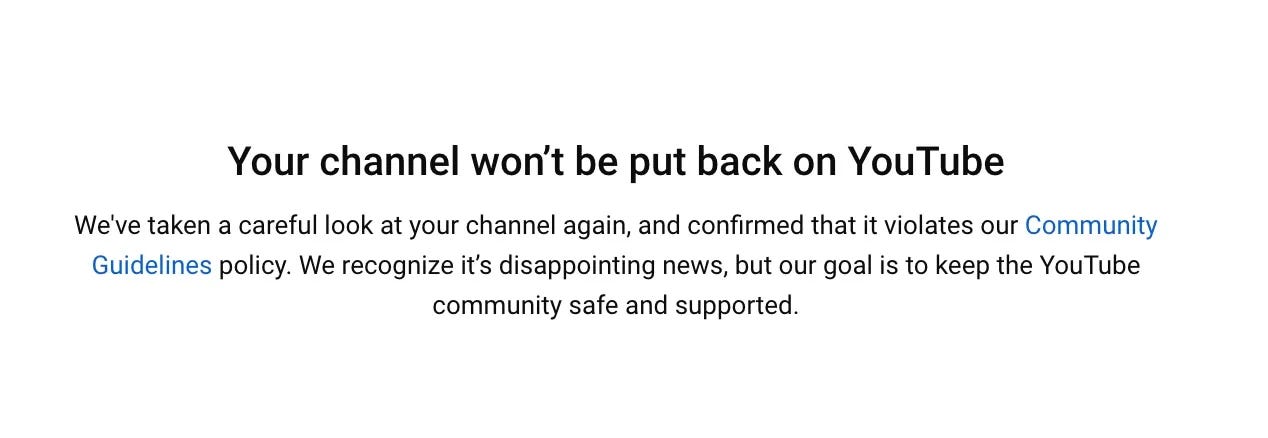
- In 2024, our YouTube channel remained online but became effectively invisible. I was blocked and have not been able to log in ever since. No explanation given.
- Videos of interviews on, say RT, were deleted (that is how weak NATO’s argument were).
- Channels were removed without explanation.
- Vimeo blocked TFF entirely, took down our channel there and referred to some “regional changes” – presumably those of the EU.
- Google search no longer displayed TFF content prominently.
- WordPress’ Blaze refused to accept a boost of the TFF Statement on the Genocide in Gaze and another article after that.
These are classic examples of “plausible deniability censorship”: the content is not removed, but it is buried so deeply that almost no one will find it. The reason? If taken down completely, it could be criticised as censorship. Instead, you can still see TFF’s YouTube channel – but it is a dead archive. I cannot even take it down. Neither can I press Like or comment on any video on YouTube because you have to be logged in. And I as an individual content creator, am blocked from logging in and told that the channels I am responsible for will not come back, and that includes my photography channel on YouTube!
A Structural, Not Personal, Phenomenon
It is important to emphasise that this is not a conspiracy. It is the predictable outcome of:
- political pressure from governments
- regulatory incentives in the US and EU
- platform partnerships with major think tanks
- automated systems designed to prioritise “authoritative” narratives.
Independent organisations working on peace, neutrality, conflict resolution, and critical of militarism, warfare and the US/NATO-dominated geopolitics have been disproportionately affected because their work often challenges dominant policy frameworks.
TFF’s analyses fall into categories that have been systematically down‑ranked since 2017:
- NATO’s expansion
- the wars in Syria and Ukraine
- Western militarisation
- peace proposals and diplomacy
- critiques of great‑power politics
These topics are not banned — but they are algorithmically deprioritised. If a spade is still a spade, the word is censorship – the thing the ‘free’ West regularly accuse other states of practising as if it did not do such a thing itself. It is simply psycho-political projection…
Rebuilding Digital Sovereignty
These developments have forced us to rethink our digital strategy. The open internet of the early 2000s no longer exists. Today, none of us knows how far this may go, but it is reasonable to assume that it will increase in proportion to the decline of the West’s legitimacy, economics, politics and culture and its need to justify its systematic international law-violations and its militarism to death.
In short, the time of Western uni-polar dominance over the rest of the world is over – and those of us who have predicted that for decades are not that popular – compared with, say, the commissioned researchers at state-financed research institutes and people at the state public service media.
To prepare for even worse times and to preserve our 40 years of work and ensure long‑term accessibility and survivability, we are building a new sovereign digital ecosystem through 2026:
- TFF will remain truly independent. We remain all-volunteer and exclusively people-financed and, as a principle, never accept government or corporate funds. Thus, the word “truly” to distinguish us from all those who call themselves independent but are financed by NATO and other governments.
- Substack will be the main TFF’s living daily voice with TFF Associates and also the best articles, videos and Notes outside our own circle of 50 Associates. Because Substack is neither a social media nor a homepage platform (like WordPress) but an article/newsletter platform that distributes content by email. There is no algorithm, no bots and no de-ranking of content, and so far, its leadership is does not seem to take order – like the high-tech social media companies – and didn’t pay millions to Trump’s campaign or sit in his office at his command. Stay like that, Substack!!
- The Transnational homepage – The Transnational – and my Nordic-related Jan Oberg blog will serve a) people who are not on Substack, and b) as our archive or museum, predominantly holding what TFF Associates produce.
A brand-new version of The Transnational will soon be launched, featuring everything we have produced over 40 years. Its materials shall be accessible after the founders are gone and the institution is closed down. We believe we are part of the history of peace, peace and future research and other intellectual history. - All of it will be stored both in the cloud, on different servers and on local drives for master copies – to reduce vulnerability and optimise survivability.
- We’ll continue to use Sendible to share posts across selected social media, but engage very little in debate there.
- Finally, we shall continue to accept invitations from media worldwide – video channels, newspapers and magazines – where we reach thousands and even millions of peace-interested people who also sense the need for diversity and self-reflection. This happens through a) alternative Western media, blogs and video channels and b) millions in the Rest of the world, in China, India, Russia, Vietnam, and elsewhere.
Fortunately, peace is only censored in the West, 12% of humanity – and there is another world out there that makes us feel it is meaningful to do what we do. Every day for now 40 years. The videos and Zoom sessions from these media are all posted in the TFF Video Collections on Substack. Articles from them appear on Substack and on The Transnational.
This outreach strategy and its elements reflect the – dark – times and the place we live in.
Even we, a research and public education think tank devoted to the UN Charter norm of making peace by peaceful means, have to think in terms of security politics – paradoxically against those who say they work for our security.
This multi‑layered approach aims to ensure that TFF’s analyses, peace philosophy, and historical memory remain accessible to future generations, regardless of platform policies or geopolitical pressures.
Working for peace resembles the plight of Sisyphus in Albert Camus’ famous novel, who works hard to get that stone to the top of the hill only for him to see it roll down again and again. So subscribe below, if you haven’t already.
I hope you will continue to appreciate and support what we do, how we do it, and that we continue despite the ways of the Western world and its world-threatening, self-destructive militarism.
References
- US Senate Intelligence Committee Hearings on Russian Interference (2017–2018).
- European Commission — Code of Practice on Disinformation (2018).
- Atlantic Council DFRLab — Reports on Syria and influence operations.
- US State Department — Global Engagement Center Reports.
- US Senate Intelligence Committee — Report on Russian Active Measures (2019).
- EU East StratCom Task Force — EU vs Disinfo.
- YouTube — “Authoritative Sources” and “Borderline Content” Policy (2018).
- EU Council Regulation (EU) 2022/350 — Restricting Russian media.
- European Commission — Guidance on the Application of the Digital Services Act to Crisis Situations (2022).
- Why Peace Content Is Quietly Down‑Ranked Online – from February 2026.
- My experiences with media over 50 years – In my non-memoires called WorldMoires.