

by G M Forhadul Mazumder (Dhaka Bureau)
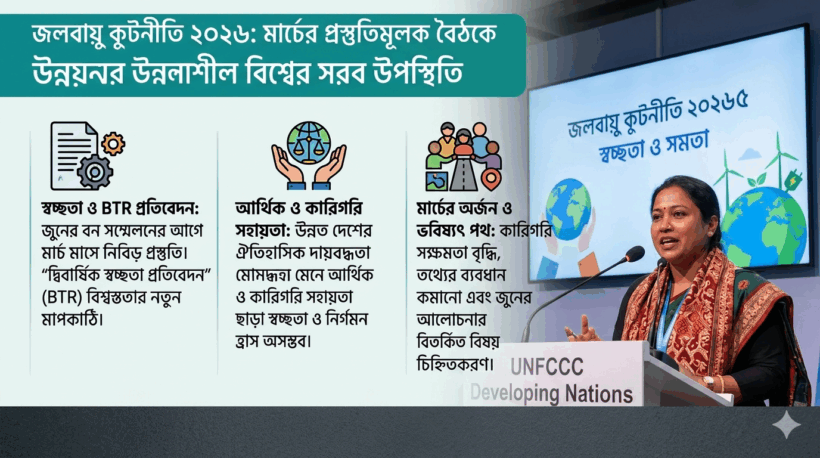
In the fight against climate change, transparency and accurate data are now required, not just promises. Throughout March, intensive preparations took place ahead of the major negotiations scheduled for June 2026 in Bonn. As a result, the ‘Biennial Transparency Report’ (BTR) is now being regarded as the new benchmark for credibility in assessing countries’ progress in emission reductions.
During the technical meetings in March 2026, developing nations clearly stated that maintaining transparency is impossible without financial and technical assistance. Future climate diplomacy will be built on the foundations of equity and differentiated responsibilities.
Since the beginning of March 2026, a new momentum has emerged in international climate diplomacy. Although these were not formal summits, the series of preparatory meetings and technical discussions under the United Nations Framework Convention on Climate Change (UNFCCC) has laid a solid foundation for the ‘Subsidiary Bodies’ (SB) sessions to be held in Bonn, Germany, this coming June.
The central theme of these meetings was ‘Transparency.’ This is not merely a mechanical process but a political tool for rebuilding trust among nations regarding global climate action.
A key focus of the March discussions was the Biennial Transparency Reports. These reports are now essential for monitoring how well countries are fulfilling their commitments under the Paris Agreement. Delegates conducted in-depth analyses, particularly regarding the challenges of report submission methods and ensuring data accuracy.
According to experts, the primary goal now is to bridge the data gap between developed and developing nations. To this end, several special sessions were held to enhance technical capacity, which will make national reviewers more efficient.
Discussions grew intense during high-level consultative meetings regarding climate finance and adaptation. Developing countries made it clear that maintaining transparency and reducing emissions is only possible if adequate financial and technical support is guaranteed.
The meetings reaffirmed the principle of ‘Common But Differentiated Responsibilities’ (CBDR). This unresolved issue- that developed countries responsible for historical pollution must bear a greater financial burden- remains at the heart of the 2026 negotiations.
Observers believe that while these March activities did not result in the signing of major treaties, they successfully set the agenda for the Bonn Climate Change Conference in June. These preparatory meetings succeeded by addressing technical complexities and aligning the political positions of various countries. Key achievements from the month-long meetings include:
Coordination: Strategic alignment between different national negotiation groups.
Technical Readiness: Building a skilled workforce to implement the transparency framework.
Future Roadmap: Identifying controversial issues for the formal discussions in June.
The intensive engagement throughout March proves that the global community is no longer content with mere promises; it is determined to make every step of implementation measurable. 2026 is set to be a decisive year in the battle against the climate crisis, with its trajectory being shaped by these behind-the-scenes discussions.
————————————————————————————————————————————————————————
The Author:

G M Forhadul Mozumder. ‘Staff Correspondent, Pressenza- Dhaka Bureau’.



