

by Asif Showkat Kollol (Dhaka Bureau)
Bangladesh’s banking sector recorded a significant drop in defaulted loans in the final quarter of 2025, offering a measure of relief after months of steep deterioration. Yet economists and banking experts caution that much of the improvement may reflect accounting adjustments and policy relaxations rather than a durable recovery in loan discipline.
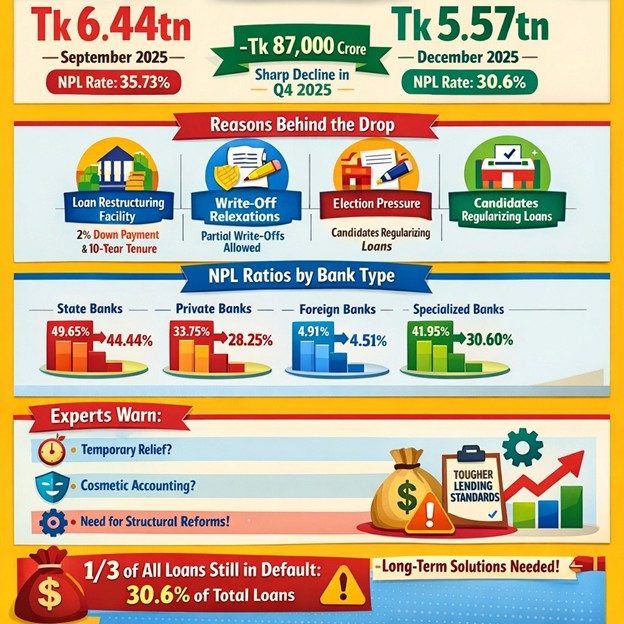
According to data from Bangladesh Bank, non-performing loans (NPLs) fell by nearly Tk87,000 crore between October and December. By the end of December 2025, total defaulted loans stood at approximately Tk5.57tn, equivalent to 30.6% of total outstanding loans.
The decline follows a surge earlier in the year. By September 2025, defaulted loans had climbed to a record Tk6.44tn- or 35.73% of total loans- after stricter loan classification rules and enhanced scrutiny under the interim administration brought previously concealed problem loans into the open. Over the course of a year, defaulted loans still rose by roughly Tk3.45tn, underscoring the scale of stress in the financial system.
Officials attribute the recent improvement to a combination of policy support measures, intensified recovery efforts and political timing. In November, the central bank introduced a restructuring facility allowing distressed borrowers to reschedule loans with just a 2% cash down payment, a two-year grace period, and a maximum tenure of 10 years. The measure was designed to help struggling businesses stabilize operations.
At the same time, rules governing loan write-offs were relaxed. In December, the central bank permitted partial write-offs for the first time, allowing banks to remove the unsecured portion of bad loans from their core accounts while treating the covered portion as recoverable. Previously, only loans classified as ‘bad and loss’ for two consecutive years were eligible for write-off, and borrowers had to be notified 30 days in advance. The revised framework shortened the notice period to 10 working days and eased other procedural requirements.
Banking officials say many defaulters took advantage of the rescheduling window, particularly as political calculations came into play. With the 13th national parliamentary election approaching, prospective candidates were required to regularize overdue loans to qualify. As a result, a number of high-profile borrowers opted for restructuring arrangements to clean up their records.
Commercial banks also stepped up cash recovery efforts in the year-end quarter, partly to present stronger balance sheets. `A simple comparison of headline figures does not capture the full picture,” said one senior central bank official, speaking on condition of anonymity. “Sustainable reduction in defaulted loans will depend on structural reforms, stronger recovery mechanisms and stricter risk assessment at the lending stage.’
Breakdowns by bank category show improvement across the board, though levels remain elevated. In state-owned commercial banks, the NPL ratio declined from 49.65% in September to 44.44% in December. Private commercial banks saw their ratio fall from 33.75% to 28.25%, while foreign banks’ NPLs edged down from 4.91% to 4.51%. Specialised banks recorded a sharper decline, from 41.95% to 30.60%.
Despite the quarterly improvement, nearly one-third of all loans in the banking system remain in default- an unusually high level by international standards. Analysts warn that unless recovery through actual repayment increases and lending standards are strengthened, the apparent progress risks being temporary.
For policymakers, the challenge now is to convert short-term statistical relief into long-term financial stability- and to prevent a fresh accumulation of bad loans in a system already under strain.
 Asif Showkat Kallol: Works for a German-based online outlet, The Mirror Asia, and is Head of News. Contributor, Pressenza- Dhaka Bureau.