

by Asif Showkat Kallol
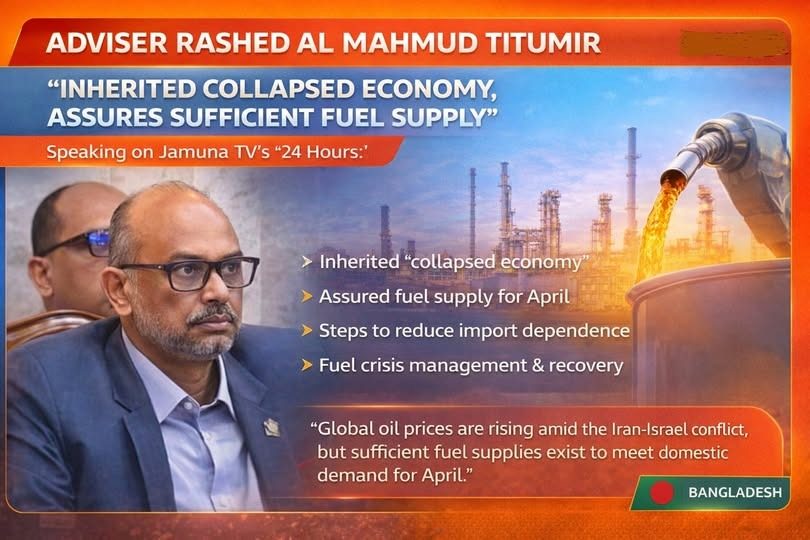
Prime Minister Tarique Rahman’s Adviser Rashed Al Mahmud Titumir, emphasized that the current administration inherited a ‘collapsed economy’ from the previous government, which left no substantial fuel reserves and took no effective steps to reduce import dependence. Despite rising global oil prices amid the Iran- Israel conflict, he assured that sufficient fuel supplies exist to meet domestic demand for April.
Speaking on Jamuna TV’s program ‘24 Hours,’ Adviser Titumir outlined the government’s approach to managing the fuel crisis, stabilizing prices, and advancing economic recovery. He stressed that the inherited economic weaknesses required immediate action, and the current measures aim to ensure adequate fuel availability, mitigate market volatility, and protect consumers.
The government adopted three main strategies to address the energy crisis. First, officials diversified supply sources, reducing reliance on a single country and securing fuel from multiple international partners. Second, the administration obtained funding through low-interest, long-term loans from the International Monetary Fund, the World Bank, and the Asian Development Bank, ensuring sufficient financing for energy imports. Third, the authorities implemented coordinated pricing, aligning domestic fuel costs with international market rates while safeguarding the interests of ordinary citizens and farmers.
The adviser addressed crowding at fuel pumps and hoarding practices. He noted that misinformation and deliberate stockpiling created artificial shortages. Officials recommended that pump owners verify supply reductions before reporting shortages. The adviser warned that storing fuel at home presents severe fire hazards. He also emphasized that the octane shortage arises from hoarding, as octane and petrol emerge as by-products from domestic gas fields.
Government caution regarding fuel price hikes stems from economic and social considerations. Price increases directly impact inflation and could amplify public hardship. Protecting the agricultural sector remains a priority, particularly during the Boro rice season, which demands substantial diesel for irrigation. Maintaining subsidies on diesel ensures manageable production costs for farmers. Authorities framed price adjustments as a measure for poverty alleviation and economic stabilization rather than populist gain.
The adviser criticized infrastructure deficiencies under the previous administration. He highlighted insufficient capacity expansion at Eastern Refinery Limited and the absence of permanent LNG terminals, which force costly monthly purchases from the international market. Addressing these structural weaknesses constitutes a core element of the current administration’s energy strategy.
Officials also discussed national debt challenges. Foreign debt rose by approximately 323-324 percent from 2008 until the previous government’s departure. Weak domestic revenue collection, capital flight, and preferential treatment of elite groups generated a self-perpetuating economic cycle. Even during the interim period, debt increased by roughly 10 billion dollars, creating ongoing fiscal pressure.
The government pursued economic reforms with clear objectives. Social protection programs aimed to prevent growth in poverty levels. Investment in agriculture and industry, stagnated under the former regime, received renewed focus. Tax reforms included the establishment of three task forces to eliminate Special Regulatory Orders (SROs) and curtail preferential practices. In parallel, the administration emphasized equitable regional development, particularly for northern agricultural zones producing potatoes, maize, tomatoes, mangoes, and lychees. Infrastructure and investment in these areas promised transformative economic effects.
The administration structured governance reforms around five strategic pillars: comprehensive state reform, inclusive socio-economic development reflecting the spirit of 1971 and other national uprisings, revitalization of the fragile economy, balanced regional development, and national cohesion through constructive parliamentary engagement rather than partisan conflict.
Fuel sector initiatives concentrated on reducing import dependency while enhancing domestic capacity. Officials expanded capabilities at BAPEX and Eastern Refinery Limited. LNG supply secured through permanent terminal infrastructure minimized reliance on costly short-term imports. The government also prepared a detailed 180-day plan aligned with constitutional budgetary constraints, providing a roadmap for the next six months, with expected implementation reflected in the upcoming budget.
The adviser stressed that Bangladesh’s energy and economic challenges result from cumulative internal and external factors, including past policy failures, global market fluctuations, and domestic mismanagement. Effective resolution requires a coherent strategy, rigorous implementation, transparency, and continuous public engagement. Authorities must monitor fuel distribution, control hoarding, safeguard inflationary stability, and support agricultural productivity while pursuing long-term structural reforms.
Overall, the government demonstrated a proactive approach to economic recovery. The combined focus on strategic financing, diversified energy sourcing, infrastructure expansion, and equitable regional development reflects a commitment to stabilizing the economy, protecting vulnerable populations, and ensuring sustainable growth. By emphasizing evidence-based decision-making and institutional strengthening, Bangladesh positions itself to navigate the current crisis while laying the groundwork for long-term resilience and national prosperity.
The Author:
 Asif Showkat Kallol: Works for a German-based online outlet, The Mirror Asia, and as Head of News and Contributor, Pressenza- Dhaka Bureau.


