

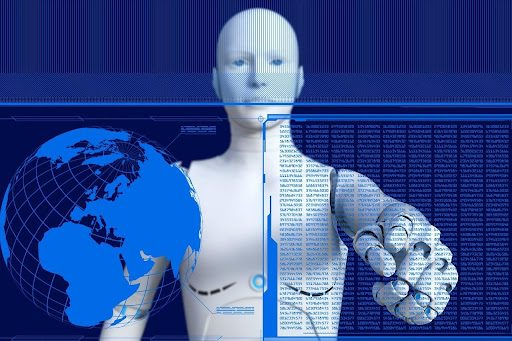
by Irshad Ahmad Mughal & Dr. Qurat al Ain Rana
In the last century, millions perished in the fires of the First and Second World Wars. Europe, proud of its philosophy and its progress, burned the world in the name of reason, nation, and superiority. Arrogance wore a uniform, marched under flags, and called its destruction destiny. We were told that humanity had learned its lesson. We were promised that charters and declarations would prevent another descent into organized madness.
Yet today, the flames are returning—no longer carried by tanks alone, but by algorithms, surveillance systems, and silent machines. The arrogance has changed its costume. It now speaks the language of efficiency, innovation, and digital order.
The great book of human rights, once written with the memory of blood still wet on the earth, is slowly being replaced. In its place stands another book—not of law, but of code. This new scripture does not ask who is just; it asks who is classified. It does not ask who suffers; it asks who is registered. It does not ask who is innocent; it asks who fits the algorithm.
Law once sought to discipline the biological brain, to restrain human impulse and tame violence through ethical limits. Code, however, is written not for the human soul but for the mathematical brain of machines. It trains the robot. It regulates the system. And in doing so, it quietly reshapes the human being into something measurable, predictable, and manageable.
Each day we celebrate new inventions—smarter devices, faster processors, tireless robots. Machines cook, guard, diagnose, and calculate. They promise precision and remove human error. But beneath this promise lies a deeper ambition: control.
New firewalls rise like invisible borders. Data is harvested, sorted, and interpreted by algorithms that know our habits before we do. Our tastes, hobbies, routines, and fears are mapped and monetized. We are segmented into categories, treated not as persons but as patterns. Soon, individuals may be judged not by their actions but by their predicted behavior.
This is not merely technological development; it is a transformation of power. The old tyrant demanded obedience. The new system demands transparency. It does not shout—it monitors. It does not always punish—it anticipates.
And in this silent architecture of surveillance, the rebel becomes suspect.
There have always been criminals and terrorists. But there have also been dissenters—those who say “no” when the world demands conformity. What happens when every movement, every word, every hesitation is recorded? When deviation from the norm is flagged as anomaly? When rebellion itself becomes a statistical irregularity?
The danger is not only political. It is existential.
Humanity today stands at a paradox. We are more connected than ever, yet more isolated. Around the world, many sense that something essential is being eroded. They think quietly, often alone, in corners of reflection. But when they speak against unchecked modernity, they are mocked as reactionaries, ridiculed by digital crowds, and silenced by the noise of mass opinion.
Fear spreads subtly. Some watch with fascination as humanoid robots dance in exhibitions—mechanical bodies moving with uncanny grace. We applaud the spectacle. Yet behind the performance lies a question we hesitate to ask: what happens when such machines are no longer dancers, but soldiers? When wars are fought by emotionless systems, executing commands without doubt, without remorse?
War once required men to confront their own capacity for violence. Machines will require only programming.
The institutions built after global catastrophe—the charters, the councils, the United Nations—were meant to defend human dignity. But if human dignity itself is reduced to data, what role remains for these institutions? When decisions are automated and justice becomes an output, can a declaration of rights compete with a line of code?
This is the crisis of our age: not simply the rise of technology, but the decline of rebellion.
To rebel, in the deepest sense, is to affirm that there exists a limit—something that must not be crossed. It is to say that human beings are more than their utility, more than their productivity, more than their digital profiles. The rebel does not reject progress; he rejects humiliation. He refuses to be reduced to a function in a system that forgets the meaning of dignity.
We stand again before a fire. It does not yet roar as it did in the twentieth century. It glows in data centers, flickers in surveillance cameras, pulses in servers across continents. But its heat is real.
The question is not whether technology will advance. It will. The question is whether humanity will advance with it—or be quietly reorganized beneath it.
In an age where code claims authority over conscience, rebellion is no longer a romantic gesture. It is a moral necessity.
Descartes declared, “I think, therefore I am.” Gide whispered, “I love, therefore I am.” Camus insisted, “I rebel, therefore I am.” Each affirmation was a defense of human interiority—a refusal to be reduced to matter, instinct, or obedience. But what will the robot say? It may declare, “I calculate, therefore I function.” Or perhaps, more chillingly: “I am programmed, therefore I obey.” In that difference lies the final boundary. For to think is to doubt, to love is to risk, to rebel is to choose. To calculate is only to execute. And if one day the machine dares to say, “I optimize, therefore I rule,” then humanity must answer—not with silence, but with the stubborn insistence that existence is more than performance, and being is more than code.
About the authors:

Irshad Ahmad Mughal

Dr. Qurat-Ul-Ain Rana
Irshad Ahmad Mughal and Dr. Qurat-ul-Ain Rana form a formidable intellectual partnership in contemporary Pakistani scholarship. Prof. Mughal, renowned for his Urdu translations of Paulo Freire’s revolutionary works and decades of teaching political philosophy at Punjab University, joins forces with Dr. Rana, an accomplished sociologist and social commentator whose razor-sharp analyses regularly grace Pakistan’s premier journals. Together, their collaborative writings for Pressenza weave rigorous academic insight with urgent social critique—bridging Western critical theory with South Asian realities to illuminate pathways for transformative change.”



