

by Kawser Ahamed (Dhaka Bureau)
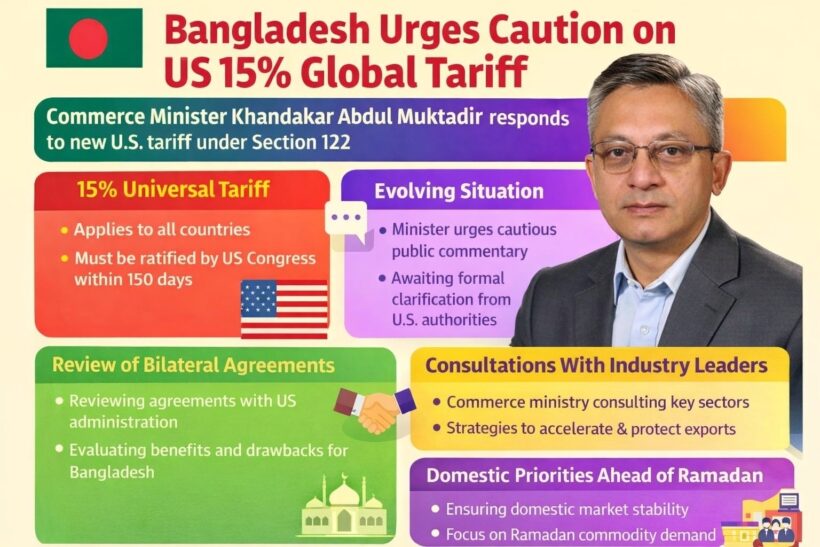
Bangladesh’s newly appointed Commerce Minister, Khandaker Abdul Muktadir, stated that the government is closely monitoring Washington’s escalating trade position following the U.S. announcement of a 15% universal tariff under Section 122. This move could have significant implications for export-dependent economies.
Speaking to journalists, the Minister emphasized that this measure is not specific to Bangladesh but applies equally to all countries. However, formal written clarification regarding the policy’s scope, implementation timeline, or potential exemptions has not yet been received from U.S. authorities.
Under U.S. law, for the tariff to remain in effect, it must be approved by Congress within 150 days of its introduction.
An Evolving Situation
Describing the situation as ‘evolving,’ the Minister called for caution in public commentary, noting the sensitivity of bilateral relations between Dhaka and Washington. He urged the media to avoid speculative or premature conclusions until further clarity emerges.
The Bangladesh economy, which relies heavily on exports- particularly Ready-Made Garments (RMG)- could face significant headwinds if the tariffs are fully implemented without mitigating measures.
Review of Bilateral Agreements
The Minister confirmed that the government is also reviewing trade-related agreements signed with the United States during previous administrations. Officials are assessing whether these provisions serve Bangladesh’s economic interests and align with current national priorities. Future courses of action will be determined after evaluating the benefits and potential drawbacks of existing commitments.
Consultations with Industry Leaders
In response to the U.S. announcement, the Ministry of Commerce has initiated consultations with representatives from key sectors, including textiles, pharmaceuticals, and manufacturing. These discussions aim to identify strategies to accelerate exports, address structural bottlenecks in industries, and safeguard competitiveness amidst shifting global trade dynamics.
Officials indicated that protecting domestic industries remains central to the government’s vision, especially as external economic uncertainties intensify.
Domestic Priorities During Ramadan
Alongside international trade concerns, the government is prioritizing domestic market stability during Ramadan, a period when demand for essential commodities traditionally surges. The Minister stated that ensuring adequate supply and preventing price volatility for critical consumer goods will be a parallel focus in the coming weeks.
Strategic Patience
Despite refraining from detailed policy disclosures at this stage, the Minister stressed that the government will act decisively if national interests are compromised. For now, Dhaka appears to be adopting a strategy of strategic patience- monitoring developments in Washington while building internal consensus.
The coming months could prove critical for Bangladesh’s export trajectory as policymakers weigh diplomatic engagement against economic contingency planning in an increasingly protectionist global climate.
————————————————————————————————————————————————————————
The Author:
 Kawser Ahamed: Staff Correspondent and Head of Admin, Pressenza- Dhaka Bureau.


