

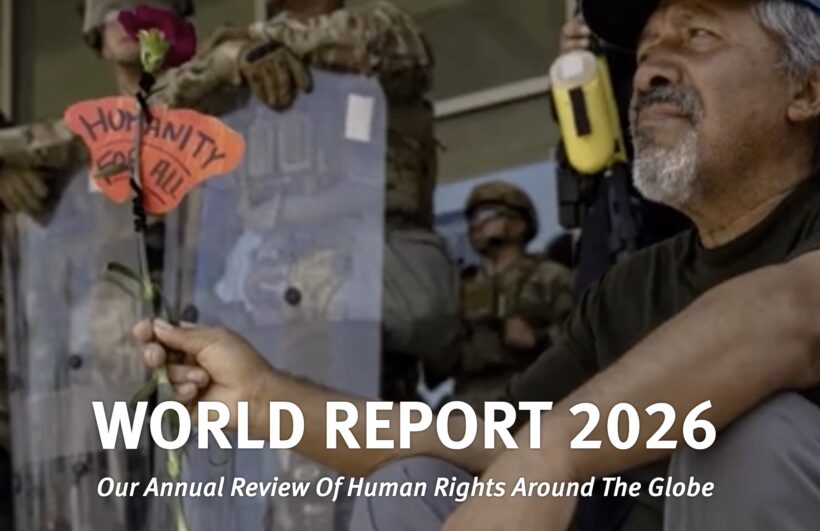
In 2026, Human Rights Watch issued one of the most severe warnings ever made regarding the state of human rights in the United States. It was not a sectoral critique nor a limited reproach, but a structural diagnosis: according to the organization, the country is undergoing the worst human rights crisis of the 21st century. This assertion is not rhetorical. It is grounded in verifiable patterns of institutional erosion, weakening of the rule of law, and the normalization of practices incompatible with the international standards that the United States historically helped to build.
The assessment is part of Human Rights Watch’s World Report 2026 and of public statements by its executive director, Philippe Bolopion, who has described the current U.S. government as openly hostile to human rights. Such language is unusual in the organization’s reporting on Western democracies, underscoring the gravity of the political and institutional moment facing the country.
According to Human Rights Watch, the crisis is not expressed solely through direct violations of civil rights, but through a deeper process of dismantling democratic checks and balances. Judicial independence, separation of powers, freedom of the press, and academic autonomy have all come under sustained pressure, whether through administrative decisions, expansive legal reforms, or official rhetoric aimed at delegitimizing those tasked with overseeing executive power.
This regression does not appear as an abrupt rupture, but as a gradual accumulation of measures that, taken together, alter the normal functioning of a constitutional democracy. Human Rights Watch warns that this trajectory bears troubling similarities to processes observed in countries that have shifted toward forms of electoral authoritarianism or institutional illiberalism.
One of the central axes of the report is the use of internal security and migration control policies as vectors of rights erosion. Operations carried out by Immigration and Customs Enforcement, characterized by mass detentions, accelerated deportations, and practices that undermine due process, have had a disproportionate impact on migrants, asylum seekers, and racialized communities. The invocation of obsolete legal frameworks, such as the Alien Enemies Act, to justify exceptional measures has been identified by the organization as incompatible with the international obligations assumed by the United States.
Added to this is the growing deployment of federal forces in civilian contexts, including protests and demonstrations, using tactics that Human Rights Watch considers disproportionate and, in some cases, lethal. The report documents deaths, arbitrary detentions, and the absence of effective accountability mechanisms, outlining a scenario in which security is imposed as an absolute priority over fundamental rights.
The internal crisis also has an international dimension. Human Rights Watch emphasizes that the withdrawal of the United States from key multilateral human rights mechanisms, such as the UN Human Rights Council or the International Criminal Court, has significantly weakened the global protection architecture. The selective application of human rights discourse in foreign policy, condemning abuses in adversary states while minimizing or ignoring those committed by allies, further undermines the credibility of the international rules-based system.
This context exacerbates structural problems that predate the current administration but have intensified in recent years. Systemic racial discrimination, police violence, restrictions on voting rights, and inequality in access to justice continue to disproportionately affect African American, Indigenous, and Latino communities. Human Rights Watch notes that, rather than advancing corrective measures for these long-standing failures, recent policies have tended to reinforce them or exploit them politically.
From a comparative perspective, the organization situates the U.S. crisis within a broader global trend of democratic backsliding. It cautions, however, that the U.S. case has a qualitatively distinct impact due to the country’s political, legal, and symbolic weight. When a power that for decades presented itself as a guarantor of the liberal international order erodes its own standards internally, the multiplier effect on other governments is immediate. Practices that were once difficult to justify become normalized under the banners of sovereignty or national security.
In this context, Human Rights Watch has called for the formation of alliances among democracies that maintain an effective commitment to human rights, capable of acting as a counterweight to normative degradation driven both by traditional authoritarian regimes and by democracies in regression. This call implicitly acknowledges that the United States can no longer be automatically assumed to be a pillar of that system.
The report’s conclusion is unequivocal. The current situation does not constitute a temporary anomaly or an excess that can be corrected without cost. It is a profound crisis that calls into question the continuity of the U.S. democratic model as conceived after the Second World War. According to Human Rights Watch, without structural reforms, the restoration of institutional checks, and a genuine return to international legal frameworks, the United States faces the risk of consolidating a regression whose effects will extend far beyond its borders.