

There are quite a few movies depicting nuclear war and its aftermath. One of them is based on Nevil Shute’s “On the Beach”, a book that has awakened Helen Caldicott’s concern about nuclear weapons.
The film “The day after” is said to have inspired President Ronald Reagan to de-escalate his arms race with the Soviet Union.
A question one may ask is: “What would be the effect of a film showing nuclear weapons being eliminated?One movie could be made that would show a roadmap toward the total elimination of nuclear weapons and encourage people to become actual actors in this elimination. Let’s dream about what such a movie could show…”
- Convincing “ordinary people” that the nuclear arms race is folly
One of the best ways to convince: Prices in the supermarkets, rents, waiting times in the emergency rooms…
Research showed that engaging at least 3.5% of the population brings change. The U.S. population is close to 343 million. The 3.5% of 343 million is about 12 million. Thus, in the U.S.,12 million people should take part in a protest. The largest single-day protest in the U.S., April 22, 1970, which was on environmental conservation, gathered an estimated 20 million. Thus, gathering 12 million in the U.S. is very possible.
In Canada, with a population of 42 million, about 1.5 million protesters would be needed. Over a million workers participated in the General strike on October 14, 1976. Thus, here too, gathering 3.5% of the population should be possible.
One of the problems with convincing people that the elimination of nuclear weapons is necessary is the belief that deterrence keeps us safe. Apart from the problems of accidents or use by an unauthorized person or by an unwise leader, and assuming deterrence “works”, what can we expect from continuing the nuclear arms race? The percentage of resources used for armaments, including nuclear armaments, will increase. What will happen when 50% of the money we give to our state will go to armaments?
- Preparing activists
To prepare the civil society for activism, courses like the ones described by Marina Serina could take place: preparation for public speaking and practicing research like New York activists did in a “charming café” – don’t forget the “tasty pastries”!
Now is a good time to engage young people, as it has been shown that in 2019, 73% of millennials in the U.S. find the use of nuclear weapons in wars or armed conflicts unacceptable.
In its February 12, 2026 article, the Arms Control Association states that “there is a growing alliance of nongovernmental organizations and leaders calling for action from the U.S. president and Congress, as well as the leaders of the other nuclear-armed states, to halt and reverse the arms race.”
- Establishing a treaty that gives a roadmap to the total elimination of nuclear weapons.
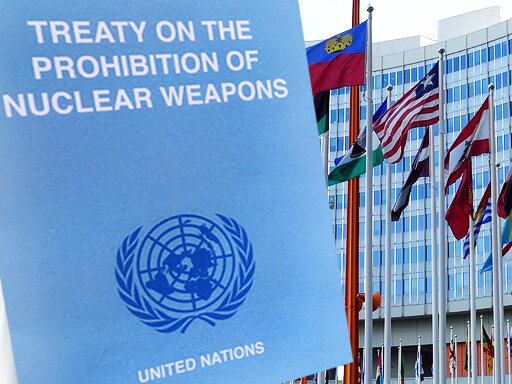
The artisans of the Treaty on the Prohibition of Nuclear Weapons (TPNW) and of the Treaty on the Non-proliferation of Nuclear Weapons (NPT) did a wonderful job, but the job is not finished.
As is said in TPNW: setting the record straight, “The creation and maintenance of a world without nuclear weapons is likely to require several diplomatic initiatives and agreements”.
In 2009, Ban Ki-moon, former Secretary – General of the United Nations, proposed a “five-point plan to rid the world of nuclear bombs”. In this plan, he stresses reliable verification, disarmament commitments, legal obligations, accountability, and transparency, as well as the elimination of other weapons of mass destruction and the limitation of “missiles, space weapons, and conventional arms.”
More recently, Back from the Brink ( 2017-2026) proposed a plan for the US to “lead a global effort to prevent nuclear war”, urging the U.S. to, among other things, “pursue global elimination of nuclear weapons through a verifiable agreement among nuclear-armed states to eliminate their nuclear arsenals.”
It is clear that a new treaty is needed. The TPNW needs a brother!
This new treaty – let’s call it the Treaty on the total elimination of nuclear weapons, or “TTENW”, should be prepared. This preparation should involve experts from various fields, but also organisations like the International Campaign to Abolish Nuclear Weapons (ICAN), International Physicians for the Prevention of Nuclear War (IPPNW), Back from the Brink (BftB), and Campaign for Nuclear Disarmament (CND). The UN should also be involved. Inspiration can be taken from the preparation of the TPNW as given by ICAN.
- Convincing the leaders to sign the “TTENW”
Convincing our leaders and governments to sign the “TTENW” is without doubt the hardest part. To make the job easier, let’s first remember that, as of January 2024, there are 74 states parties to the TPNW, and an additional 25 who have signed it.
To show our leaders how dangerous nuclear weapons are, relevant parts of the talk offered by Tony Robinson at the World Humanist Forum – Asia of April 3, 2022 and the accompanying article should be made available.
One of the tasks will be to induce the leaders to trust and talk to each other, to remind them of their common humanity.
The correspondence between Kennedy and Khrushchev possibly saved us from nuclear war.
After the failure of the “Vienna summit” of June 4, 1961, after the two leaders “argued at length and quite aggressively”, Khrushchev wrote a long letter to Kennedy, sharing his ideas “in a purely informal and personal way”. He compared the earth to Noah’s Ark, where both “clean” and “unclean” animals want to continue the trip. “We should live in peace and cooperation so that the Ark maintains its buoyancy, or else it sinks” concluded Khrushchev.
The ideas of informal correspondence and the Ark’s analogy both appealed to Kennedy.
President Obama also tried diplomacy. His Middle East envoy, George Mitchell, said: “There is no such thing as a conflict that can’t be ended…Conflicts are created, conducted, and sustained by human beings. They can be ended by human beings.”
According to Nicholas Wheeler, the reconciliation between France and Germany after WW2 was helped by the friendship between the German Chancellor Konrad Adenauer and the French President Charles de Gaulle.
Recently, on February 3, 2026, Colombia’s president Petro met with president Trump “in an attempt to defuse months of tensions.” They may not have become best friends, but Petro emerged from the White House with a red MAGA hat. He, however, added an “s” to America!
To facilitate discussion and friendship, opportunities should be given to politicians to meet and talk in a relaxed and pleasant atmosphere. Why not invite them to operas, ballets, concerts, model train shows, including the possibility to play with the models, and giant LEGO constructions, with the possibility to participate?
There could also be “Vienna hours” offering hot chocolate with lots of whipped cream and pastries.
- Reaching the goal: Studying, perfecting, and signing the new treaty, as well as the TPNW
Once they feel comfortable with each other, leaders and politicians should study the “TTENW” and suggest modifications until they all feel ready to sign it and start the process, including becoming party to the TPNW.
That’s our dream!
Now, let us change it into a work of art; as Paul K. Chappell says: “To replace the old paradigm of war with a new paradigm of waging peace,(…) we must be artists who will make the world our masterpiece.”



