

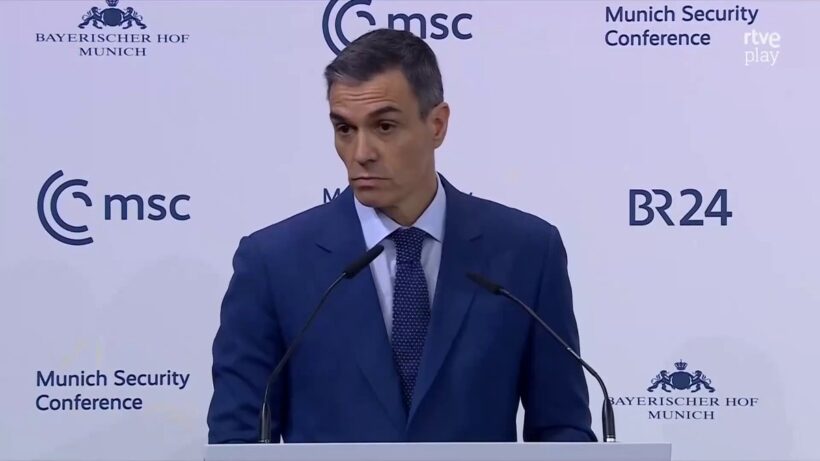
On Saturday, February 14, Pedro Sánchez delivered the following speech at the Munich Security Conference:
“Thank you very much. Good morning.
I’ve come to Munich to meet with friends and allies, to listen to experts, and to show Spain’s commitment to the multilateral order and the security of Eastern European nations.
We Spaniards are far away from Russia, but we know quite well that Putin is a real threat, that the world is becoming more unstable, and that we Europeans must strengthen our defence capabilities to protect, of course, our freedom and way of life, but also to provide security guarantees to our international partners. We are also aware of this, that since I became Prime Minister, Spain has tripled its defence spending and has doubled the number of soldiers deployed in NATO missions.
We need, of course, to ensure our sovereignty, our territorial integrity and our security. But I strongly believe that nuclear rearmament is not the right way of doing it. And I am hardly the first one thinking that: 70 years ago, our parents and grandparents came to the conclusion that nuclear deterrence was a far too costly and risky way of avoiding conflict between nations. Too costly because it demanded that colossal public investments and too dangerous because on several ocasions, technical or human errors came close to triggering a full-scale nuclear war between the West and the former Soviet Union. A war which would have brought humanity to the brink of extinction.
After a few decades, our predecessors realised that the risks posed by nuclear deterrence far outweighed its contributions to peace. They realised that the system that requires zero mistakes and constant correction to avoid total destruction is not a guarantee. It is a gamble.
President Ronald Reagan stated, and I quote, “a nuclear war cannot be won and must never be fought”. And John F. Kennedy said that, and I quote, “the weapons of war must be abolished before they abolish us”. So this was not about left or right. It was about doing the right thing. This collective realisation led to an international agreement to undertake a gradual, verifiable process of nuclear disarmament. Treaties were signed, and nuclear arsenals were dramatically reduced.
But now the tide is turning. Nuclear powers have forgotten the lessons of the past and they are expanding their nuclear arsenals once again. Together, they are spending more than 11 million dollars every single hour on them. And experts estimate that the US alone will invest 946 billion dollars in nukes over the next decade, enough to eradicate extreme global poverty. In my view, this is a mistake, a historical error that we cannot commit again, particularly not today with artificial intelligence casting a shadow of uncertainty over the entire world.
That is why I would like to humbly ask all these powerful nations, please stop nuclear rearmament. Sit down, negotiate, and sign a new START treaty to ensure continuity of the one that has just expired. As a non-nuclear country that has witnessed nuclear bombs accidentally being dropped on its territory back in 1966, I beg you, prevent the launch of a new arms race while it is possible. Humanity will be forever grateful if you do, and it will heavily judge you if you don’t.
We need to stop Putin. We need to strengthen our deterrence capabilities, but let us do it in a coordinated and targeted way that we can control. Let’s build a true European army, not in 10 years, but now. Spain will join with all the resources that are needed.
Let’s strengthen our multilateral system, reforming and empowering those institutions that, despite their flaws, have succeeded in maintaining peace in the West for decades. And also, let’s invest in the values of solidarity, empathy, and cooperation that have brought us this far.
Because the rearmament that we most urgently need in the world is a moral one.
Thank you.”
This timely speech is important because it explicitly rejects nuclear deterrence and nuclear rearmament, and the fact that he did so at the Munich Security Conference—where nuclear deterrence is practically a structural pillar—carries significant weight.
It is a clear and forceful speech that directly addresses the nuclear problem. It does not merely reject proliferation; it questions the logic of nuclear rearmament and nuclear deterrence as a strategy. It introduces an ethical and strategic doubt in a space where deterrence is usually presented as unquestionable, and it champions diplomacy and multilateralism as real alternatives to the arms race.
In other words, Sánchez did not simply say that nuclear weapons are dangerous; he said that the strategy that justifies them is dangerous as well.
The position expressed by Sánchez is fully consistent with the Treaty on the Prohibition of Nuclear Weapons (TPNW), the first international agreement that not only prohibits the use of these weapons, but also their development, possession, and threat of use. The treaty represents a paradigm shift: it challenges nuclear deterrence as a legitimate security strategy and replaces it with a logic based on preventing humanitarian harm and strengthening international law.
In this context, it is particularly relevant that Spain, now, as a non-nuclear country and a declared defender of multilateralism, move from rhetoric to action. Aligning with the majority of the international community means officially rejecting nuclear deterrence as a security strategy and explicitly supporting the TPNW. This is not an idealistic stance, but a decision consistent with the values the prime minister himself claims to uphold: cooperation, historical responsibility, and collective security based on shared rules.
If nuclear rearmament is a gamble—as Sánchez states—the TPNW offers a concrete alternative to step away from that dangerous game. Turning this vision into a state policy, sustained over time and independent of domestic political cycles, would strengthen Spain’s international credibility and its real and lasting commitment to global peace and security.
Call to action
This debate must not remain confined to diplomatic forums or international conferences. Civil society has a fundamental role to play in driving this change. For this reason, it is important to demonstrate public support for Spain’s accession to the TPNW and for the explicit renunciation of nuclear deterrence as a security strategy.
One concrete way to do so is by supporting this public petition, which calls on the Prime Minister to sign the Treaty on the Prohibition of Nuclear Weapons:
👉 https://generation-zero-nukes.movements.mov/pet/que-pedro-sanchez-firme-el-tpan
The speech is already on the table. Now is the time to turn words into lasting commitments. Because, as Sánchez himself reminded us in Munich, the rearmament the world most urgently needs is not military or nuclear, but moral.