

By Masum Parvez Kallol (Dhaka Bureau)
In the rapidly evolving global order of the 21st century, despite unprecedented leaps in technology and economy, a profound lack of trust has emerged regarding the ethical standards of leadership. In recent years, leaked documents and the controversial actions of influential global networks have proven that the current leadership crisis is not merely political- it is a deep-seated psychological and moral crisis.
The Psychological Spectrum of Global Leadership
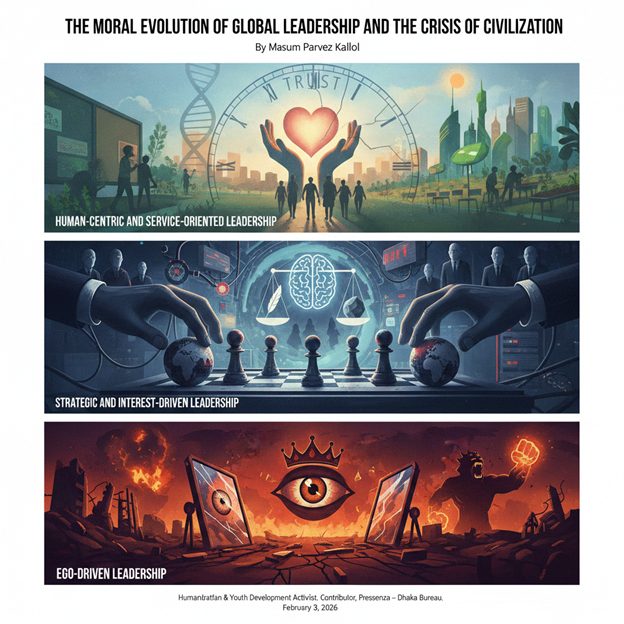
When analyzing the psychological framework of leadership, it can be categorized into three primary dimensions:
- Human-Centric and Service-Oriented Leadership: Here, power is viewed as a ‘sacred trust.’ Service takes precedence over governance, ensuring long-term social stability and collective well-being.
- Strategic and Interest-Driven Leadership: This is the most prevalent trend in contemporary global politics. In this model, ‘risk analysis’ and national or group interests carry more weight than moral ideals.
- Ego-Driven Leadership: This poses the greatest risk to civilization. In this sphere, authority itself becomes the ultimate goal, and criticism is perceived as a personal threat. Historically, major humanitarian disasters have rooted themselves in this specific psychological disposition.
The Retrogression to Primitive Instincts
By definition, civilization is the transition from the primitive instinct of ‘might is right’ to the rule of law and human rights. However, when global policymakers operate beyond the reach of accountability, Charles Darwin’s theory of ‘survival of the fittest’ is dangerously misinterpreted. While modern society sought to redefine this concept through the lens of ‘integrity and cooperation,’ the current global landscape- where economic and political influence bypasses accountability- raises a haunting question: Are we psychologically regressing toward a primitive era where brute force outweighs conscience?
The Crisis of Moral Credibility
The greatest threat to modern civilization is neither economic recession nor technological disparity; it is the ‘crisis of moral credibility.’ When the public loses faith in the established system, societal polarization intensifies and extremism gains ground. This systemic fracture cannot be repaired through international treaties alone.
From Local Roots to Global Change
The seeds of leadership are sown at the grassroots level. The ‘DNA’ of future leaders is shaped in classrooms, on playgrounds, and within local communities. Therefore, if humanity desires ethical global leadership, it must first cultivate ethical local leadership.
The future of civilization will not be written solely in the conference rooms of luxury hotels; rather, it will be defined by the daily decisions of every citizen and institution. When an organization or an individual prioritizes transparency over convenience and accountability over control, civilization moves a step forward.
Conclusion: A Call for Balance
The urgent demand of the modern world is a balanced synthesis of power and morality. When power ceases to be a tool for service and becomes merely a medium for dominance, the fine line of civilization begins to blur. If we are to remain on the path toward building a modern and humane future, maintaining this equilibrium between authority and ethics is the greatest challenge of our time. Our collective conscience must serve as the beacon in these uncertain times- a conscience that can only be awakened through a steadfast attitude of non-violence.
####
The Author:

Masum Parvez Kallol: Humanitarian & Youth Development Activist. Contributor, Pressenza- Dhaka Bureau



