

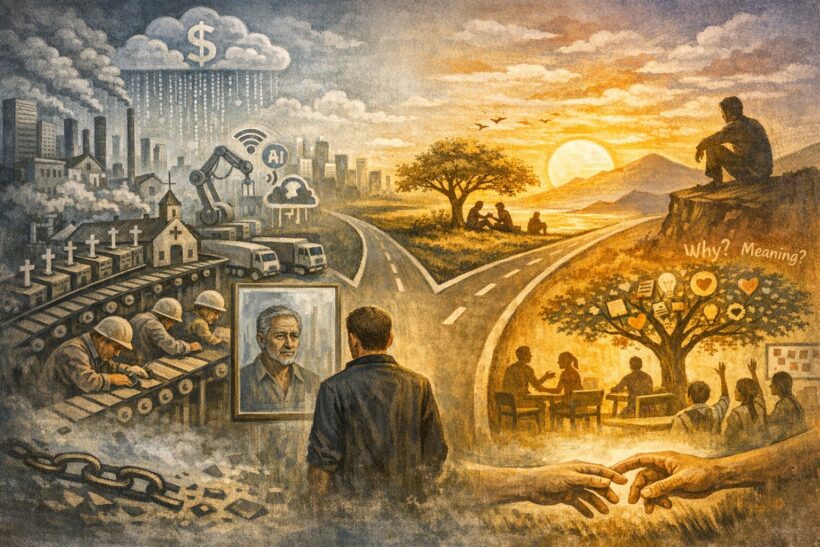
We are at a crossroads of civilization, facing contradictions that cannot be solved by the same logic that created them. We are attempting to answer the future of humanity with a mindset inherited from the past.
“Life is what happens when you are busy making other plans.” — John Lennon
We live in the most materialistic epoch in history. Everything revolves around production—the making of objects. Factories, warehouses, housing developments, cars, films, videos, data centers. Even churches are increasingly objectified: they manufacture faith. Schools become factories for tomorrow’s workers and their bosses.
Political parties have become the marketing arm of these materialist structures. We only need to look at the most progressive program offered in the last mayoral race in New York City to see the problem of the contemporary “left” in a nutshell.
Zohran Mamdani was elected on a bold, affordability-focused platform. His campaign argued that New York City had become too expensive for ordinary residents. His program promised rent freezes for rent-stabilized apartments, the construction of 200,000 affordable homes, free city buses and city-owned grocery stores, expanded childcare, and a higher minimum wage – all funded through increased taxes on corporations and the wealthiest residents. Together, these proposals aimed to make life more affordable, equitable, and sustainable for working-class New Yorkers.
And yet—where are human beings in all this? Where is the space to grow, to flourish, to develop meaning?
There is no human planning in his proposals—only city planning. We design streets and housing, then push people to adapt to the environments we have built, instead of shaping environments around the inner development of human life.
The reality is that people — from Los Angeles to Beijing — are being asked to adapt to a world shaped by a materialist mindset, one born of industrialization. But most of our suffering, confusion, and future challenges cannot be resolved by that mindset. Our future does not depend on producing more and better objects.
I have colleagues who are over 70 and continue working—not for economic reasons, but because they have nothing else to do with their lives. Suicide rates continue to rise, revealing a deeper problem. Experts cite “multiple converging factors” that lead to hopelessness. Existential distress is now framed as a mental-health issue: if you cannot adapt to the materialist world, then something is wrong with your mind.
This analysis is not only insufficient—it is wrong.
The issue is concrete and serious for the future of humanity. Imagine China after two or three generations of uninterrupted technological and economic development. What happens to human life once survival is no longer the central problem? The materialist mindset fears artificial intelligence because it threatens jobs, but it fails to see the opportunity in this: by freeing human beings from material alienation, we allow them to redirect their energy toward meaning, creativity, and transformation.
We love dogs—but humans are not dogs. When a dog looks into a mirror, it does not recognize itself. A human does. A human sees change, aging, loss, and continuity. A human asks: What has happened to me? Countless thoughts emerge in front of a mirror because consciousness reflects on itself.
Now imagine a political movement that openly states that human beings are not born with a predefined essence or purpose—that we exist first and create meaning through our choices and actions. Imagine a candidate saying that the most important political question is the meaning of your life. Imagine schools where curricula are built around the qualities, talents, and inner vocations of each student, and how these can contribute to transforming the world.
Today, the opposite is true. Many of the most innovative businesses are created by people who drop out of institutions designed to standardize them.
The central weakness of the Left today is its inability to adapt. It remains framed by the categories of the past century: class struggle, worker unity, mass mobilization, working class, middle class. But the question people wake up with is not “Which class do I belong to?” It is “Why am I living this life, and how do I get through my day?”
When you are young, you work for money. After twenty years—and two divorces—that explanation collapses.
This is not anti-materialism, but post-material humanism.
Until we create new structures—political parties, social spaces, media, art, and forms of entertainment—that place existential meaning at the center, our era will continue to reproduce the wars and destructions of the previous one.
Perhaps this begins very simply: by spending less time watching news on television or endlessly browsing events happening a thousand miles away, and more time observing our own lives—our days passing, their repetitions and transformations—and asking what sense all of this has.
We will not resolve discrimination through laws alone, but by lived experience—by encountering the truth that I exist because you exist. The right to exist is not just a slogan; it is a fact of life.



