

International humanitarian law emerged from the extreme experience of the twentieth century. The Geneva Conventions and their additional protocols were not conceived as abstract moral declarations, but as a concrete attempt to impose limits on violence even in war. That normative framework, however, is now facing profound erosion. Not because of legal obsolescence, but because of the normalization of its violation.
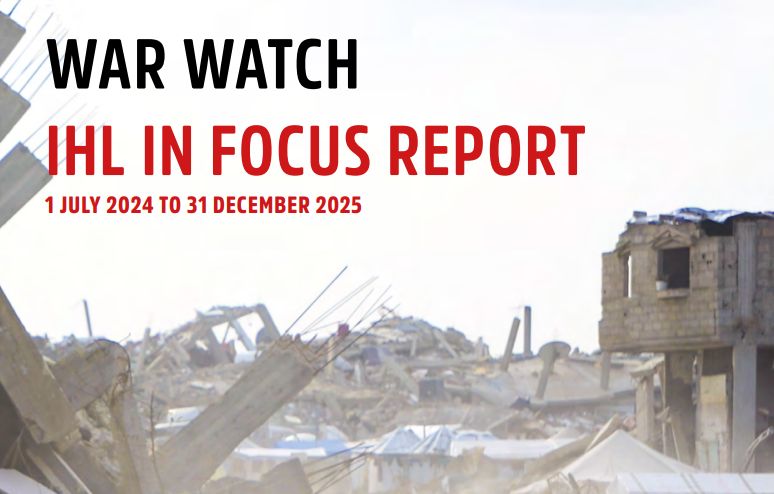
The report War WATCH – IHL in Focus Report 2024–25, published in early 2026 by the Geneva Academy of International Humanitarian Law and Human Rights, offers an exhaustive legal diagnosis of this drift. The study analyzes twenty-three active armed conflicts between July 2024 and December 2025 and documents serious and repeated violations of humanitarian law in virtually all of them. Its conclusion is unequivocal: the system is at a critical point.
Far from presenting these violations as inevitable collateral damage, the report stresses that many of them respond to recognizable patterns. Attacks against civilians and civilian objects, destruction of essential infrastructure, use of imprecise weapons in densely populated areas, sexual violence, torture and ill-treatment of protected persons appear as recurring practices rather than exceptions. All this occurs even though the legal obligations prohibiting such conduct are clear, binding and universally ratified.
One of the central contributions of the report is its insistence that the problem is not normative, but political. The gap between legal obligations and the reality of conflicts is not explained by gaps in the law, but by the absence of political will on the part of states to “respect and ensure respect” for international humanitarian law, as required by the Geneva Conventions themselves. That positive obligation, the Academy recalls, is not limited to refraining from violations, but also entails the duty to prevent, punish and not facilitate violations by third parties.
The report places particular emphasis on impunity. The lack of credible investigations, limited international judicial cooperation, and the deliberate weakening of mechanisms such as international criminal justice have created an environment in which war crimes are committed with the reasonable expectation that there will be no consequences. This structural impunity not only affects direct victims but also undermines the very authority of humanitarian law as an effective limit on the use of force.
Another key element is the role of the arms trade. The Geneva Academy highlights the contradiction between the formal commitments of states and the persistence of arms transfers to contexts where there is a clear risk that such weapons will be used to commit serious violations of international humanitarian law. At this point, the report does not limit itself to an ethical critique, but recalls that international law imposes concrete obligations of risk assessment and suspension of transfers when those risks are substantial.
The growing use of new military technologies also occupies a relevant place in the analysis. Imprecise weapons systems, remote attacks using drones and the progressive automation of violence are increasing the physical and moral distance between those who decide and those who suffer the effects of war. For the Academy, this evolution does not exempt actors from legal responsibility; on the contrary, it requires an even more rigorous application of the principles of distinction, proportionality and precaution.
Beyond the diagnosis, the report formulates a fundamental warning. If the international community continues to tolerate the practical erosion of international humanitarian law, the risk is not only an increase in civilian victims, but the loss of credibility of the very legal system intended to limit barbarity. The law of war, the Geneva Academy reminds us, does not collapse overnight; it is progressively hollowed out when its violation becomes routine and politically profitable.
In that sense, the report does not announce the end of international humanitarian law, but it does point to a dangerous threshold. The survival of the system does not depend on new rules, but on a basic political decision: to apply those that already exist, without selective exceptions or implicit hierarchies among victims.



