

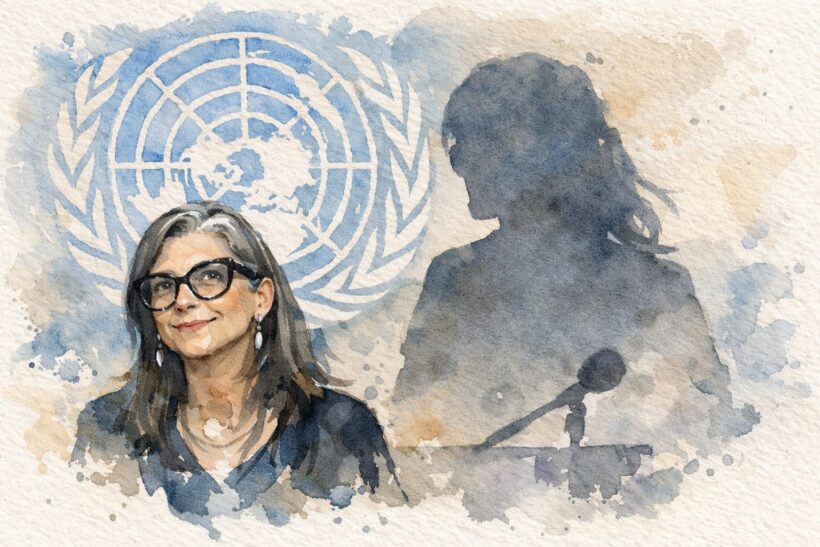
On the morning of February 26, 2026, in the United States District Court for the District of Columbia in Washington, D.C., Francesca Albanese’s husband, acting on behalf of their minor daughter —a U.S. citizen— filed a lawsuit against President Donald Trump, Secretary of State Marco Rubio, Attorney General Pam Bondi, and Treasury Secretary Scott Bessent over the sanctions that the U.S. government imposed on Albanese in July 2025. The legal action directly accuses the U.S. Executive Branch of violating fundamental constitutional rights of Albanese and her family by applying a sanctions regime based, according to the filing, on the opinions she expressed in the exercise of her mandate as United Nations Special Rapporteur for the occupied Palestinian territories.
The plaintiffs argue that “Francesca’s expression of her opinions regarding the facts as she has determined them in the Israeli-Palestinian conflict and regarding the work of the International Criminal Court is core activity protected by the First Amendment.” This literal statement from the complaint reflects the family’s position that the sanctions were imposed not for criminal conduct or for a specific legal violation, but for the exercise of a form of expression that, in the United States, is protected under freedom of speech. The plaintiffs contend that the punitive measure taken by the U.S. government constitutes retaliation for the content of official reports in which Albanese, in fulfillment of her UN mandate, assessed events in Gaza and the West Bank and stated, in formal contexts, that there were indications consistent with the definition of genocide under the 1948 Convention.
According to the same sources, the judicial filing also asserts that the sanctions violate additional guarantees enshrined in the U.S. Constitution. The complaint states that the measures “constitute unreasonable seizures and deprivations of property without due process” in violation of the Fourth and Fifth Amendments, because they froze assets and blocked transactions that, according to the family, have had a tangible impact on Albanese’s daily life and that of her relatives. The text indicates that the revocation of her visa, the ban on entry into the country, and the financial restrictions have complicated access to family income, housing stability in Washington, and Albanese’s basic legal and economic operability.
The sanctions imposed in July 2025 included the revocation of her U.S. visa, the prohibition of entry into U.S. territory, her inclusion in the Treasury Department’s sanctions list, and the consequent freezing or blocking of transactions under U.S. jurisdiction. According to the account incorporated into the complaint and reproduced by various media outlets, these measures affected Albanese’s access to accounts and financial operations connected to the international banking system, limited her contractual and professional capacity, and generated practical difficulties for her family, including the inability to maintain their Washington residence under normal conditions. The family maintains that the restrictions have had disproportionate economic, administrative, and personal effects, arising solely from the exercise of her international mandate.
According to the grounds of the claim, the use of executive authority to impose sanctions “exceeds the legal limits assigned by Congress” and constitutes an abuse of power because it is based on political opinions and legal analyses produced within the framework of an international mandate, rather than on criminal conduct or a clear threat to national security. The complaint asserts that these sanctions penalize the content of legitimate expressions made in her capacity as Special Rapporteur and that such penalization cannot be sustained under the U.S. system of public liberties.
The lawsuit is situated within a conflict between the function of independent experts appointed by United Nations bodies and the use of unilateral coercive measures by sovereign states. Albanese’s mandate, conferred by the Human Rights Council, entails investigating, documenting, and reporting violations of international humanitarian law and human rights law. According to the complaint, the sanctions imposed by the United States operate as a penalty for fulfilling that mandate, with the U.S. Executive interpreting the Special Rapporteur’s activities as politically hostile, particularly because of her recommendations and her support for inquiries by the International Criminal Court concerning alleged responsibilities in the conflict.
It has emerged that judicial sources who have reviewed parts of the document indicate that the lawsuit seeks a declaration from the federal court that the application of sanctions against Albanese on these grounds is unconstitutional, an order restoring any affected assets, and a prohibition preventing the U.S. Executive from using its sanctions authority in a way that penalizes the exercise of freedom of expression or official functions of international experts. The plaintiffs also request compensation for damages suffered as a result of the measures, alleging economic, personal, and familial harm stemming from the restrictions.
This case has generated intense debate in the field of international and constitutional law because it questions whether a state such as the United States may sanction an independent UN expert based on the content of her reports and opinions, and whether this constitutes a troubling precedent for the independence of multilateral human rights mechanisms. The court will have to determine whether the Executive Branch’s actions are justified under U.S. sanctions legislation or whether, on the contrary, they violate constitutional guarantees by punishing protected expression and exceeding the limits of authority granted to the Executive.
In diplomatic terms, the lawsuit has been interpreted as a clash between the legitimate exercise of functions within the United Nations system and the normative sovereignty of a state that interprets those functions as contrary to its foreign security policies. The outcome of this litigation could have consequences beyond Albanese herself, as it will test the relationship between freedom of expression, international mandates, and the authority of states to impose sanctions in the absence of criminal conduct or an objective threat to national security, prompting a profound reflection on the limits of sanctions policy in an increasingly polarized global context.
This case has generated intense debate in the field of international and constitutional law because it questions whether a state such as the United States may sanction an independent UN expert based on the content of her reports and opinions, and whether this constitutes a troubling precedent for the independence of multilateral human rights mechanisms. The court will have to determine whether the Executive Branch’s actions are justified under U.S. sanctions legislation or whether, on the contrary, they violate constitutional guarantees by punishing protected expression and exceeding the limits of authority granted to the Executive.
Beyond the specific litigation, the case raises a question that transcends the legal sphere: what happens when those entrusted with the mandate to document possible international crimes themselves become the target of punitive measures for carrying out that function? The human rights architecture was conceived to provide a minimum layer of protection against abuses of power. If that architecture cannot shield those who sustain it, the message conveyed is troubling for any society that aspires to accountability.
At a time when international humanitarian law is under extreme pressure and the gravest legal categories —such as genocide or war crimes— return to the center of public debate, the treatment of oversight mechanisms is not a technical detail. It is a signal of the strength or fragility of the collective commitment to truth, even when that truth proves uncomfortable for the most powerful states.



