

by Asif Showkat Kallol (Dhaka Bureau)
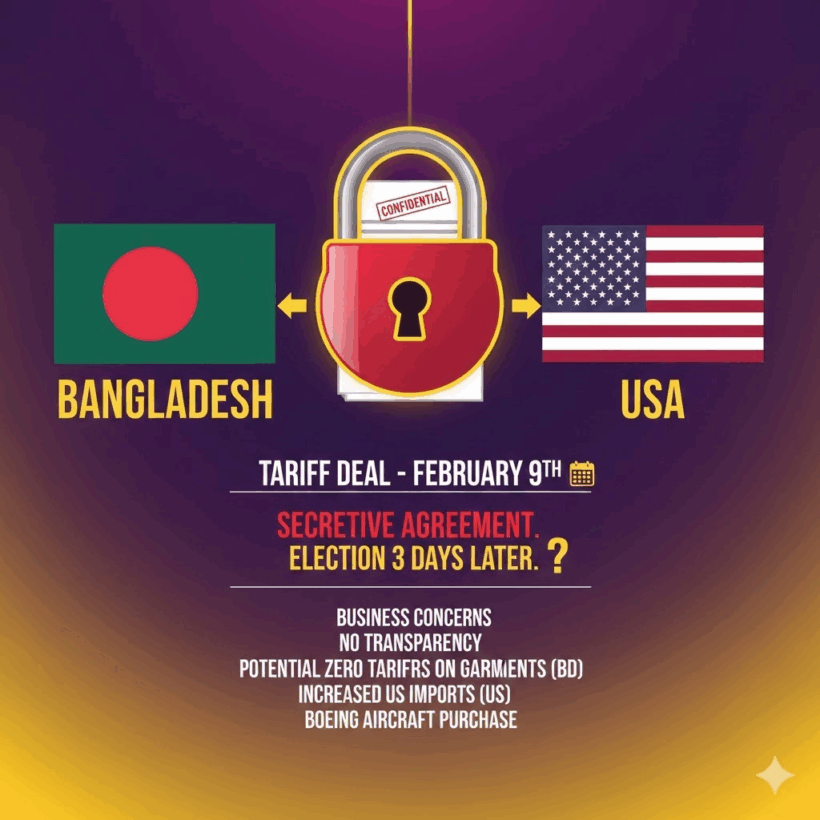
Bangladesh’s interim government is poised to sign a tariff agreement with the United States on 9 February(Monday), just two days before the country’s 13th national parliamentary election. The move has sparked unease among business leaders, economists, and political observers over transparency, timing, and long-term implications.
The agreement, expected to be signed in Washington, DC, could reduce the US reciprocal tariff on Bangladeshi exports from 20%, with officials indicating that negotiations are underway to push tariffs on garments- the country’s largest export sector- down to zero.
Sheikh Bashir Uddin, adviser on civil aviation and tourism, said on Sunday that the deal was being pursued ‘in the national interest’ and was not a rushed decision. Speaking at a press conference in Dhaka, he said Bangladesh was seeking to ensure smoother trade relations with advanced economies before a newly elected government takes office.
However, critics argue that signing such a consequential agreement at the end of an interim administration’s tenure- without public disclosure of its contents- raises serious questions of democratic accountability.
A Deal Shrouded in Secrecy
Details of the agreement remain undisclosed. Bangladesh has already signed a non-disclosure agreement (NDA) with the US, preventing publication of the draft text. As a result, neither business stakeholders nor the public know the precise commitments being made.
The interim government’s mandate will effectively expire days after the signing, once voting takes place on 12 February and a new government is formed. Responsibility for implementing the agreement will fall to the incoming administration.
‘This is not just a tariff deal; it has long-term geopolitical and political implications,’ said Debapriya Bhattacharya, distinguished fellow at the Centre for Policy Dialogue (CPD). ‘The process is not transparent, and without access to the draft, there is no way to assess its benefits or costs.’
Business Community Uneasy
Exporters and domestic market-oriented businesses have voiced concern over the lack of consultation. Inamul Haque Khan, senior vice-president of the Bangladesh Garment Manufacturers and Exporters Association (BGMEA), said stakeholders had been left ‘in the dark.’
‘Those who may be adversely affected have had no opportunity to review or discuss the draft,’ he told daily Prothom Alo. ‘I was surprised that the signing has been scheduled just three days before the election. Given its significance, it would have been better handled by an elected government.’
Dhaka Chamber of Commerce and Industry president Taskeen Ahmed echoed the concern, saying the interim administration could have avoided signing the deal so close to the polls. ‘This responsibility should ideally rest with a government elected by the people,’ he said.
US Demands and Trade-offs
Bangladesh currently enjoys a favourable trade balance with the US, exporting around $6bn worth of goods annually while importing about $2bn. US president Donald Trump has repeatedly sought to narrow such gaps by pressing trading partners to increase imports of American goods.
According to commerce ministry sources, Washington’s demands extend beyond tariff adjustments. They reportedly include provisions on digital trade and technology, rules of origin, national security clauses, reduced non-tariff barriers, and wider acceptance of US standards and certifications.
The US is also said to be pushing Bangladesh to increase imports of American agricultural products such as wheat, soy oil, corn, and cotton, as well as aircraft, aircraft parts, and liquefied natural gas. There are indications that Bangladesh is being encouraged to reduce imports from China and increase purchases of US defence equipment.
Boeing Purchase Proposal
As part of the negotiations, Bangladesh’s state-owned carrier Biman has proposed purchasing 25 Boeing aircraft, with 14 deliveries planned by 2035. Sheikh Bashir Uddin said the proposal was linked to efforts to ‘rebalance’ bilateral trade.
A Pattern of End-of-term Decisions
The tariff deal comes amid a series of major long-term agreements signed by the interim government in recent months, including port terminal concessions to foreign operators in Chattogram and Dhaka. Critics argue that these decisions will bind future governments without public debate.
Analysts say it is rare for a caretaker or interim administration to sign agreements of such magnitude immediately before an election. Some argue Bangladesh could have requested a postponement from Washington.
‘If you rush into signing, questions will inevitably arise,’ said Bhattacharya. ‘The concern is whether the hands of the next elected government are being tied.’
The commerce secretary, Mahbubur Rahman, confirmed that 9 February was the agreed date for signing, while cautioning that the final tariff rate reduction would only be known once the deal is concluded.
For now, the agreement’s contents remain confidential—leaving businesses, voters, and the next government to inherit a deal whose full consequences are yet to be publicly examined.
—————
The Author:
 Asif Showkat Kallol: News Head of the Mirror Asia and Contributor, Pressenza- Dhaka Bureau.