

By Sakhawat Kawsar (Dhaka Bureau)
Following a landslide electoral victory, Tarique Rahman is set to ascend to the pinnacle of power in Bangladesh. However, like many historic leaders before him, he faces a striking paradox: an absolute mandate often carries the seeds of an absolute fall.
After 17 years of exile, grueling legal battles, and a brutal crackdown on his party, the Bangladesh Nationalist Party (BNP), Rahman’s return is being hailed by supporters as a ‘restoration of the nation’s soul.’ Yet, political analysts and veteran journalists warn that the transition from a victim of authoritarianism to a ‘guardian of democracy’ is fraught with systemic traps.
Rahman’s political lineage is unparalleled in Bangladesh. His father, Ziaur Rahman, was a war hero and President who introduced multi-party democracy. His mother, Begum Khaleda Zia, was the country’s first and three-time female Prime Minister. This legacy serves as both a protective shield and a monumental burden for the incoming leader.
Speaking to the International Press Agency Pressenza, political analyst, Professor Dr. SM Ali Reza of Dhaka University said: ‘While a landslide victory is enjoyable, it is equally alarming. History shows that large majorities often breed complacency and sycophancy within leadership, eventually diverting them from the path of good governance and pulling them into the abyss of misrule.’
The 2026 government operates under a reality vastly different from any previous political transition. They are under the sharp scrutiny of ‘Generation Z.’ the student-led revolution of 2024, which ended Sheikh Hasina’s 15-year iron rule, has fundamentally altered the nation’s social and political contract.
‘This generation has learned to speak eye-to-eye with power,’ Professor Reza noted. “They no longer wish to just read about being the ‘owners of the republic’ in textbooks; they demand to see its reflection in reality.’’
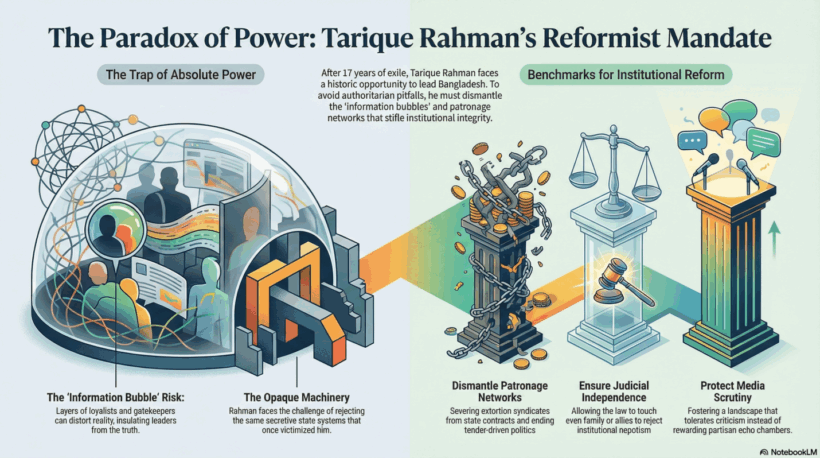
The fall of the previous Awami League administration is now viewed as a dire warning of the `information bubble.’ Analysts argue that a circle of opportunists, intelligence agencies, and party syndicates filtered reality through three layers before it reached Hasina, a process that ultimately accelerated her downfall.
For Tarique Rahman, the ultimate test lies in whether he can dismantle these deep-rooted cultures:
- Tender-driven Politics: Breaking the cycle of extortion and looting syndicates.
- Institutional Nepotism: Ensuring the law takes its independent course even if family members or close associates are accused.
- Media Control: Moving away from “partisan journalism” that eventually blinds the ruler.
The fourth pillar of the state, the media- will be the most critical barometer for the new administration. As a publisher and acting editor himself, media professionals expect Rahman to understand the perils of controlling the press.
Experts suggest that “when the media turns into party activists, the ruler’s fall becomes only a matter of time. If Tarique Rahman seeks lasting public trust, he must treat the press as a ‘mirror,’ not an ‘enemy’.”
In the context of Bangladesh, the new government must immediately focus on the three pillars of public trust: Home Affairs, Law, and Health. Transparent policing, establishing a genuine Rule of Law, and a functional healthcare system are seen as the `silent explosives’ that can either stabilize a government or shatter its foundation.
As a new political sun begins to rise over Dhaka, both Bangladesh and the global community watch with bated breath: will Tarique Rahman choose the old path of centralized power, or will he carve out a difficult but honorable path of institutional humility and good governance?
About the Author:
 Sakhawat Kawser: Special Correspondent, Bangladesh Pratidin and Contributor, Pressenza- Dhaka Bureau.



