

by Sheikh Mohammad Arif (Dhaka Bureau)
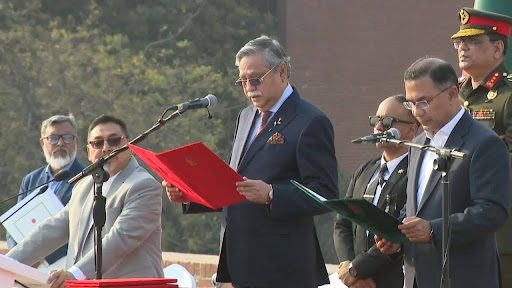
Tarique Rahman, Chairman of the BNP, has become the new Prime Minister of the Government of the People’s Republic of Bangladesh. He took his oath on Tuesday (February 17) at the South Plaza of the National Parliament House. President Mohammed Shahabuddin administered the oath. He was sworn in as the 11th Prime Minister of the country. In the 13th National Parliamentary Election held on February 12, his party, the BNP, secured an absolute majority by winning more than two-thirds of the seats.
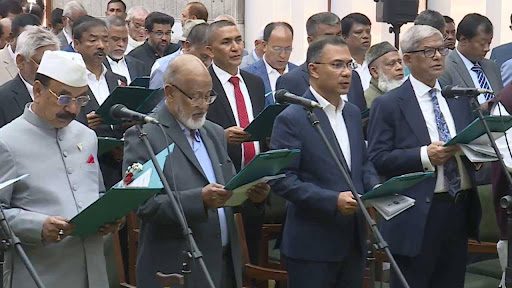
Tarique Rahman takes the oath for the first time as a Member of Parliament at the National Parliament on Tuesday morning, alongside the newly elected MPs of the BNP. Photo courtesy: BNP Media Cell.
Tarique Rahman first took his oath as a Member of Parliament on Tuesday morning. Subsequently, in a parliamentary meeting, BNP lawmakers elected him as the Leader of the House and Prime Minister. He was elected leader of the parliamentary party during the first meeting of the ruling party. Following his swearing-in as Prime Minister, the ministers of the new government were sworn in first, followed by the ministers of state. A major surprise in the newly formed cabinet is Dr. Khalilur Rahman, the National Security Advisor of the recently outgoing interim government, who has become a minister under the technocrat quota.
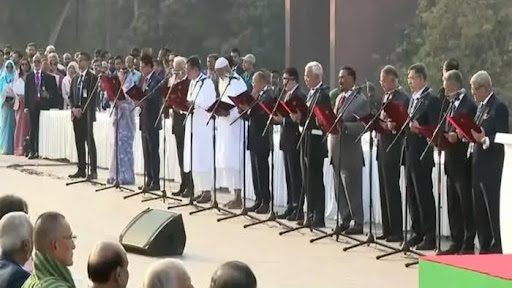
The ministers of the new government take their oath of office before the President of Bangladesh, Mohammed Shahabuddin. Photo courtesy: BNP Media Cell.
With this, the journey of the new government in Bangladesh has begun under the leadership of Prime Minister Tarique Rahman. Simultaneously, the BNP-led government has returned to power after nearly two decades. This government was formed through elections 18 months after an interim government took charge following the fall of the Sheikh Hasina-led Awami League government. In the national elections held last Thursday, the BNP won 209 seats, while its alliance partners secured 3 seats.
The swearing-in ceremony was attended by newly elected MPs, representatives of the interim government, and invited local and foreign guests. Leaders from various South Asian countries, including India, Pakistan, and Nepal, were also present.
Among the invited guests, Om Birla, the Speaker of the Indian Lok Sabha, represented New Delhi. Breaking the long-standing tradition of Bangladesh’s history, the inauguration ceremony of the new government was held at the South Plaza of the National Parliament House complex instead of the President’s official residence, Bangabhaban.
Previously, the BNP was in power from 2001 to 2006. After 20 years, the party formed the government with a massive majority in the 13th National Parliamentary Election. The BNP government’s cabinet consists of 50 members, including 25 ministers and 24 ministers of state. Among them, three are technocrats. Of the 25 ministers, 16 are new faces, and all 24 ministers of state are new. In total, 41 out of the 50 cabinet members are new faces. BNP Chairman Tarique Rahman is also a new addition; this is the first time he has simultaneously become an MP, a cabinet member, and the Prime Minister of the country.
Notably, Mr. Tarique Rahman took over as the party chairman following the death of his mother just one month before the election. However, his journey over the years was not “strewn with roses.”He had to overcome a difficult path to reach this point. From carrying the burden of numerous cases and being forced into exile, to enduring remand, imprisonment, and managing the party from abroad, he ascended to the pinnacle of state power after navigating an extremely challenging road.
In 2007, during the military-backed caretaker government, Tarique Rahman was arrested on corruption charges. After spending 18 months in prison, he was released in September 2008 and moved to London with his family. He returned to Dhaka on December 25, after nearly 17 years. Tarique Rahman, who leads a colorful life, is the eldest son of Bangladesh’s first military ruler and late President Ziaur Rahman, and the country’s first and three-time female Prime Minister, Khaleda Zia. He was born on November 20, 1965. After completing his primary education at Dhaka BAF Shaheen College, he enrolled in the Department of International Relations at Dhaka University in the 1980s, though he later dropped out.
During the Liberation War in 1971, Ziaur Rahman’s family, along with many other military officers’ families, was detained. At that time, their two sons, Tarique Rahman and the late Arafat Rahman, were also in captivity. In the 1980s, he joined the anti-Ershad movement against military ruler Hussain Muhammad Ershad. In 1988, he officially became active in the BNP as a member of the Gabtoli Upazila unit of the Bogra District BNP. However, his formal journey with party politics began during the 1991 parliamentary elections, when he managed the five constituencies from which Khaleda Zia contested.