

We are living in a moment that demands action. Many people feel it viscerally: something is wrong, old structures are failing, and silence is no longer acceptable. Across communities, people are mobilizing—marching, organizing, donating, speaking out. The desire to act is widespread and sincere.
By Dennis Redmond
At the same time, there is confusion, exhaustion, and fragmentation. Many people want to act but don’t know how to do so in a way that is sustainable, effective, or aligned with their deepest values—especially those committed to nonviolent action. This is not a failure of commitment or courage. It reflects a deeper gap in how we understand change itself.
The question before us is not whether people should act, but how we support activists to act in ways that strengthen them rather than deplete them—and that build something new rather than reproduce what no longer works.
Approaching this moment requires humility. Not the humility of withdrawal or doubt, but the humility to recognize limits—of our knowledge, our conditioning, and our readiness for what comes next. If old forms no longer work, we must admit that the new ones are not yet fully known. Supporting action in this moment means acting while learning, and learning while acting.
Social Change and Personal Change Are Not Separate
One of the foundational insights of the Humanist Movement, rooted in Universalist Humanism and developed by Silo, is that social change and personal change are inseparable. You cannot transform yourself without actively engaging in transforming your environment. At the same time, you cannot meaningfully change the environment unless you are willing to change yourself (as we are deeply conditioned by that environment).
Action in the world is not only a means of changing external conditions; it is also how we transform ourselves. Then, as we change, our sense of what is possible in the world begins to shift. What once appeared fixed or inevitable loosens its grip. The future becomes imaginable again—not as an abstraction, but as something that can be shaped through intentional action.
When this relationship is misunderstood, activism becomes draining. People give more and more of themselves without developing the inner capacities—clarity, coherence, resilience—that allow action to be sustained. When it is understood, action itself takes on new meaning and becomes the vehicle through which those capacities are strengthened.
The Missing Education: Our Inner World
Most of us were never taught how our inner world works.
We learned math and history, maybe civics and economics—but not how images shape behavior, how past experiences condition future projections, or how unresolved tensions express themselves as external violence. We were rarely taught to notice internal violence, even as we condemn violence in the world around us.
We are not taught about human intentionality, the primacy of the future, or the importance of coherent action. Nor are we taught to attend to our internal or cenesthetic registers—the bodily sensations that continually give us information and that, if recognized and interpreted well, can help guide our action.
As a result, many activists enter moments like this one with deep moral clarity but lack the tools to navigate the internal pressures and shifting landscapes that sustained engagement brings. Action becomes reactive. Energy fragments. Meaning collapses into the pressure for immediate results.
Supporting people now requires helping them reconnect with capacities they already possess—but may not yet know how to use consciously.
An Experience in Solidarity—and Transformation
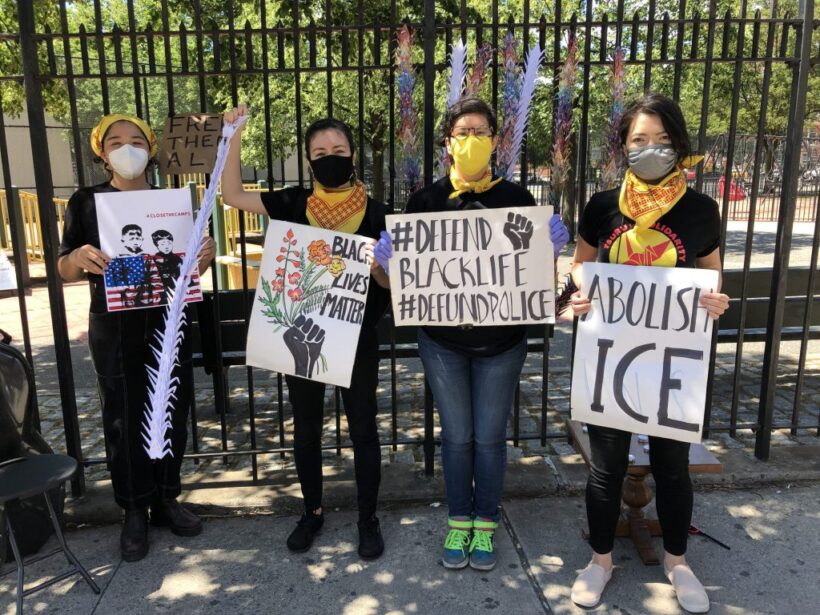
I came to understand this more clearly through my recent work with Tsuru for Solidarity (Tsuru), a group of primarily Japanese American volunteers committed to opposing the proliferation of immigration detention centers and standing in solidarity with communities targeted today. Many members of Tsuru are survivors or descendants of people incarcerated by the U.S. government during World War II. They know, painfully, what happens when communities are isolated and allies are absent. Watching history repeat itself—often in amplified and normalized form—has been both enraging and galvanizing. Rather than remain silent, they have chosen to act.
What is striking about Tsuru is that its members recognize that how they do things is just as important as what they do. They tend to see things structurally: the connections between generations; the understanding that what happens to you affects me; the recognition that trauma is carried forward if it is not addressed collectively. They also recognize that state violence takes many forms—detention, surveillance, exclusion, criminalization—but that these expressions often share common roots. This orientation matters. It creates openness to deeper learning and to forms of action that seek not only to resist harm, but to transform the conditions that produce it.
Last fall, I facilitated a workshop with Tsuru staff and senior volunteer leaders—about 35 people—at a retreat in Seattle. The questions guiding our time together were not tactical, but human: How do we support activists so they do not burn out? How do we help people recognize the meaning of their actions even when those actions do not produce immediate, visible results?
Tsuru already engages in healing circles, grounded in the recognition that trauma is transmitted across generations and continues to shape communities unless addressed collectively. Our workshop built on this foundation, focusing on nonviolence while expanding how violence is understood. We explored how internal violence—unresolved tension, fear, resentment, urgency—shapes external action, even in movements committed to justice.
For Tsuru members, choosing to take action means placing themselves in a limit situation. A limit situation is one in which familiar responses no longer work—where we are pushed out of our comfort zone and required to give a new response. These situations confront us with our own limitations, but also reveal where transformation is needed and where it is possible.
Rather than treating the discomfort or frustration that arises in activism as personal failure, we approached these experiences as information—as a sign that something new is being asked of us. When met with attention rather than resistance, these moments become openings for learning how to act differently, with greater coherence and care.
This is where nonviolence begins—not as a tactic, but as a response that seeks not to replicate patterns of violence and instead offers something new, something that expands what is possible. Activists often turn to violence when they feel they have no options—when the future appears closed and force seems like the only remaining response. The kind of internal work described here helps people see options where none seemed to exist before. When we experience change within ourselves—when we discover that new responses are possible—we are far more likely to recognize the possibility of change in society as well.
What This Experience Clarified
What I learned through this experience is that supporting people in this moment is not primarily about giving answers or directing their action. It is about helping activists recognize the internal tools they already possess—their capacity for attention, intention, coherence, and empathy—and using their action in the world to strengthen those capacities, rather than exhaust them.
As people change in this way, their image of the future does not simply expand—it reorients. The future opens not as a promise of results, but as a lived sense of direction. From this experience emerges a grounded faith: faith in oneself, faith in others, and faith in humanity’s capacity to move beyond what is and what has been.
Creating impact in the short term matters. Harm is real, conditions are urgent, and relief is needed now. At the same time, short-term impact is not always realizable, especially when confronting entrenched systems or structural violence. Holding a longer-term vision is not a way of diminishing urgency; it is a way of sustaining meaning. When activists can situate their actions within a longer arc, they are better able to persevere, learn, and remain connected to why they began acting.
This moment—marked by pain and uncertainty—can also be understood as an opportunity. We are not only responding to what is failing; we are already laying the foundations for what will come next. As action strengthens inner capacities and nonviolence becomes a way of responding rather than a tactic, new possibilities begin to take shape in lived, concrete ways. What we are building is not only a different system, but a different way of being human together—here, now, in how we choose to act.
Dennis Redmond is a longtime nonviolence advocate, currently serving as Coordinator for the Community for Human Development in the United States and as a co-founder of the Hudson Valley Park of Study and Reflection. As Coordinator for the Community for Human Development, Redmond has played a central role in organizing and advancing initiatives that promote nonviolence, social justice, and ethical engagement in communities—most notably in events such as the New York City Walk for Nonviolence.



