

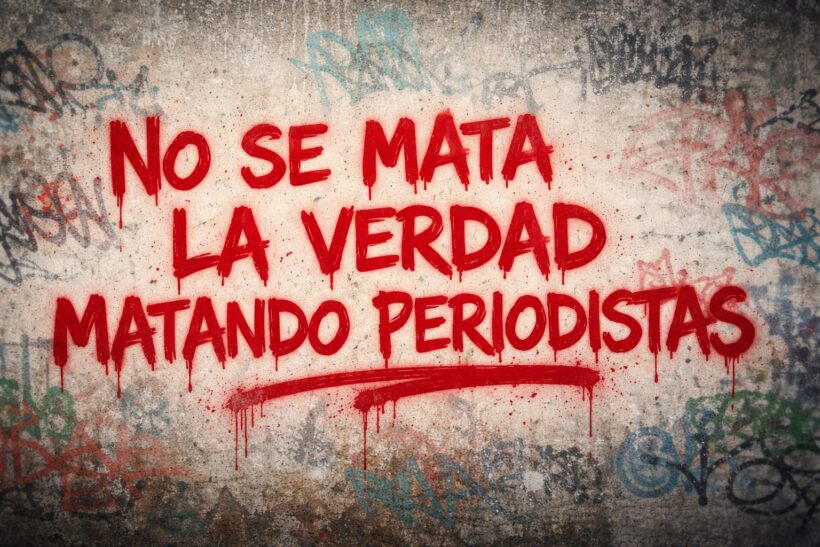
A report by the Committee to Protect Journalists (CPJ), an international organization based in New York, reveals that 2025 was the deadliest year for the press in more than three decades. Two-thirds of the deaths occurred in Gaza. The figures are not abstract: they are colleagues who died holding on to the truth in the midst of war.
In 2025, 129 journalists and media workers did not simply die around the world. One hundred and twenty-nine people who had chosen to remain where others fled were killed. Men and women who carried no weapons, only cameras, microphones, notebooks and phones. They died because their work was to look directly at what power preferred to keep out of frame.
The special report published by the Comité pour la protection des journalistes —Comité para la Protección de los Periodistas (Committee to Protect Journalists, CPJ)— confirms that it was the deadliest year for the press since the organization began documenting these cases more than thirty years ago. The figure is not a statistical fluctuation; it is a threshold marking a turning point in the relationship between war and journalism.
Of those 129 killings, 86 occurred in the context of Israel’s offensive in Gaza. Two out of every three journalist deaths worldwide occur in a single territory. Never before had one conflict accumulated such a proportion of lethality against the press. The report details that most of the victims were Palestinian journalists working inside the Strip, in an environment where access for international media was severely restricted. Those who were reporting the war were also enduring it.
CPJ documents that more than three-quarters of the journalists killed in 2025 died in armed conflict zones. It also records a significant increase in cases classified as intentional killings and warns that, in most of them, no transparent investigations or effective accountability have taken place. Impunity does not appear as an accident of the system, but as a condition that allows repetition.
In Gaza, journalistic work became an extreme form of civil resistance. Hossam Shabat, a young Palestinian reporter, died on March 24, 2025, when an airstrike hit the vehicle in which he was traveling to cover events in the northern Strip. The CPJ report includes him among journalists struck while carrying out reporting duties in the field. Shabat had previously received threats. He knew his name was circulating. Even so, he remained. Remaining, in that context, was not a rhetorical gesture; it was a conscious decision to assume the risk so the world could see what was happening amid the rubble.
The report adds a detail that reinforces the gravity of the situation: three deaths —including one classified as murder— occurred after the October 2025 ceasefire. The protection that a cessation of hostilities should have strengthened did not translate into an immediate reduction of risk for the press.
The description of Gaza in the document reads like a forensic diagnosis of investigative impossibility: if there is no free access, if communications are broken, if the population and the press are displaced, if evidence is destroyed, the traceability of each death becomes nearly irrecoverable. The report frames this as a scenario that favors the absence of judicial accountability.
Beyond Gaza, the report records killings in Sudan, Ukraine, Mexico, Haiti, the Philippines, and other countries. In some cases, journalists died in crossfire; in others, they were executed for investigating corruption, organized crime or abuses of power. The common pattern is the fragility of real protection. International humanitarian law recognizes journalists as civilians; practice shows that this legal category does not always stop the bullet.
The moral arithmetic of the report is clear: if journalism is a thermometer of freedoms, this record is not merely a statistic but an indicator of the degradation of the right to inform and, by extension, the public’s right to know. “We are all at risk when journalists are killed for reporting the news,” declares CPJ CEO Jodie Ginsberg, quoted in the document.
In this framework, the organization insists on the rule of international humanitarian law: journalists are civilians and should never be deliberately targeted. The intentional killing of a journalist by an army constitutes a war crime. For this reason, the report explicitly calls for targeted killings of journalists to be investigated independently and impartially as war crimes, and points to the persistent lack of willingness by Israel to investigate and prosecute crimes committed by its army. The text further details the chain of responsibility, from individuals in IDF units up to the highest levels of command.
The document also calls for a radical reform in the way governments investigate the killing of journalists in order to bring perpetrators to justice. Among the measures mentioned are the creation of an international investigative task force and the imposition of targeted sanctions against those responsible.
There is something profoundly disturbing about the normalization of these figures. One hundred and twenty-nine dead in a single year could become just another line in an annual report if not examined closely. Yet behind every number is a network of relationships, a newsroom, a community that lost someone who asked, recorded and wrote. CPJ does not merely count deaths; it maps the growing risk faced by those who report.
The broader implication suggested by the report is systemic: liberal democracy rests on access to information; when reporting becomes a crime and documenting a war turns a journalist into a target, citizens lose the common ground from which to deliberate, judge and resist.
The question the report leaves is not only how many journalists died in 2025, but what that reveals about our time. When reporting becomes a lethal activity on this scale, the problem extends beyond the profession. Without journalists, there is no independent testimony. Without independent testimony, violence goes unrecorded, and what is not recorded can be denied.
These 129 names are not an annual statistic. They are a list of colleagues who died exercising the right —and the duty— to tell the story. Honoring their memory requires more than citing them in a report; it requires defending the principle that truth should not be paid for with life.



